
Lieferung heute & morgen

Qualitätsgarantie

Willkommens-Angebote freischalten: KOSTENLOSE Lieferung | Bis zu 80 % RABATT | Kostenlose 30-Tage-JoyPlus-Testphase
App herunterladen
A new ceramic pan promises healthy, low-fat cooking and easy cleanup. But the market is overwhelming, and not every product delivers on its promises. Many buyers find that after just a short time, the non-stick performance fades, or the pan is incompatible with their stovetop. This guide will help you identify the crucial features and make an informed decision that suits your cooking habits.
Before we dive into the important features, you should be aware of the typical traps that often lead to disappointment.
To avoid the problems mentioned above, you should check three technical aspects before buying. These are the primary determinants of your new pan's longevity and functionality.
The heart of any ceramic pan is its non-stick surface. Look for products explicitly declared as PFOA-free and PFAS-free. These chemical compounds, which can be found in traditional non-stick coatings, are suspected of being a health concern. A modern, healthy pan with a ceramic seal offers a safe alternative. Some manufacturers also reinforce their coatings with particles like diamond or titanium to increase abrasion resistance and create a scratch-resistant pan. Nevertheless, a golden rule applies: to protect the surface, only use wooden or silicone utensils.
A pan's ability to conduct heat quickly and evenly depends on the material of its body. Forged aluminium has become the standard, as it is lightweight and has excellent thermal conductivity. For owners of an induction hob, another detail is essential: the base of the pan must contain a ferromagnetic layer. Therefore, always look for the symbol for ceramic pan induction (a stylised coil) or an explicit mention in the product description.
The handle determines not only the handling but also whether the pan is oven-safe.
Based on the quality criteria mentioned, we have identified some products that are particularly suitable for specific user profiles.
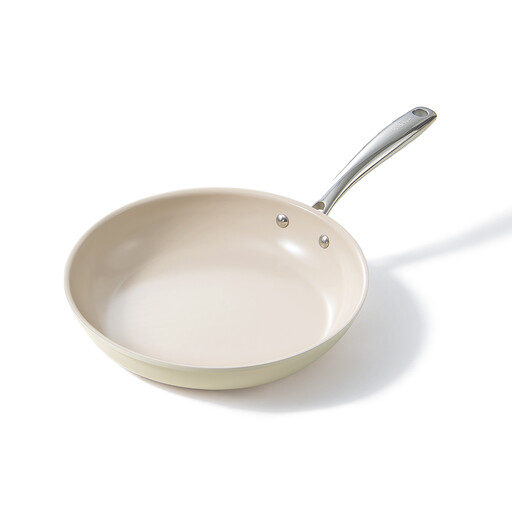
Why this model is a great fit: With a 20 cm diameter, this pan is ideal for one to two-person households, frying eggs, or preparing small side dishes. It covers all the basic requirements without unnecessary frills.
It is suitable for all hob types, including induction, and is oven-safe to high temperatures thanks to its riveted stainless steel handle—a level of versatility not always found in this price range.
The triple-layer ceramic coating allows for cooking with minimal oil. The forged aluminium body ensures fast and even heat distribution.
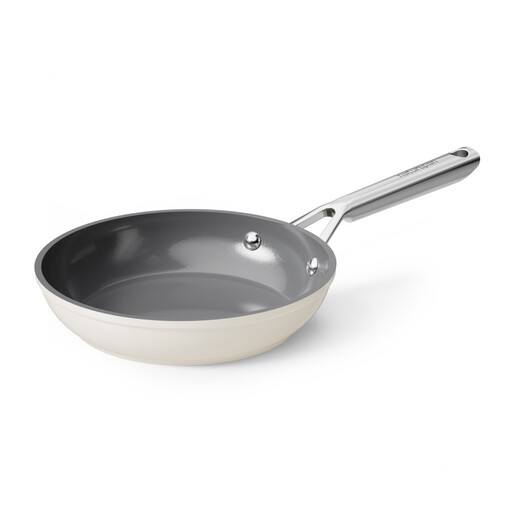
Why this model is a great fit: For families or hobby chefs who cook daily and value durability. The 24 cm size is a universal standard for most dishes.
According to the manufacturer, the coating is reinforced with diamond and titanium particles, which promises greater resilience compared to simple ceramic surfaces, thus counteracting the problem of rapid wear and tear.
The pan is PFAS/PFOA/PTFE-free, suitable for all hob types, and oven-safe up to 230°C. The stainless steel handle is designed to stay cool on the hob.

Why this model is a great fit: Perfect for small kitchens, RVs, or anyone who values organization. The set replaces multiple individual pieces and can be stacked for incredibly compact storage.
This set cleverly solves the problem of limited versatility. The detachable handle allows the pots and pans to move seamlessly from the hob to the oven (up to 450°C), into the fridge, or directly to the table.
The set is PFAS/PTFE/PFOA-free, suitable for all hob types including induction, and dishwasher-safe. The stacking design saves up to 75% of cupboard space, according to the manufacturer.
We have compiled a complete, up-to-date list of products that fully meet these strict selection criteria and UK safety regulations.
1. On average, how long does a ceramic coating last? The lifespan of a ceramic coating heavily depends on its care. With daily use and careful handling (no metal utensils, no overheating while empty, gentle cleaning), you can expect a lifespan of one to three years. Reinforced coatings may potentially last longer.
2. Is a ceramic pan really a healthier alternative? Ceramic coatings are manufactured without per- and polyfluoroalkyl substances (PFAS), including PFOA and PTFE. At very high temperatures, these substances can release fumes in traditional non-stick pans. For this reason, the ceramic pan is often preferred by health-conscious consumers as a healthy pan.
3. How do I clean a ceramic pan to preserve its non-stick properties? Always let the pan cool down completely after use before it comes into contact with water. Clean it with warm water, a mild dish soap, and a soft sponge or cloth. Although many models are declared dishwasher-safe, hand washing is generally recommended to maximize the lifespan of the non-stick surface.