
Lieferung heute & morgen

Qualitätsgarantie

Willkommens-Angebote freischalten: KOSTENLOSE Lieferung | Bis zu 80 % RABATT | Kostenlose 30-Tage-JoyPlus-Testphase
App herunterladen
A high-quality ceramic pan promises healthy cooking with minimal oil and effortless cleanup. However, the market is flooded with products whose claims don't hold up in practice. Many buyers find that the non-stick performance quickly deteriorates or the pan warps after only a short time. As your Joybuy Product Recommendation Officer, I'll help you identify the common pitfalls and make an informed decision.
Before you invest, it's crucial to distinguish marketing hype from actual product features. Pay close attention to these three points to avoid buyer's remorse:
To avoid the problems mentioned above, you should focus on specific technical features when making your selection. These three parameters are crucial for performance and longevity.
A ceramic-coated frying pan can vary greatly in its construction. Look for multi-layered or reinforced ceramic coatings, often infused with particles like titanium or diamond. These offer superior abrasion resistance and durability. The pan body itself should ideally be made of forged or cast aluminium, as this material conducts heat quickly and evenly. A thicker base prevents the pan from warping at high temperatures.
If you own an induction hob, a ceramic pan for induction is essential. This requires a ferromagnetic base, which is usually integrated into the aluminium bottom as a separate stainless steel plate. This type of "sandwich" base not only ensures induction compatibility but also significantly improves heat retention and distribution on all hob types. Always check the product description for explicit information on hob suitability.
An oven-safe ceramic pan vastly expands your cooking options. You can sear a dish on the hob and then finish it in the oven or brown it under the grill. The handle is the deciding factor here: stainless steel or detachable handles generally allow for high temperatures (often up to 260°C), whereas plastic or Bakelite handles are typically only heat-resistant up to about 150–180°C. A 28 cm ceramic pan is a versatile size for most households, well-suited for preparing meals for 2–4 people.
Here are some recommendations tailored to different user profiles and their requirements.
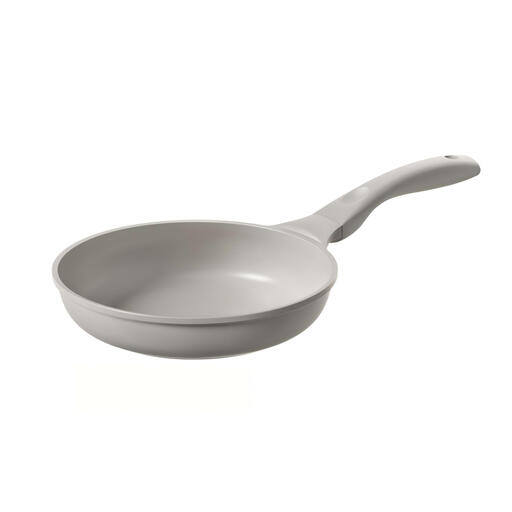
Why it's a good fit: Ideal for singles or small households looking for a reliable, non-toxic basic pan for daily use without a large investment. The 24 cm size is perfect for eggs, pancakes, or searing smaller portions.
The coating is explicitly declared as PTFE/PFOA/PFAS-free, going beyond the usual marketing promises. The base is designed for all hob types, including induction, ensuring solid heat distribution.
Offers comprehensive non-toxic properties and induction compatibility at a very accessible price point. The heat-resistant Bakelite handle stays cool on the hob.
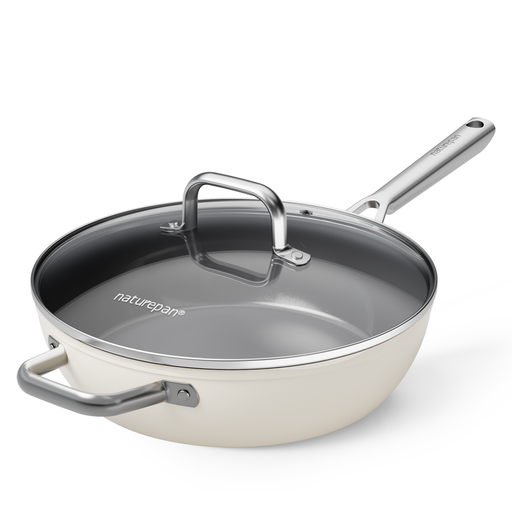
Why it's a good fit: Perfect for families or home cooks looking for an all-in-one solution. The high sides and included lid make the pan ideal for braises, sauces, and one-pot meals. Its oven-safe design offers maximum flexibility.
The ceramic coating, reinforced with diamond and titanium particles, is designed for longevity and resists rapid wear. The stainless steel handle allows for high oven safety up to 260°C, increasing its versatility.
Combines a large capacity (28 cm, high sides) with a robust, reinforced coating and high oven safety. Completely PFAS-free and suitable for all hob types.
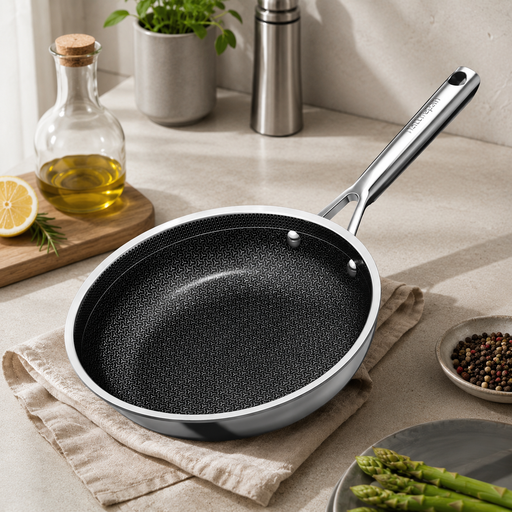
Why it's a good fit: For ambitious cooks who want to combine the searing power of stainless steel with the non-stick properties of ceramic. The hybrid technology is designed for exceptional performance and durability.
The 5-layer hybrid construction with a stainless steel core and laser-etched hexagonal pattern ensures superior heat distribution and stability, preventing hot spots and warping. The diamond-titanium reinforced ceramic coating is extremely scratch-resistant.
The innovative hexagonal surface technology allows for sharp searing on the stainless steel ridges, while food releases easily from the ceramic valleys. Fully oven-safe and suitable for all hob types.
We have compiled a complete, up-to-date list of products that fully meet these strict selection criteria and safety regulations. Discover more models that suit your needs.
To maximise the coating's lifespan, you should hand-wash the pan with a soft sponge and mild washing-up liquid, even if it's labelled as dishwasher-safe. Avoid using metal utensils; opt for cookware made of wood, silicone, or plastic instead. Furthermore, it's best to cook at low to medium heat, as the excellent thermal conductivity of ceramic pans often makes high temperatures unnecessary.
No, not automatically. A ceramic pan for induction requires a base with magnetisable properties. Look for explicit labelling in the product description such as "suitable for all hob types" or "induction-compatible". A look at the bottom of the pan can also help: the coil symbol (a stylised spiral) indicates induction suitability.
PFAS (per- and polyfluoroalkyl substances) is a large group of chemicals used in many conventional non-stick coatings (like PTFE, colloquially known as Teflon). Some of these substances are suspected of being harmful to health and accumulating in the environment. A pan that is declared PFAS-free avoids this entire group of chemicals, relying instead on a mineral-based ceramic foundation. This is considered a safer choice for health-conscious cooking.