
Lieferung heute & morgen

Qualitätsgarantie

Willkommens-Angebote freischalten: KOSTENLOSE Lieferung | Bis zu 80 % RABATT | Kostenlose 30-Tage-JoyPlus-Testphase
App herunterladen
A good frying pan is the cornerstone of any kitchen. The ceramic pan, in particular, has surged in popularity in recent years, offering a non-stick alternative without controversial chemicals like PFAS. However, the market is crowded, and many products fail to deliver on their promises. As your Joybuy Product Recommendation Officer, I'll cut through the marketing hype to show you what truly matters in finding a durable and functional pan.
Many buyers are disappointed after a short time when their fried eggs suddenly stick or the pan's base warps. This is often due to three common pitfalls:
To avoid a bad purchase, focus on verifiable product features rather than advertising slogans. Three characteristics are of central importance.
A ceramic-coated frying pan typically consists of a metal core (usually aluminium or stainless steel) and a ceramic non-stick layer.
For those with an induction hob, the quality of the pan's base is crucial. An induction ceramic pan needs a full-surface, ferromagnetic base to efficiently convert the hob's energy into heat. A simple test: if a magnet holds firmly across the entire base, the basic requirement is met. A thick, encapsulated base also ensures it lies flat and distributes heat evenly without "hot spots".
A pan's flexibility is shown by its additional uses. An oven-safe ceramic pan allows you to sear dishes on the hob and then finish or bake them in the oven. The handle is the deciding factor: stainless steel or detachable handles generally permit high temperatures, whereas plastic or Bakelite handles are often only heat-resistant up to about 150-180°C or not oven-safe at all.
Size is also a practical factor. A 28 cm ceramic pan is a versatile all-rounder for families or preparing larger portions, while smaller 20 or 24 cm models are sufficient for single-person households, fried eggs, or side dishes.
Based on these objective criteria, we have identified several products that represent a considered choice for different user profiles.

Why This Fits Their Persona: With a 28 cm diameter, this pan offers ample space for family-sized meals. It's designed for all hob types and focuses on core functions: reliable, toxin-free non-stick performance and easy cleaning for a busy lifestyle.
The thickened base ensures fast, even heat distribution on induction hobs, countering the problem of poor induction performance. The coating is explicitly declared as PFAS-free.
Universal hob compatibility, including induction. Ergonomic Bakelite handle that stays cool. Easy to clean by wiping or in the dishwasher.
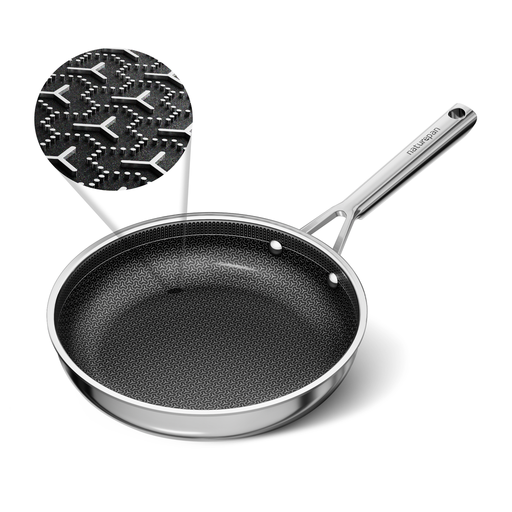
Why This Fits Their Persona: Ideal for cooks who want to do more than just fry. Being oven-safe up to 260°C and its hybrid stainless steel and ceramic construction allow for searing on the hob and then finishing in the oven, offering maximum flexibility.
The laser-etched hexagonal structure combines the durability of stainless steel with the non-stick properties of ceramic. This addresses the issue of simple "scratch-resistant" claims by providing a physically more resilient surface.
5-layer hybrid construction for even heat. Oven-safe up to 260°C. PFAS-free diamond-titanium ceramic coating.
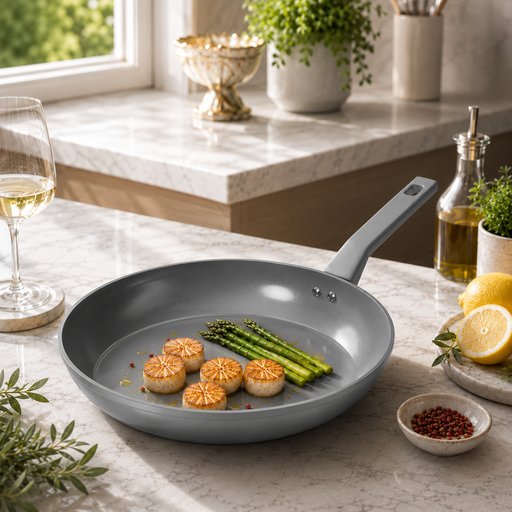
Why This Fits Their Persona: The compact 20 cm size is perfect for omelettes, single servings, or small kitchens. It offers all the essential benefits of a modern ceramic pan—induction compatibility and a PFAS-free design—in a straightforward, space-saving format.
The multi-layer base with a stainless steel plate ensures rapid and even heat distribution, thus avoiding the pitfall of poor induction performance. The diamond-titanium coating aims for greater durability than standard ceramic pans.
Compact size. Free from PFAS, PFOA, lead, and cadmium. Suitable for all hob types, including induction.
We have compiled a complete, up-to-date list of products that fully meet these strict selection criteria and safety regulations.
Proper care is crucial for longevity. Always let the pan cool down after use before cleaning it with water to avoid thermal shock. Use soft sponges and mild washing-up liquid. Although many pans are listed as dishwasher-safe, hand washing significantly extends the life of the coating. Absolutely avoid using metal utensils; instead, opt for kitchen tools made of wood, silicone, or plastic.
Ceramic coatings are considered a healthy option because they are manufactured without PFAS (like PFOA or PTFE, the main component of Teflon). This means that even if accidentally overheated, no potentially harmful fumes are released. A healthy pan is therefore often synonymous with one that is verifiably PFAS-free.
The induction symbol (a coil) on the packaging or the pan's base is the first clue. For a reliable assessment of efficiency, you should pay attention to the description of the base. Terms like "encapsulated sandwich base" or "full-surface induction base" indicate higher quality. A simple at-home test is to hold a magnet to the base. The more strongly it sticks, and the larger the area it adheres to, the better the energy transfer will be on an induction hob.