
Lieferung heute & morgen

Qualitätsgarantie

Willkommens-Angebote freischalten: KOSTENLOSE Lieferung | Bis zu 80 % RABATT | Kostenlose 30-Tage-JoyPlus-Testphase
App herunterladen
The search for the right ceramic pan for induction can quickly become overwhelming. Many models promise durability and perfect cooking results, but in practice, weaknesses often appear after just a short time. Uneven heat distribution on the induction hob or a non-stick coating that quickly deteriorates are common frustrations. To help you with your selection, we'll highlight the crucial features and show you how to avoid typical purchasing traps.
Before deciding on a model, you should critically examine the common marketing claims. Two issues in particular often lead to disappointment:
To make an informed decision, you should focus on three core technical features. These largely determine the performance, durability, and safety of your new pan.
A ferromagnetic base is essential for induction hobs. But quality is what determines efficiency. Look for a thick, encapsulated base that absorbs heat quickly and distributes it evenly across the entire cooking surface. A solid base also prevents the pan from warping at high temperatures and ensures a stable, flat surface, which optimises energy transfer.
The desire for a PFAS-free pan is a key selling point. Modern ceramic coatings are a good non-stick pan without Teflon. However, there are significant differences in quality. A simple ceramic layer can quickly lose its non-stick effect. A titanium ceramic coating, often reinforced with diamond particles, offers demonstrably higher abrasion resistance and longevity. This is a crucial factor for anyone who values healthy cooking with little fat and durable kitchen equipment.
A pan's functionality extends beyond frying. An oven-safe pan significantly expands its uses, such as for gratinating dishes or keeping food warm in the oven. When considering this, check the heat resistance of both the pan body and the handle. For households with limited storage, like in small kitchens or campervans, cookware with a detachable handle is a smart solution. Such systems allow for space-saving stacking of pots and pans.
Based on the quality criteria mentioned, we have identified a few models suitable for different user profiles.
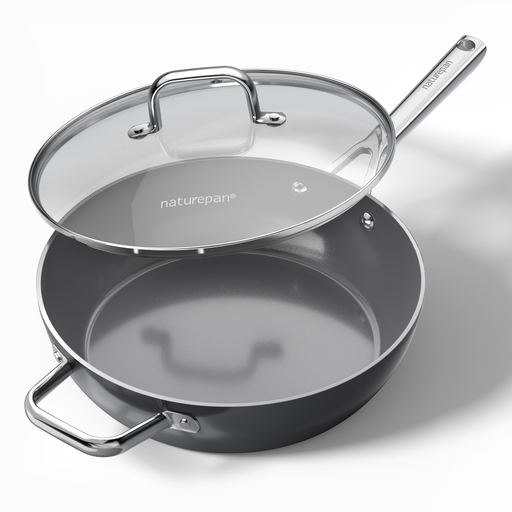
Why This Fits Their Persona: With a 28 cm diameter, high sides, and a matching lid, this pan is ideal for family-sized portions, stews, and sauces. It's an all-rounder for daily use.
The optimised base ensures even heat distribution on induction hobs, while the diamond- and titanium-reinforced ceramic coating offers greater durability than standard coatings.
High versatility thanks to its deep design and lid; oven-safe up to 260°C for flexible cooking methods.
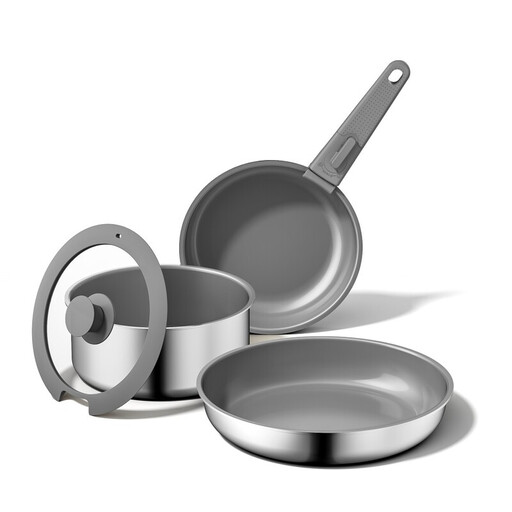
Why This Fits Their Persona: This induction pan set is the solution for anyone with limited storage. Thanks to the detachable handle, the cookware can be nested perfectly, saving up to 70% of space in a cupboard or campervan.
The set combines a space-saving feature with high-quality materials. The three-ply stainless steel base ensures excellent heat conduction on induction, while the robust coating promises longevity.
Maximum space-saving through a stackable design with cookware with a detachable handle; oven-safe up to 250°C.
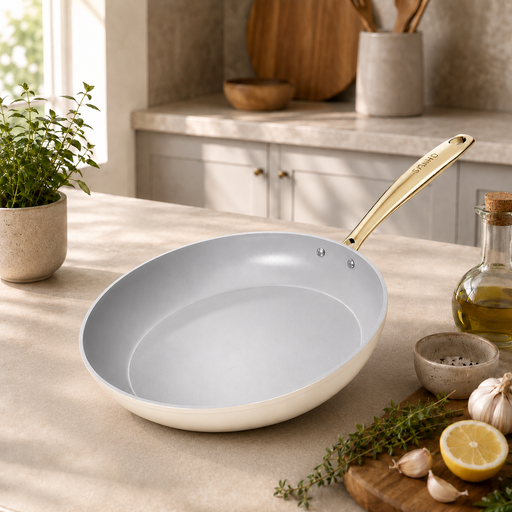
Why This Fits Their Persona: This compact 20 cm pan is ideal for smaller households. The focus is clearly on healthy cooking: the coating is explicitly free of PFAS, PFOA, PTFE, lead, and cadmium.
It directly addresses concerns about harmful substances with a transparent declaration. The diamond-titanium coating on an aluminium core ensures durability and excellent heat conduction.
Consistently free of harmful substances for health-conscious cooking; the thick cast aluminium body heats up quickly and evenly.
We have compiled a complete, up-to-date list of products that fully meet these strict selection criteria and all relevant safety standards.
Proper care is crucial. Avoid using metal kitchen utensils; instead, opt for tools made of wood, silicone, or plastic. Allow the pan to cool down after use before cleaning it with warm water and a soft sponge. Although many pans are dishwasher-safe, gentle hand washing will extend the life of the non-stick coating. Avoid heating the empty pan on the highest setting.
Yes, a ceramic coating reinforced with titanium or diamond particles is significantly more robust and abrasion-resistant compared to basic ceramic surfaces. It offers greater resilience against everyday wear and tear. However, it is not completely immune to scratches. Careful handling, especially avoiding sharp-edged metal objects, is still recommended to preserve the non-stick properties long-term.
Look for the official induction symbol on the packaging or the bottom of the pan—it looks like a horizontal coil. A simple test is also helpful: hold a magnet to the base of the pan. If the magnet sticks firmly, the base is ferromagnetic and therefore suitable for induction. A flat, thick base also ensures optimal contact with the hob.