
Lieferung heute & morgen

Qualitätsgarantie

Willkommens-Angebote freischalten: KOSTENLOSE Lieferung | Bis zu 80 % RABATT | Kostenlose 30-Tage-JoyPlus-Testphase
App herunterladen
A good frying pan is the heart of any kitchen. But the search for the right ceramic pan for induction can quickly become overwhelming. Many promise long-lasting non-stick performance and healthy cooking, but not all live up to their marketing claims. As your Joybuy Product Recommendation Officer, I'll help you identify the crucial features and avoid common purchasing pitfalls.
Before you invest, you should critically examine the marketing promises. Three issues in particular often lead to disappointment:
To make an informed decision, focus on these three technical features. They are the key to performance and durability.
For health-conscious cooks, a pan without PFAS is the top choice. Specifically look for products declared as PFAS-free and PFOA-free. These per- and polyfluoroalkyl substances are suspected of being harmful to health. A high-quality healthy pan relies on a mineral-based ceramic coating.
For greater durability, some modern coatings are reinforced with particles like diamond or titanium. These composite materials increase the hardness and abrasion resistance of the surface, which can extend its lifespan with proper handling.
A good frying pan for ceramic and induction is distinguished by a multi-layered base. An aluminium core ensures fast and even heat distribution, while an outer layer of ferromagnetic stainless steel ensures compatibility with induction cooktops.
Look for terms like "encapsulated sandwich base" or a reference to an integrated stainless steel plate. A thick, warp-resistant base prevents the pan from deforming at high temperatures and ensures optimal contact with the cooktop.
The versatility of a pan often only becomes apparent at second glance. A pan that is oven-safe opens up significantly more possibilities for you—from browning dishes to keeping food warm.
To check this, examine the handle material:
Instead of making a one-size-fits-all recommendation, we have identified models tailored to specific user profiles.
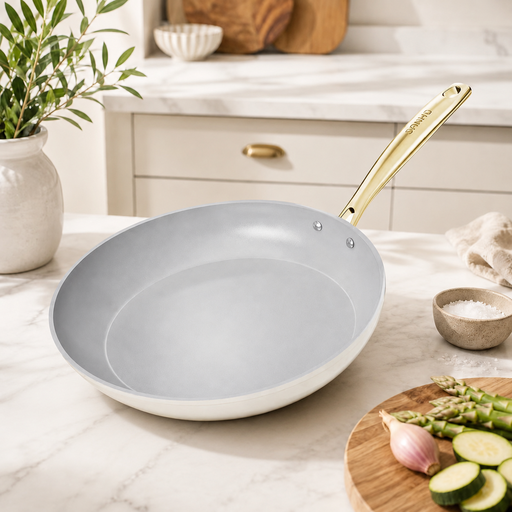
Why This Fits Their Persona: Ideal for daily use in family kitchens. The 26 cm size is versatile for everything from pancakes to chicken fillets, and the high oven-safe temperature allows for flexible cooking methods.
The diamond-titanium reinforcement offers a more robust surface than simple ceramic coatings (countering Trap 2). The encapsulated stainless steel base ensures reliable and even performance on induction hobs (countering Trap 3).
High oven safety up to 260°C allows for seamless cooking from stovetop to oven. The coating is also free of PFAS, PFOA, and PTFE.
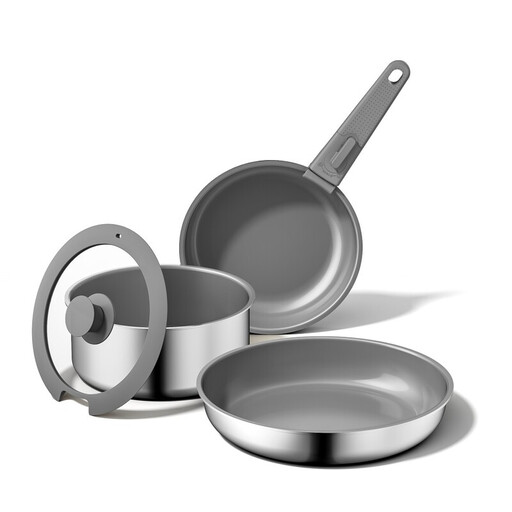
Why This Fits Their Persona: Perfect for small kitchens, RVs, or anyone who values an organised space. The detachable handle allows the pots and pans to be stacked, saving valuable cupboard space.
This ceramic pan set is more than just a pan; it's a well-designed system. The three-layer stainless steel construction ensures solid induction performance (countering Trap 3), while the secure click mechanism of the handle is not just a gimmick.
Saves up to 70% of cupboard space, according to the manufacturer. The entire set is oven-safe (up to 250°C) and dishwasher-safe, offering maximum flexibility and easy cleaning.
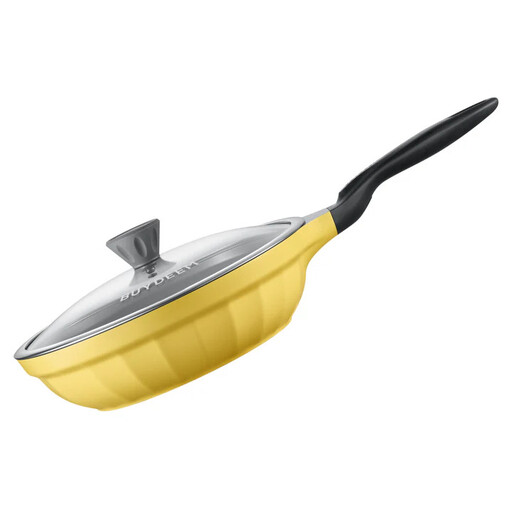
Why This Fits Their Persona: For cooks who value material quality and precise cooking results. The focus here is on extremely even heat distribution, ideal for delicate foods or high-heat searing.
The massive, 5.5 mm thick base actively prevents the pan from warping and ensures an optimal, stable contact surface on the induction hob (countering Trap 3). The explicit mention of the Swiss ILAG ceramic coating provides transparency about the material's origin (countering Trap 1).
The exceptionally thick base construction provides excellent heat retention and distribution, which prevents hot spots and reduces the risk of food burning.
We have compiled a complete, up-to-date list of products that fully meet these strict selection criteria and German safety regulations.
The lifespan of a ceramic coating depends heavily on use and care. With proper treatment—meaning no metal utensils, hand washing with a soft sponge, and avoiding overheating—a high-quality coating can retain its non-stick properties for several years. However, it is a wearable part and is not designed to last forever.
The most common problem is an unsuitable pan base. For a pan to work on an induction cooktop, its base must be magnetic. Hold a magnet to the bottom; if it doesn't stick firmly, the pan is not suitable, or only partially suitable, for induction. Another issue can be a warped base that doesn't make full contact with the cooktop.
Ceramic coatings are manufactured without the chemical groups PFAS and PFOA. This is the main reason they are considered a healthy pan. With conventional PTFE coatings (often known by the brand name Teflon), potentially harmful fumes can be released if severely overheated above 260°C. Since ceramic coatings do not contain these substances, this specific risk is eliminated.