
Lieferung heute & morgen

Qualitätsgarantie

Willkommens-Angebote freischalten: KOSTENLOSE Lieferung | Bis zu 80 % RABATT | Kostenlose 30-Tage-JoyPlus-Testphase
App herunterladen
The search for the right ceramic pan can quickly become overwhelming. Many promise healthy cooking and long-lasting non-stick performance, but the reality in the kitchen is often quite different. As your Joybuy Product Recommendation Officer, I'll help you identify the crucial features and avoid marketing traps, ensuring your next frying pan is a worthwhile investment.
Three problems in particular repeatedly lead to disappointment:
The performance of a ceramic-coated frying pan depends on more than just the top layer. A high-quality ceramic coating is the first step towards a healthy pan, as it allows for cooking with very little fat and, when used correctly, does not release any harmful substances.
Look for coatings reinforced with additional particles like diamond or titanium. These additives increase the surface's mechanical resilience and abrasion resistance, which can extend the life of the non-stick properties. Such a non-stick pan without PFOA and PFAS provides a solid foundation for daily use.
The pan body itself is just as crucial. An aluminium core ensures fast and lightweight heat conduction, while a solid, encapsulated base made of ferromagnetic stainless steel makes the pan suitable for all hob types, especially induction, and prevents warping at high temperatures.
Compatibility with your hob is a fundamental criterion. Specifically look for a pan for all hob types if you want to stay flexible or own an induction cooktop. You can identify an induction pan by the corresponding symbol (a coil) on the pan's base or in the product description.
The base should be thick and perfectly flat. This is the only way the pan will sit flush on the cooktop, ensuring optimal energy transfer and even heat distribution. A solid base also retains heat better and responds more stably to temperature changes.
An oven-safe pan significantly expands your cooking options. You can sear dishes on the hob and then finish cooking or gratinate them in the oven. Check the maximum temperature resistance, which depends on the handle material:
Instead of making a one-size-fits-all recommendation, we have selected models that meet specific needs and avoid the pitfalls mentioned earlier.
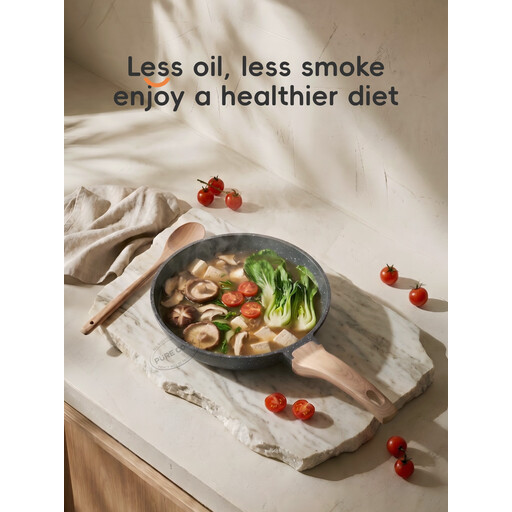
Why It's a Match: Ideal for one to two-person households or for preparing smaller dishes like fried eggs or pancakes. The light weight and cool-touch wooden handle make handling simple and safe.
The aluminium body ensures fast, even heating, which avoids the "hot spot" pitfall common in smaller pans. The non-stick coating is designed for an easy start to low-fat cooking.
Lightweight and suitable for all hob types, including induction. The wooden handle stays cool on the hob and offers a secure grip.
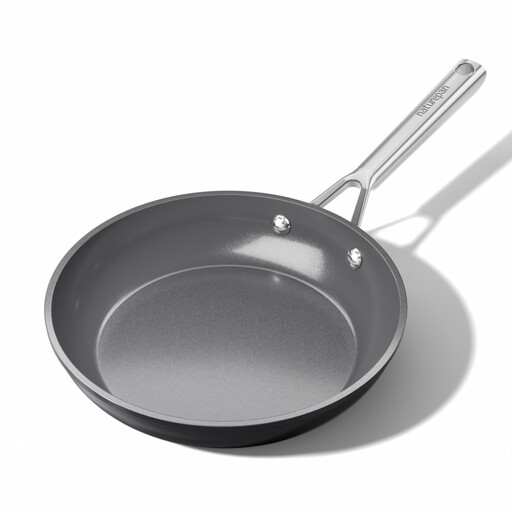
Why It's a Match: The universal 24 cm size is perfect for the daily meals of a 2-3 person family. The pan is robust, versatile, and designed for seamless transition from hob to oven.
The ceramic coating, reinforced with diamond and titanium particles, counteracts the problem of short-lived non-stick performance. The optimised base ensures even heat distribution without hot spots.
Completely PFAS, PFOA, and PTFE-free. The high oven-safe temperature of up to 260°C and suitability for all hob types offer maximum flexibility.
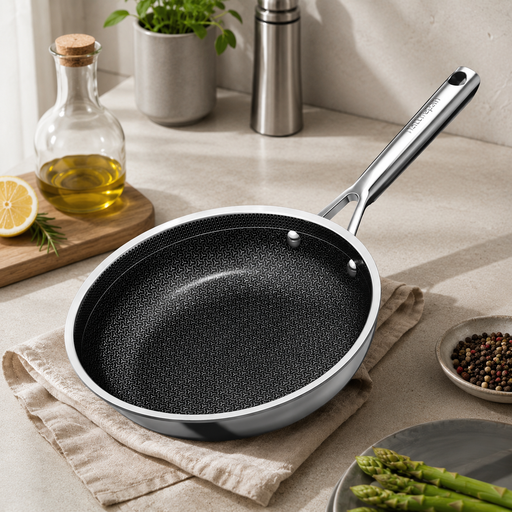
Why It's a Match: For cooks who want to combine the non-stick properties of ceramic with the searing power of stainless steel. The large surface is ideal for family-sized portions, steaks, or stir-fries.
The laser-etched hexagonal structure with raised stainless steel ridges allows for high-heat searing, while the ceramic valleys ensure non-stick performance. The 5-ply construction guarantees superior heat control and durability.
Combines the benefits of stainless steel (high-heat searing) and ceramic (non-stick). Extremely scratch-resistant and oven-safe up to 260°C for maximum culinary freedom.
We have compiled a complete, up-to-date list of products that fully meet these strict selection criteria and safety regulations.
To protect the non-stick coating, you should follow a few basic rules:
Ceramic coatings are made on a mineral basis (sand derivatives) and are generally free of potentially harmful chemicals like PFAS, PFOA, and PTFE. Unlike some traditional non-stick coatings, they do not release harmful fumes, especially when overheated. This makes them a popular choice for health-conscious households.
A pan suitable for induction must have a ferromagnetic base. Look for the induction symbol (a stylised coil) on the packaging or the bottom of the pan. A high-quality model will have a thick, fully-clad base that sits perfectly flat on the cooktop. This ensures efficient, even energy transfer and prevents annoying buzzing noises during cooking.