
Lieferung heute & morgen

Qualitätsgarantie

Willkommens-Angebote freischalten: KOSTENLOSE Lieferung | Bis zu 80 % RABATT | Kostenlose 30-Tage-JoyPlus-Testphase
App herunterladen
A high-quality ceramic pan for induction promises healthy, low-fat cooking and easy cleanup. But the market is flooded with products whose marketing claims often don't hold up in practice. Many buyers find that after just a few months, the non-stick effect diminishes, the base warps, or the coating shows scratches.
As your Joybuy Product Recommendation Officer, I'll help you navigate these common pitfalls. We'll focus on the critical features that define a durable, high-performance ceramic pan, ensuring your investment pays off in the long run.
Before we turn to the solutions, we should identify the problems that frequently lead to disappointment:
To make an informed decision, you should focus on three core technical features rather than relying on marketing buzzwords.
The term "ceramic pan" describes a frying pan that is ceramic-coated. The key advantage is that these coatings are generally made without per- and polyfluoroalkyl substances (PFAS), which include PTFE (known by the brand name Teflon) and PFOA. A ceramic pan that is PFAS-free is an excellent choice for healthy cooking, as no controversial chemicals are released during proper use.
Look for coatings reinforced with particles like titanium or diamond dust. These additives increase the mechanical resistance and longevity of the non-stick surface compared to simple ceramic sealants.
The base of the pan is crucial for optimal performance on an induction hob. A Teflon-free pan for induction requires a ferromagnetic base. High-quality models feature a multi-layered "sandwich base," often consisting of an aluminium core for rapid heat conduction and a stainless steel plate for magnetic induction and stability.
A base thickness of at least 4.5 mm is a good benchmark. A thicker base retains heat better, distributes it more evenly, and prevents the pan from warping with temperature changes—a common problem with budget-friendly pans.
A ceramic pan that is oven-safe significantly expands your cooking options. You can sear dishes on the hob and then finish cooking or gratinate them in the oven. Oven safety is largely determined by the handle material:
Here are some models that represent a considered choice for different needs, based on their objective product features.
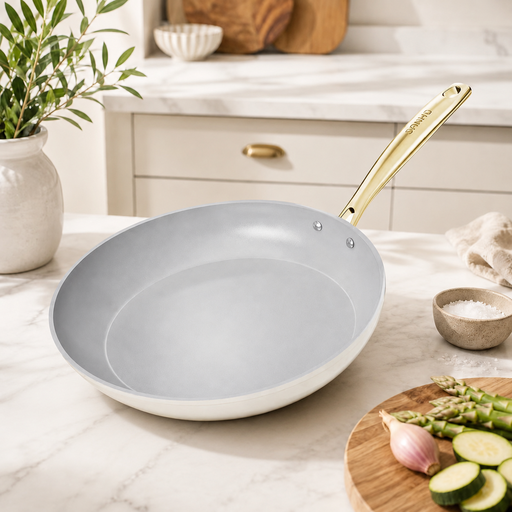
Why it's a match: At 26 cm, this pan is an ideal size for the daily meals of a small family. It combines practical everyday features with a robust construction.
The patented diamond-titanium coating is, according to the manufacturer, more durable than conventional ceramic. The encapsulated stainless steel base ensures even heat distribution on induction hobs and prevents hot spots.
High oven safety: Suitable up to 260°C, making it highly versatile. PFAS-free: Free of PFAS, PFOA, PTFE, lead, and cadmium for health-conscious cooking.
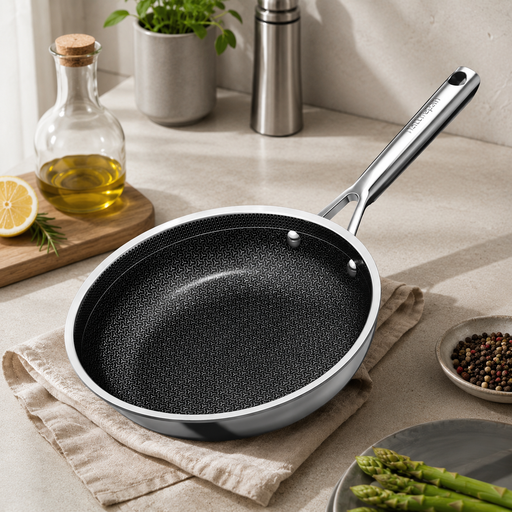
Why it's a match: For cooks who value precise searing and maximum durability. The hybrid technology is designed for intensive use and high temperatures.
The laser-etched hexagonal structure with raised stainless steel ridges physically protects the underlying ceramic coating from scratches. The 3-ply core provides superior, rapid, and even heat distribution.
Hybrid surface: Combines the searing properties of stainless steel with the non-stick effect of ceramic. Robust construction: 5-ply build and a coating that is, according to the manufacturer, 5 times more scratch-resistant.
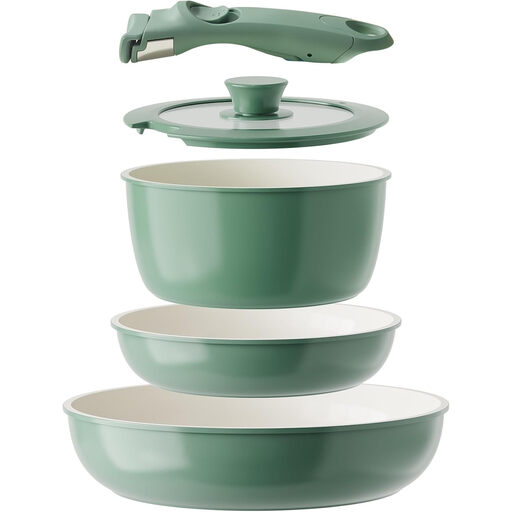
Why it's a match: This ceramic cookware set is ideal for kitchens with limited storage, for RVs, or for anyone who prefers a tidy and flexible system.
The system with a detachable handle eliminates a common weak point (wobbly, fixed handles) and allows for extremely space-saving, stackable storage. The versatility of the set replaces multiple individual pans.
Space-saving design: Stackable cookware with a detachable handle saves up to 75% space, according to the manufacturer. High oven safety: Without the handle, the cookware is oven-safe up to 450°C (842°F).
We have compiled a complete, up-to-date list of products that fully meet these strict selection criteria and all relevant safety standards.
Proper care is crucial. Clean the pan by hand with a soft sponge and mild dish soap, even if it's labelled dishwasher-safe. Always avoid metal utensils and abrasive scouring agents. Let the pan cool completely before cleaning to prevent thermal shock, which can damage the coating.
This often happens due to overheating or using scratching utensils. Ceramic coatings are more sensitive to very high temperatures than PTFE. It's best to cook at low to medium heat. A buildup of burnt-on fat and protein residue, which may be barely visible to the naked eye, can also impair the non-stick performance. Therefore, a thorough yet gentle cleaning after each use is important.
A higher investment can be worthwhile if it goes into superior materials. More expensive models often offer a thicker, multi-layer base for better thermal performance, a more resilient, reinforced ceramic coating, and a more robust overall construction (e.g., riveted handles). These features directly contribute to a longer lifespan and better cooking performance, allowing the initial higher cost to pay for itself over time.