
Lieferung heute & morgen

Qualitätsgarantie

Willkommens-Angebote freischalten: KOSTENLOSE Lieferung | Bis zu 80 % RABATT | Kostenlose 30-Tage-JoyPlus-Testphase
App herunterladen
The search for the right ceramic pan for induction can quickly become overwhelming. Promises of durability and healthy cooking often clash with the reality of non-stick properties fading after just a few months. As your Joybuy Product Recommendation Officer, I'm here to help you separate marketing hype from fact and make an informed decision.
Many buyers invest in a new pan only to find it doesn't live up to its promises. Before you make a choice, you should be aware of the three most common pitfalls that lead to disappointment:
To avoid these pitfalls, it's crucial to focus on the technical features that define a high-quality non-stick pan for induction.
A pure ceramic coating can be brittle. Modern pans, therefore, rely on a titanium-ceramic coating. This involves reinforcing the base ceramic layer with titanium or diamond particles. The result is a harder, more abrasion-resistant surface that better withstands daily use. Look for multi-layer constructions, as they generally offer greater durability. Such a design is a good indicator of a healthy pan without PFOA and other harmful substances that is also robust.
Induction technology requires a ferromagnetic base to generate heat. For optimal performance, the pan's base should have the following characteristics:
A modern kitchen demands flexible cookware. Having an oven-safe frying pan significantly expands your cooking options—from searing on the hob to finishing in the oven. Check the maximum temperature resistance of both the pan body and the handle. For households with limited storage, such as in small kitchens or RVs, a cookware set with a detachable handle is an extremely practical solution.
Here are some models that represent a considered choice for specific user profiles based on their objective features.
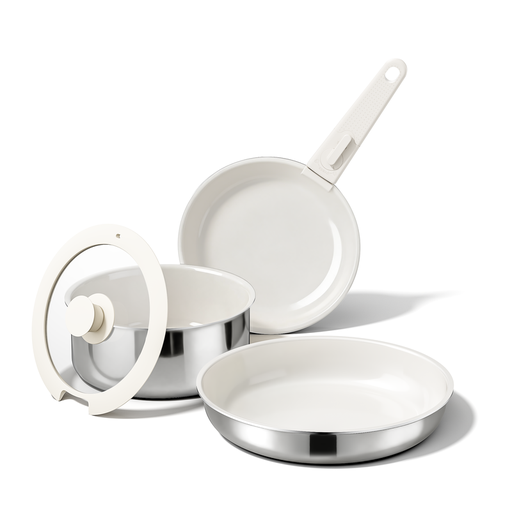
Why This Fits Their Persona: Ideal for small kitchens, RVs, or anyone who values an organised space. The set stacks compactly and covers basic cooking needs.
The three-layer stainless steel body ensures even heat distribution, thus avoiding the problem of hot spots on induction hobs.
Detachable handle for maximum space savings (up to 70%). The entire set is oven-safe up to 250°C and dishwasher-safe.
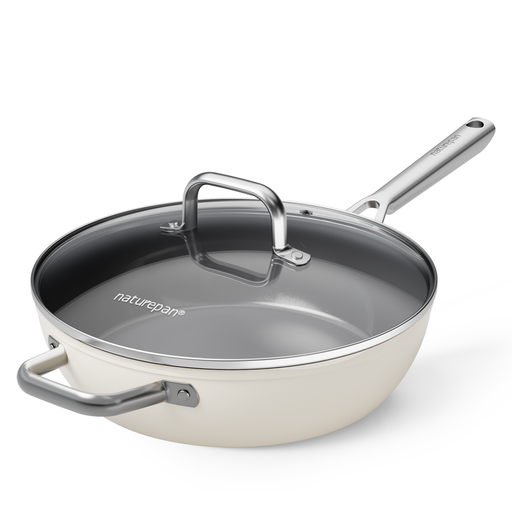
Why This Fits Their Persona: Perfect for families and home cooks looking for a versatile, large pan for braises, sauces, and stews. The high sides and lid minimise splatters.
The coating, reinforced with diamond and titanium particles, is more durable than conventional ceramic, addressing the problem of rapid wear.
Free from PTFE/PFOA/PFAS for safe, healthy cooking. The pan is oven-safe up to 260°C and suitable for all hob types, including induction.
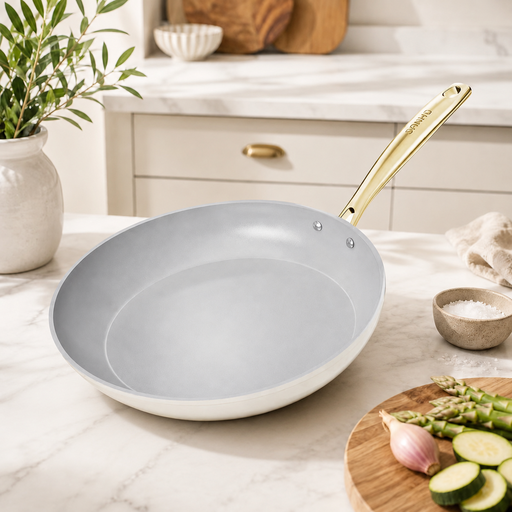
Why This Fits Their Persona: A reliable all-rounder for daily use. Ideal for quick meals like pancakes, chicken fillets, or vegetables. Easy cleaning saves time in your daily routine.
The explicit labelling as free from PFAS, PFOA, PTFE, lead, and cadmium provides clarity and bypasses the confusion of vague "toxin-free" claims.
The encapsulated stainless steel base and aluminium core ensure fast, even heating. The ergonomic handle stays cool on the hob.
We have compiled a complete, up-to-date list of products that fully meet these strict selection criteria and German safety regulations.
1. How long does a ceramic coating really last? The lifespan heavily depends on the quality of the coating and its care. A high-quality coating reinforced with titanium or diamond particles can retain its non-stick properties for several years with proper handling (avoiding metal utensils, hand washing, not overheating). Simpler ceramic coatings often wear out more quickly.
2. Can I use metal utensils in a titanium-ceramic pan advertised as "scratch-resistant"? Although reinforced coatings are more resilient, it is generally recommended to use wooden, silicone, or plastic utensils. This protects the surface and maximises the lifespan of the non-stick property. Aggressive scratching with metal can damage even the most robust coating over time.
3. How can I tell if a pan is optimally suited for my induction hob? Look for a thick, multi-layer base with an integrated ferromagnetic plate. A simple test: if a magnet holds firmly to the bottom of the pan, the magnetic conductivity is good. A flat, solid base is also an indicator of even heat distribution and prevents the typical buzzing or vibrating on some induction hobs.