
Lieferung heute & morgen

Qualitätsgarantie

Willkommens-Angebote freischalten: KOSTENLOSE Lieferung | Bis zu 80 % RABATT | Kostenlose 30-Tage-JoyPlus-Testphase
App herunterladen
Finding the right ceramic pan for induction can quickly become a complex task. You want a durable, health-safe, and high-performance ceramic frying pan that works perfectly with your modern hob. However, the market is filled with marketing claims that don't always deliver. This guide will help you identify the crucial features and avoid common purchasing pitfalls.
Before making a decision, it's important to understand the most common issues found in low-quality pans that lead to frustration in the kitchen.
To avoid these problems, you should focus on three technical features that define a high-quality ceramic pan for induction.
For optimal performance on an induction hob, a multi-layered base with a ferromagnetic core (usually stainless steel) is essential. Look for a sufficient base thickness (typically over 4 mm). A thick, encapsulated base not only ensures rapid and perfectly even heat distribution but also prevents the pan from warping at high temperatures. This makes it a pan suitable for all hob types that retains its shape and function over the long term.
A modern PFAS-free pan (per- and polyfluoroalkyl substances) is a conscious choice for health-oriented cooking. High-quality ceramic coatings are free from harmful substances like PFOA, lead, and cadmium. The crucial difference lies in durability. Look for coatings that are reinforced with particles like diamond or titanium. These additives significantly increase mechanical resistance and abrasion resistance, extending the lifespan of the non-stick properties.
Having an oven-safe ceramic pan significantly expands your culinary possibilities. You can sear dishes on the hob and then finish them in the oven or gratinate them. Check the maximum temperature resistance. Pans with stainless steel handles are often heat-resistant up to 260°C, while models with plastic or silicone handles usually have lower heat limits or are not suitable for the oven at all. A riveted or securely screwed handle also ensures long-lasting stability.
Based on these objective criteria, we have identified several models that are particularly well-suited for specific user profiles.
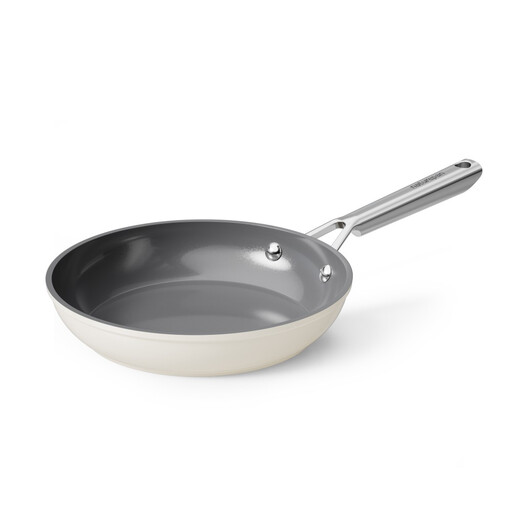
Why This Fits Their Persona: Ideal for single-person households or small portions like fried eggs or omelettes. Its compact size saves space and energy, while the high-quality coating enables healthy cooking with minimal oil.
The ceramic coating, reinforced with diamond and titanium particles, is significantly more durable than basic coatings and counteracts the rapid wear of the non-stick properties.
Completely PFAS/PFOA-free. High oven-safe temperature of up to 260°C thanks to the stainless steel handle, which is a rarity in this size class.
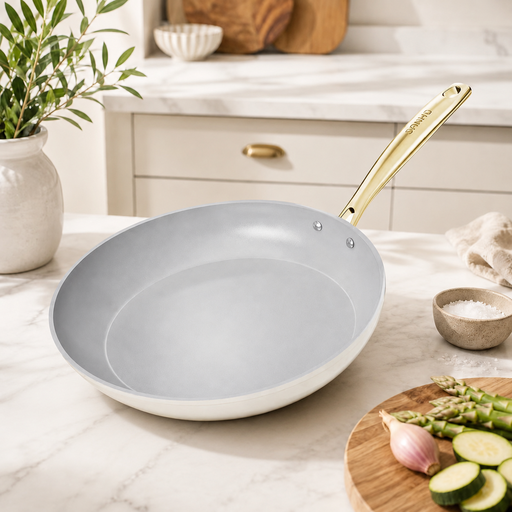
Why This Fits Their Persona: The 26 cm size is an all-rounder for daily use, from pancakes to chicken fillets for a small family. It offers enough space without being cumbersome and is suitable for a wide variety of dishes.
The encapsulated stainless steel base and aluminium core directly address the "induction deception" by ensuring fast, even heating without warping.
According to the manufacturer, the patented diamond-titanium coating is exceptionally scratch-resistant and durable. Its oven safety up to 260°C offers maximum cooking flexibility.
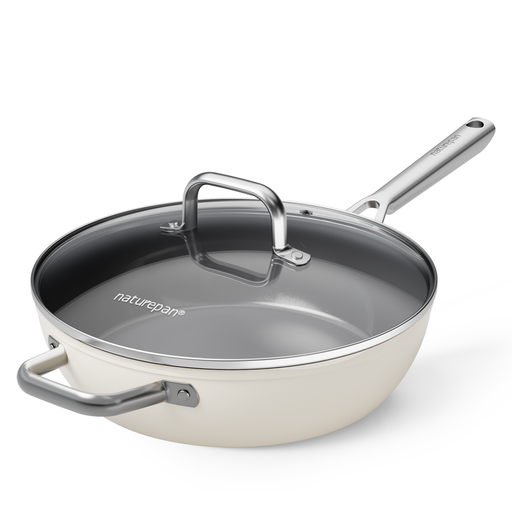
Why This Fits Their Persona: The 28 cm ceramic pan with its high sides and matching lid is perfect for larger portions, stews, sauces, and one-pot meals. It almost replaces a casserole dish and is ideal for families or cooking for guests.
This model combines all the key positive features: a reinforced, scratch-resistant coating, a stable induction base, and high oven safety, thereby avoiding all three common pitfalls.
The high sides and included lid allow for splatter-free frying and braising. Its high versatility from hob to oven (up to 260°C) makes it a central tool in the kitchen.
We have compiled a complete, up-to-date list of products that fully meet these strict selection criteria and safety regulations.
The lifespan of a ceramic coating depends heavily on its quality and proper care. Basic coatings can lose their non-stick properties after 6-12 months. High-quality, particle-reinforced coatings can last for several years with proper care (hand washing, no metal utensils).
Always let the pan cool down completely after use before exposing it to water to avoid thermal shock. Clean it by hand with a soft sponge and mild washing-up liquid. Avoid steel wool or abrasive scourers. Use only wooden, silicone, or plastic cooking utensils.
Yes, an intact, high-quality ceramic coating allows you to cook many foods with little to no fat. This supports a health-conscious diet. However, for optimal searing results and to protect the coating, adding a small amount of oil or butter can still be beneficial.