
Lieferung heute & morgen

Qualitätsgarantie

Willkommens-Angebote freischalten: KOSTENLOSE Lieferung | Bis zu 80 % RABATT | Kostenlose 30-Tage-JoyPlus-Testphase
App herunterladen
Finding the right frying pan can be more complicated than you might think. Especially when you're looking for a healthy coated pan free from harmful substances, you'll encounter a flood of marketing terms and promises. Many health-conscious households opt for a ceramic pan to avoid the risks associated with chemicals like PFAS. However, not every product advertised as "healthy" delivers on its promise. Before you make a decision, it's important to know the most common pitfalls that can lead to a bad investment.
Choosing the wrong pan not only leads to frustration in the kitchen but also to unnecessary expense. Watch out for these three common problems:
To avoid these pitfalls, you should focus on verifiable technical features. Two parameters are crucial for the longevity and safety of your pan.
The term "ceramic" alone is not a sufficient quality indicator. Modern, durable coatings go a step further.
The base is the foundation of the pan and is critical for its cooking performance.
Based on these objective criteria, we have identified several models that are suitable for different user profiles and requirements.
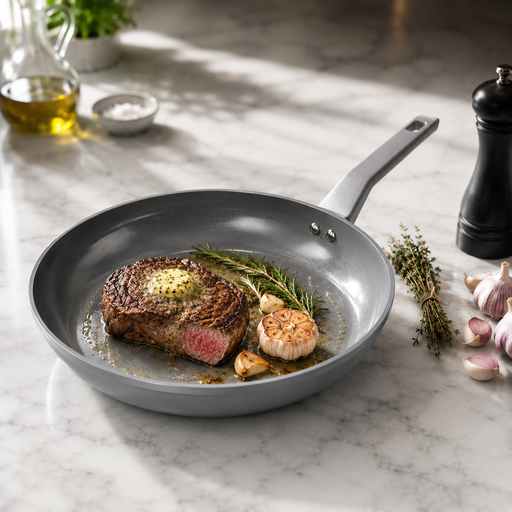
Why It's a Match: Ideal for daily cooking of breakfast, vegetables, or fish. The 26 cm size is versatile for small to medium-sized households, and its easy cleanup saves time in the daily kitchen routine.
The diamond- and titanium-reinforced ceramic layer is designed for durability and is more resilient than simple ceramic. It is explicitly declared as PFAS-, PFOA-, and PTFE-free. The multi-layered base ensures even heat distribution on all cooktops.
Good non-stick performance for low-fat cooking. Dishwasher-safe for easy cleaning. Ergonomic Bakelite handle that stays cool to the touch.
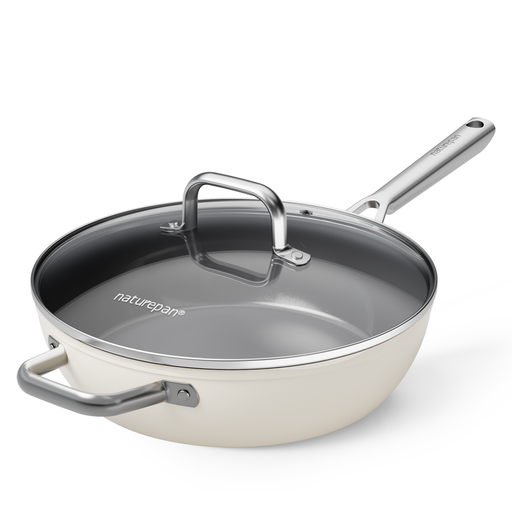
Why It's a Match: Perfect for dishes that are seared on the stovetop and finished in the oven. The high sides and included lid make it ideal for braises, sauces, and one-pot meals.
The titanium-ceramic coating is robust. The stainless steel handle makes it a true oven-safe pan (up to 260°C / 500°F). The optimised base ensures excellent, even heat distribution required for demanding dishes.
High versatility (frying, braising, baking). Includes a matching lid. PFAS-free for safe cooking at high temperatures.
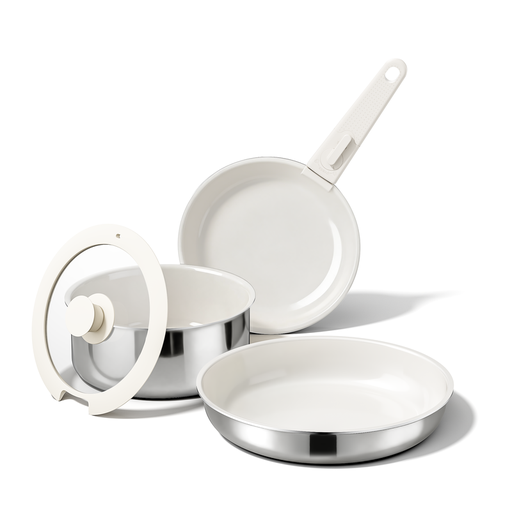
Why It's a Match: The solution for small kitchens, RVs, or anyone who values a tidy cupboard. Thanks to the detachable handle, the entire non-toxic pan set can be stacked to save an incredible amount of space.
This set combines a durable Diamond-Titanium ceramic coating with a robust stainless steel body for optimal heat distribution. It is explicitly PFOA-free and uses a non-toxic ceramic coating. The detachable handle is also oven-safe up to 250°C (480°F).
Saves up to 70% storage space, according to the manufacturer. Universally applicable on all cooktops, in the oven, for serving at the table, and for storage in the refrigerator. The entire set is dishwasher-safe.
We have compiled a complete, up-to-date list of products that fully meet these strict selection criteria and all applicable safety regulations.
The lifespan of a ceramic coating heavily depends on its quality and care. Basic coatings can lose their non-stick properties after 1-2 years of daily use. A reinforced titanium-ceramic coating is designed for longer durability. To maximise its lifespan, always use wooden or silicone utensils, avoid overheating the pan when empty, and refrain from using abrasive scouring pads for cleaning.
No non-stick coating is completely indestructible. The term "scratch-resistant ceramic pan" generally refers to an increased resistance to normal wear and tear from cooking and cleaning with non-metallic utensils. Using knives, forks, or other metal objects in the pan will still damage the surface.
You can identify a good ceramic induction frying pan by three features: First, the product description must explicitly state its suitability for induction cooktops. Second, the pan's base should be thick and perfectly flat to ensure full contact with the cooking surface. Third, a multi-layered base with an integrated ferromagnetic stainless steel plate is a clear sign of quality, ensuring fast and even heat distribution.