
Lieferung heute & morgen

Qualitätsgarantie

Willkommens-Angebote freischalten: KOSTENLOSE Lieferung | Bis zu 80 % RABATT | Kostenlose 30-Tage-JoyPlus-Testphase
App herunterladen
The search for the right frying pan can be a challenge. Many home cooks and families want a durable non-stick pan without Teflon that is safe for their health and easy to use. A ceramic pan often comes into focus here, as it is known for its smooth surface and its properties as a PFAS-free pan.
This article serves as an objective guide. We'll introduce the key features of a high-quality ceramic pan and present a selection of models that are compelling choices for daily use in modern kitchens due to their specific attributes.
To make an informed decision, a few technical aspects are crucial. These criteria will help you find a pan that meets your requirements for functionality and durability.
The core feature of a ceramic pan is its coating. It's manufactured on a mineral basis (derived from sand) and is made without the chemical group of per- and polyfluoroalkyl substances (PFAS). Look specifically for labels like PFAS-free and PFOA-free. Such a coated frying pan allows for cooking with little to no fat, without any health concerns. Modern ceramic coatings are often reinforced with particles like diamond or titanium to increase their abrasion resistance.
Not every pan works on every cooktop. If you own an induction cooktop, the "induction-compatible" label is essential. A ferromagnetic base is technically necessary for this. Furthermore, oven safety greatly increases its versatility. A pan declared as oven-safe allows you to sear dishes on the stovetop and then finish cooking or keep them warm in the oven. Check the maximum temperature resistance, which can vary depending on the handle material.
Although many models are advertised as dishwasher-safe, hand washing with a soft sponge and mild detergent is recommended to maximise the lifespan of the non-stick coating. A truly scratch-proof pan doesn't exist, but high-quality ceramic coatings are very resilient with proper use—meaning, avoiding metal utensils. The smooth surface prevents stubborn food from sticking and generally makes cleaning straightforward.
Here you'll find a curated selection of ceramic pans that stand out for their material composition, functionality, and intended use.
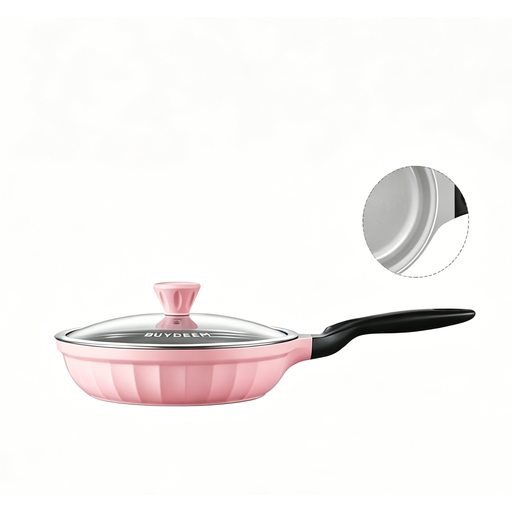
Why it stands out: This model from the Cheflite series combines a lightweight cast-aluminium body with a Swiss ceramic coating. This construction ensures very fast and even heat distribution, which improves cooking results and saves energy. The included glass lid and cool-touch handle enhance everyday convenience.
Pros:
Who is it for? Ideal for daily use in households of 3–4 people. Anyone looking for a reliable, health-conscious pan with a lid for versatile dishes will find a suitable model here.
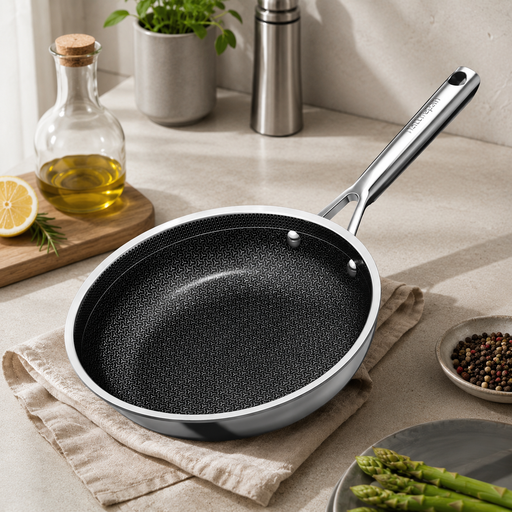
Why it stands out: The naturepan features an innovative 5-layer hybrid construction. A laser-etched hexagon pattern of stainless steel ridges rises above the ceramic non-stick surface. This technology allows for high-heat searing like in a stainless steel pan, while the recessed areas ensure non-stick properties.
Pros:
Who is it for? For ambitious home cooks who need a larger pan (for 4–6 people) and don't want to compromise between high-heat searing and non-stick functionality. Perfect for steaks, whole chickens, or dishes that are finished in the oven.
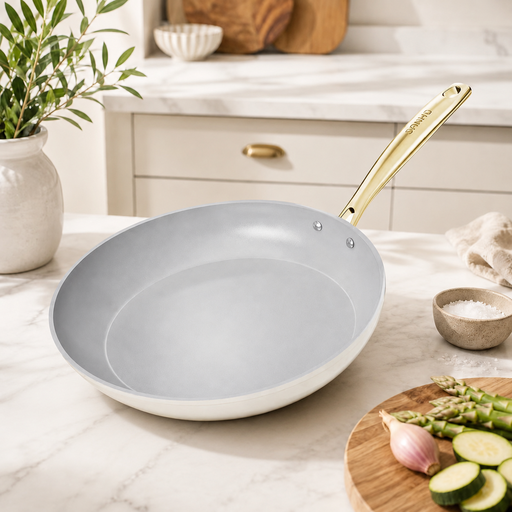
Why it stands out: The Sanho pan is distinguished by its patented diamond-titanium coating, which promises exceptional hardness and durability. The core of highly conductive aluminium with an encapsulated stainless steel base ensures fast and very even heat distribution, making it energy-efficient.
Pros:
Who is it for? An excellent all-rounder for health-conscious users and small families. If you're looking for an especially robust and versatile scratch-resistant pan for daily use that performs well on both the stovetop and in the oven, this is the right choice.
Haven't found the right model for your kitchen yet? There is a wide variety of ceramic pans that differ in size, shape, and specific features.
? Explore our full selection of Safest Ceramic Frying Pans to find the ideal product for your needs.
1. Are ceramic pans truly scratch-resistant? Ceramic coatings are harder and more resistant to scratches than traditional PTFE coatings. However, they are not indestructible. To maximise their lifespan, using utensils made of wood, silicone, or plastic is recommended. Models with diamond or titanium reinforcements offer enhanced durability.
2. How do you clean a ceramic pan correctly? Even if a pan is labelled as dishwasher-safe, hand washing remains the gentlest method. Let the pan cool down after use, then clean it with warm water, a mild detergent, and a soft sponge. Avoid steel wool or abrasive scourers, as they can damage the surface.