
Lieferung heute & morgen

Qualitätsgarantie

Willkommens-Angebote freischalten: KOSTENLOSE Lieferung | Bis zu 80 % RABATT | Kostenlose 30-Tage-JoyPlus-Testphase
App herunterladen
A ceramic table lamp can provide a functional addition to your living room, bedroom, hallway or home office. However, it is only with everyday use that you discover whether a table lamp really suits its intended location. In many cases, it is not the design but unclear information about the lamp holder, bulb or dimensions that leads to a disappointing purchase.
In photos, table lamps often appear more compact or larger than they do in your own home. So check the height, width and depth carefully. A table lamp for the living room should, for example, leave enough space on a sideboard. As a bedside lamp, it should neither overwhelm the available surface nor cover the light switch.
E14 and E27 are not interchangeable. An E14 table lamp requires a bulb with the corresponding base, while an E27 table lamp uses larger standard fittings. You should also check the maximum wattage. A bulb with a higher wattage could cause the fitting or lampshade to become excessively hot.
Many table lamps are supplied without a bulb. In this case, the colour temperature depends on the separately purchased bulb. Warm white options are often suitable for a decorative table lamp in a living area. Check the Kelvin rating on the packaging and bear in mind that a fabric or light-coloured shade will diffuse the light further.
Pay attention to the specified lamp holder, maximum power rating and mains voltage. The models featured here have different specifications:
The wattage indicates the permitted consumption or the fitting’s maximum load. With LED bulbs, the actual power consumption is usually lower than with traditional incandescent bulbs. However, it remains essential that the base and maximum wattage are compatible.
A ceramic lamp with a fabric shade requires a level, stable surface. Before ordering, measure the available space and consider the distance from walls, curtains and other heat-sensitive objects.
The Beliani FERGUS is listed as measuring 33 × 33 × 52 cm. The Lameke models have smaller shade dimensions and may therefore be suitable for more compact surfaces. Even so, the overall effect will depend on the location, the height of the furniture and the desired distribution of light.
For these products, ceramic is primarily used for the lamp base. Depending on the model, the shade is made from fabric, polycotton, linen blends or paper cord. These materials can create a softer, more diffuse light, but should be kept dry and cleaned carefully.
The protection rating is also relevant for indoor use. The Beliani lamp is rated IP20, making it suitable for dry indoor areas. It should not be used in damp rooms or outdoors. An in-line cable switch makes the lamp easier to operate, but it does not replace careful positioning on a stable surface.
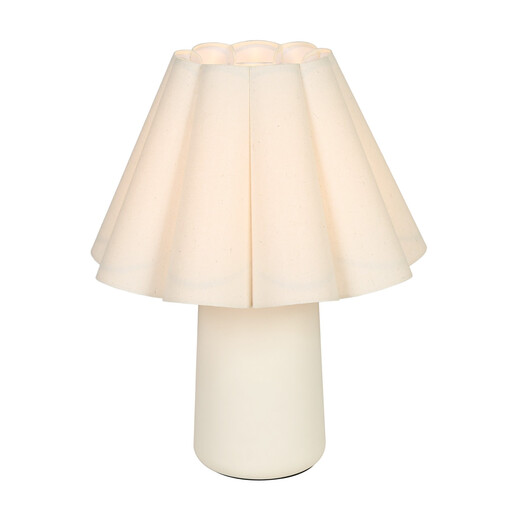
Why this product suits this profile: The combination of a ceramic base and white crinkled fabric shade is ideal for shoppers looking for a compact indoor table lamp with clear technical specifications.
The fitting and maximum load are specified as E14 and 25 W. This reduces uncertainty when choosing a bulb.
Ceramic and fabric materials, 1.6 m of exposed cable and an in-line switch, according to the product information.
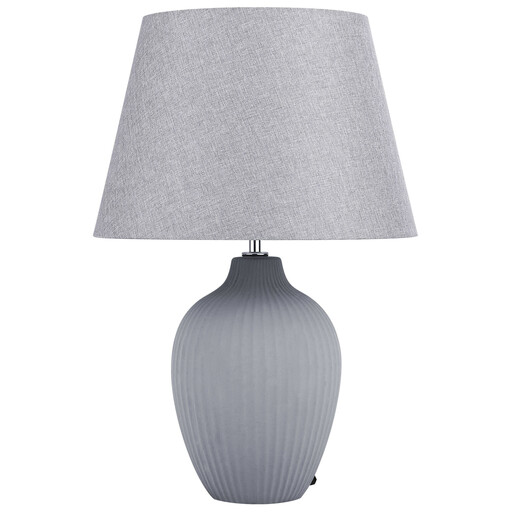
Why this product suits this profile: This grey table lamp combines a ribbed ceramic base with a linen or polycotton shade, making it a good match for simply styled living rooms or bedrooms.
The product information lists the dimensions, E27 base, maximum 60 W, IP20 rating and 1.75 m cable length. This makes planning easier before you buy.
Grey ceramic base, in-line cable switch, E27 fitting and compatibility with LED, eco-halogen and energy-saving bulbs, according to the product description.
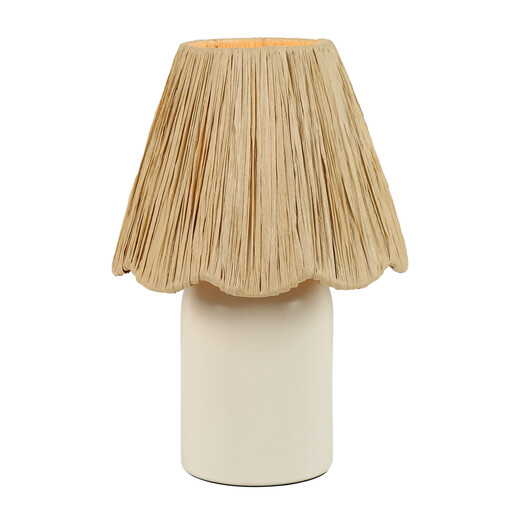
Why this product suits this profile: The wavy rattan or paper cord shade adds texture and makes this lamp suitable for rooms where the ceramic lamp is also intended to be a decorative feature.
Here too, the specifications state an E14 fitting and a maximum of 25 W. According to the product description, the lamp is intended exclusively for dry indoor areas.
Ceramic or porcelain material, 1.6 m cable, integrated switch and textured shade, according to the product information.
Running costs depend mainly on the bulb’s wattage and how long it is used each day. An LED bulb with a lower wattage may use less electricity than a traditional bulb while providing the same desired colour temperature. For warm lighting, colour temperature is more important than a high wattage.
You should also bear the following in mind:
We have put together a complete, regularly updated list of products that fully meet these strict selection criteria and the safety regulations applicable in the EU.
This depends on the individual model. E14 fittings are designed for smaller bulbs, while E27 fittings are intended for larger standard bulbs. The fitting must match the bulb base. You must also ensure that the specified maximum wattage is not exceeded.
Yes, provided that its dimensions, switch and light distribution suit the bedside table. Measure the available space and check whether the shade causes glare when you are sitting or lying down. In the bedroom, a warm white bulb with a low wattage may be a sensible choice.
The lamp’s service life depends on the fitting, cable, switch and build quality. The ceramic base itself is resistant to wear under normal use, but it can break if knocked. Store and move the indoor table lamp carefully, and do not attempt to replace damaged electrical components yourself.