
Lieferung heute & morgen

Qualitätsgarantie

Willkommens-Angebote freischalten: KOSTENLOSE Lieferung | Bis zu 80 % RABATT | Kostenlose 30-Tage-JoyPlus-Testphase
App herunterladen
A ceramic fan heater can provide bedrooms, home offices or cellars with extra heat for a short time. These appliances are compact, portable and usually operate with a PTC ceramic heating element. However, not every model will be the right choice. High wattages, claimed energy savings or safety features are often highlighted, while important details about use are left out.
A 2000-watt fan heater delivers a high maximum electrical output, but that does not automatically make it suitable for every room. Factors such as room size, insulation, ceiling height, outdoor temperature and the desired heating time are also important. A 2000-watt appliance may be sufficient for a small office, while a poorly insulated cellar will take considerably longer to heat.
An energy-efficient fan heater initially uses just as much electricity at the same output as any other appliance with a comparable wattage. An ECO mode or thermostat can reduce operating time by lowering or pausing the heating output once the target temperature has been reached. However, running costs mainly depend on operating time, power setting and your electricity tariff.
A simple guide:
Cost = power in kilowatts × operating time in hours × electricity price per kilowatt-hour
A 2000-watt fan heater is equivalent to 2 kilowatts. Two hours of operation therefore amounts to 4 kilowatt-hours. Before buying, check whether the appliance offers several power settings and automatic temperature control.
A fan heater with overheat protection or tip-over protection provides additional technical safeguards, but it does not replace safe positioning. The air outlet and intake must not be covered. Keep textiles, curtains and furniture at a sufficient distance. A fan heater should not be placed on a bed, sofa or unstable carpet, and should not be left unattended while operating.
Several settings are useful for flexible operation. Depending on the model, appliances with 750, 1000, 1500 or 2000 watts can be adjusted to suit the room size and heating requirements. A PTC ceramic fan heater regulates heat output using a ceramic heating element and airflow. Ceramic technology alone, however, is not proof of a particular efficiency level or a lower electricity bill.
A fan heater with thermostat switches the heating function on and off depending on the measured room temperature. Check which temperature range the model actually supports. According to the product information, the Adler AD 7727 can be set to a range of 10 to 35 °C; a frost-protection function at 7 °C is also specified. Other appliances, for example, cover ranges of 15 to 40 °C or 5 to 35 °C.
A clear display, straightforward controls and easily accessible temperature adjustment are particularly practical in bedrooms and home offices.
A fan heater with oscillation distributes warm air across a wider angle. Depending on the model, this may be specified as 45°, 70° or 90°. This can be helpful when several people are seated in the room, but it does not replace correct positioning.
If you want to operate the appliance from your bed or desk in the evening, look for a fan heater with remote control. A fan heater with timer is suitable when you want to limit the operating time. Also check the manufacturer’s stated noise level: the Adler AD 7727 is specified as producing less than 51 dB. For the OmniHeat model, levels of 38 to 50 dB are given depending on the operating setting. These are manufacturer-provided product specifications and may be perceived differently depending on distance and room acoustics.
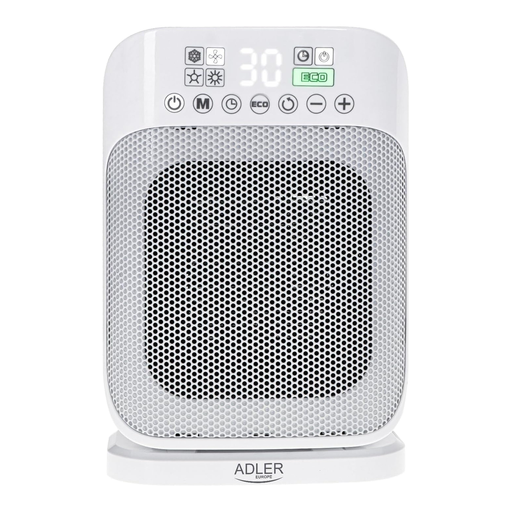
Why this product suits this profile: This model offers 1500 watts, remote control, an LED display and a compact design for indoor spaces such as offices or bedrooms.
The adjustable temperature from 10 to 35 °C means wattage is not the only control variable. Automatic 45° oscillation helps distribute the air more widely.
1500 watts, temperature range of 10–35 °C, frost-protection function at 7 °C and a specified noise level of less than 51 dB.

Why this product suits this profile: Five operating modes, ECO mode, a thermostat and a 24-hour timer provide a range of settings for regular use.
The ECO mode is described as automatically adjusting to the ambient temperature. This can reduce unnecessary full-power operation, but results depend on the room conditions.
Up to 2000 watts, five modes, 24-hour timer, adjustable thermostat, plus overheat and tip-over protection according to the product description.
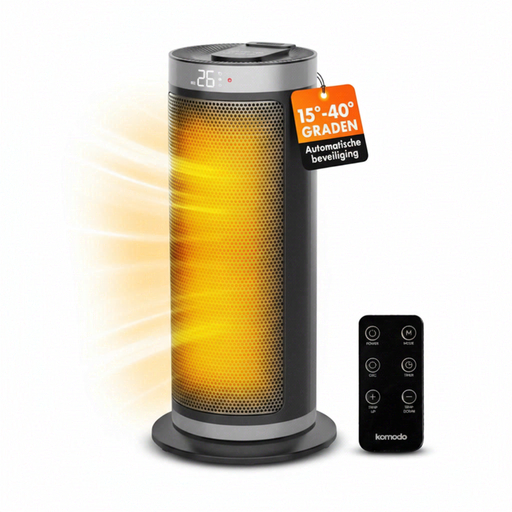
Why this product suits this profile: Three power settings, ECO mode, remote control and 90° oscillation are aimed at users who want to use the appliance regularly in different indoor spaces.
Choosing between 750, 1500 and 2000 watts reduces the need to run every application at full power. Nevertheless, the IP66 rating should always be checked against the instruction manual and the intended positioning.
750/1500/2000 watts, 15–40 °C, ECO mode, remote control, 90° oscillation, plus overheat, tip-over and automatic shut-off according to the supplier’s specifications.
We have put together a complete, regularly updated list of products that fully meet these strict selection criteria and the safety regulations applicable in the EU.
Before using the appliance for the first time, read the relevant manufacturer’s instructions. In particular:
At full power, a 2000-watt fan heater uses 2 kilowatt-hours per hour of operation. A thermostat, ECO mode and a lower power setting can reduce the actual operating time or power consumption. For an accurate estimate, multiply the consumption by your current electricity unit rate.
A ceramic fan heater can be suitable for temporary supplementary heating in the bedroom if it is positioned securely, kept sufficiently far from textiles and operates at a noise level that suits your personal sleeping environment. A timer and thermostat are practical for this use. Avoid leaving the appliance running continuously and unattended.
Its service life depends on operating time, dust exposure, care, storage and the quality of its electrical components. Clean the air inlets according to the instructions, avoid moisture and only move the appliance once it has cooled down. A general service life cannot be determined from the wattage or ceramic technology alone.