
Lieferung heute & morgen

Qualitätsgarantie

Willkommens-Angebote freischalten: KOSTENLOSE Lieferung | Bis zu 80 % RABATT | Kostenlose 30-Tage-JoyPlus-Testphase
App herunterladen
A ceramic fan heater can warm rooms quickly, whether in a home office, bedroom, living room or basement. Unlike a permanently installed radiator, an electric fan heater can be placed flexibly and moved between rooms whenever needed. However, models differ significantly in heating levels, noise, temperature control and safety features.
Simply choosing the highest wattage does not automatically mean choosing the right model. Room size, operating time, ease of use and the ability to distribute heat effectively are what really matter.
A 2000-watt fan heater delivers heat quickly, but at full power it can consume up to 2 kWh per hour of operation. The actual cost depends on your electricity tariff. A 2000-watt model is therefore not automatically an energy-efficient fan heater.
A model with multiple power levels, a thermostat and, where available, an ECO mode is usually the more sensible choice. Once the target temperature has been reached, the heater can reduce its output or pause operation. Compared with running continuously at maximum power, this can help reduce energy consumption.
Claims such as “suitable for 25 m²” depend on insulation, ceiling height, outdoor temperature and any existing heating system. A unit may have to work considerably harder in a poorly insulated basement than in a small, well-insulated home office.
For supplementary heating, the stated room size should therefore be treated as a guideline. In larger rooms, an oscillating fan heater can be useful because it prevents the airflow from being directed at one spot continuously.
A fan heater with overheat protection and tip-over protection reduces certain operating risks, but it does not replace safe placement. The unit must not be covered and should be positioned away from curtains, furniture, paper and textiles. Many product manuals recommend keeping approximately one metre clear in front of the air outlet.
An IP rating should not automatically be interpreted as approval for use in wet areas. Even when individual product specifications mention bathroom suitability, the operating manual, the exact installation location and the manufacturer’s instructions must remain the decisive factors.
Ceramic PTC heating elements warm the air as it passes through the unit. Many models offer several power levels, such as 750, 1500 and 2000 watts or 900, 1300 and 1500 watts. A lower setting is suitable for maintaining room temperature or heating smaller rooms, while the highest setting is primarily intended for rapid warm-up.
Also check the electrical specifications: In Germany, 220–240 volts and a suitable grounded socket are standard. High-power appliances should be connected directly to an appropriate wall socket. Power strips and unsuitable extension cables may become hot.
A ceramic fan heater with a thermostat adjusts its heating output according to the measured room temperature. A finely adjustable range, such as 5–35 °C or 15–40 °C, is particularly practical. A digital display makes monitoring easier, while a mechanical control may offer a simpler design.
For bedrooms and home offices, the maximum possible temperature is less important than predictable temperature control. A fan heater with a timer can also limit operating time, ensuring that the appliance does not remain on longer than necessary.
Fan noise is especially noticeable at night or during focused office work. Manufacturer claims such as 25–42 dB or below 51 dB should therefore be assessed in relation to how you intend to use the appliance. A “quiet fan heater” is not silent, and the noise level may vary depending on the heating setting.
An oscillation range of 45°, 70°, 90° or 120° distributes airflow across a wider area. A remote control is convenient when the unit is positioned on the floor or needs to be operated from bed. Child lock, automatic shut-off and an easily accessible power switch are additional factors worth considering.
The following recommendations are based on the published technical product specifications. Brand claims regarding heating area, noise levels or energy savings should be understood as manufacturer specifications and will depend on room conditions.
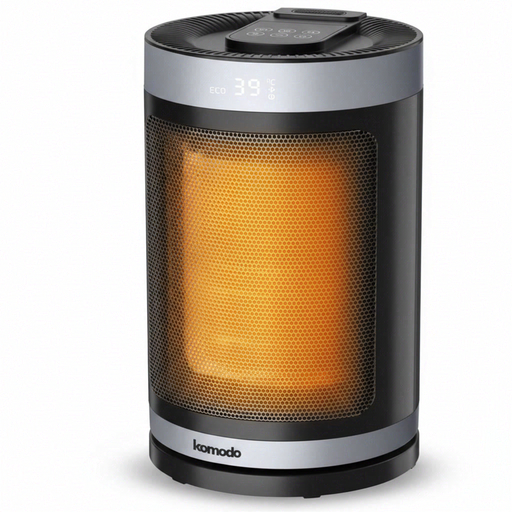
Why it fits: According to the product specifications, this compact unit is designed for smaller indoor spaces of up to approximately 15 m² and offers multiple heating levels, a thermostat and a remote control.
The 750-, 1500- and 2000-watt settings allow the output to be tailored to the room and intended use instead of relying solely on maximum power.
LED display, 90° oscillation, ECO mode and automatic shut-off according to the manufacturer’s specifications.

Why it fits: According to the manufacturer, this model is designed for 10–20 m² and has a stated noise range of 25–42 dB.
The stated 900-, 1300- and 1500-watt settings provide lower operating levels for longer periods of use.
12-hour timer, remote control, 5–35 °C thermostat, plus overheat and tip-over protection according to the product description.

Why it fits: Designed for rooms of 15–25 m² according to the supplier, this model combines 2000 watts of power with oscillation and precise temperature control.
The 5–35 °C temperature range and adjustable output help prevent the heater from running continuously at 2000 watts.
Manufacturer-rated noise levels of 25–42 dB, 70° oscillation, remote control and eight specified safety functions.
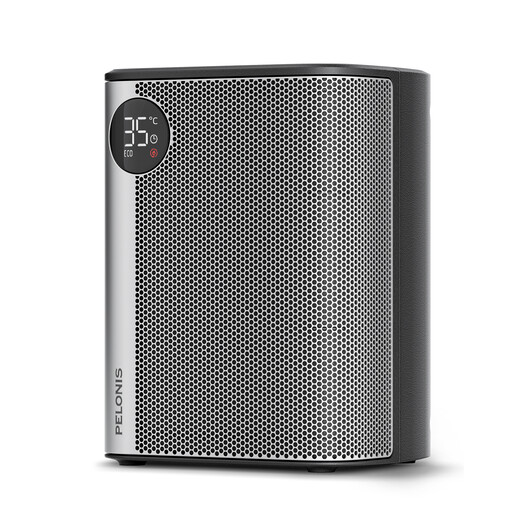
Why it fits: Five operating modes, ECO mode, a thermostat and a 24-hour timer are designed for users who want to combine a wide range of settings.
The timer limits operating time, while the ECO mode reportedly adjusts output to the ambient temperature.
Touch controls, precise temperature display, ergonomic carry handle, plus overheat and tip-over protection.
We have put together an up-to-date selection of appliances that take these criteria and the relevant safety requirements for use in Germany into account.
The CE marking indicates that the manufacturer has declared compliance with applicable EU requirements. However, it does not replace checking the manual, mains connection, safety features and actual installation conditions.
At full power, consumption can reach 2 kWh per hour. At an example electricity rate of €0.35 per kWh, that would amount to approximately €0.70 per hour. Actual consumption falls when the thermostat switches off or a lower heating setting is used.
A fan heater can be practical for short-term supplementary warmth in a single room. As a permanent heating solution, it is generally not the obvious choice because of its electricity consumption. Suitability depends on room size, insulation, operating time and electricity costs.
There is no single lifespan that can be stated universally. Dust, frequent relocation, blocked air vents and extended operating periods can increase wear. Regular cleaning while the appliance is disconnected from the power supply, dry storage and compliance with the manufacturer’s instructions all support reliable operation.