For a cereal bar labelled “low fat”, the fat content per 100 g is what matters: under EU Regulation (EC) No 1924/2006, solid foods can contain no more than 3 g of fat per 100 g to make this claim. If you’re comparing cereal bars for on-the-go snacking by fat content instead, check this figure first, then work out how much fat is in the portion you plan to eat. “No added sugar” is no substitute for comparing fat content: Netto Online lists 9.4 g of fat per 100 g for CORNY free Schoko.
Who should take care when choosing?
Consumers with a specific fat limit
If you specifically need to choose a food labelled “low fat”, check the fat content per 100 g for the exact variety. Under EU Regulation (EC) No 1924/2006, solid foods can only carry this claim if they contain no more than 3 g of fat per 100 g.
Consumers planning portions for on-the-go snacking
If you take bars to work, school or on trips and want to keep track of the fat in each snack, you’ll need the bar’s weight as well as its fat content per 100 g. A small portion doesn’t automatically make the recipe low fat.
Consumers also checking sugar and ingredients
If you’re checking sugar, ingredients or allergens as well as fat, read each piece of information separately. For example, Netto Online lists 1.5 g of sugar and 9.4 g of fat per 100 g for CORNY free Schoko.
What matters when buying?
When choosing cereal bar multipacks for on-the-go snacking, compare the fat content per 100 g first, then consider the portion you actually plan to eat. Sugar, ingredients and allergens are separate things to check.
| Criteria |
What to check |
Who it matters to |
| “Low fat” claim |
Check the fat content per 100 g on the specific pack. Under EU Regulation (EC) No 1924/2006, solid foods can only be labelled “low fat” if they contain no more than 3 g of fat per 100 g. |
If you specifically want to choose a low-fat food, a low figure per bar isn’t enough. Around 42% of consumers prioritise this fat limit when making their choice. |
| Fat per portion |
Check the bar’s weight and its fat content per 100 g; if you’re eating more than one bar, take the total amount you’ll eat into account. |
If you’re having a snack on the go, you’ll want to know how much fat is in the portion you’ll actually eat. Planning portions is the top priority for around 33% of consumers. |
| Sugar, ingredients and allergens |
Read the sugar and fat information separately; check the ingredients list and allergen labelling for the variety you’ve chosen. |
If you also need to watch your sugar intake or avoid certain ingredients, information on the front of the pack isn’t enough. Around 25% of consumers give this additional check the greatest importance. |
Common comparison mistakes
-
Assuming “no added sugar” means “low fat”
These claims relate to different properties. Netto Online lists 9.4 g of fat per 100 g for CORNY free Schoko; under EU Regulation (EC) No 1924/2006, solid foods need to contain no more than 3 g per 100 g to be labelled “low fat”.
Check sugar and fat separately in the nutrition information. If you’re choosing a product labelled “low fat”, the fat content per 100 g is what matters.
-
Comparing only the fat content per bar
A small bar may contain little fat per serving, but that doesn’t mean its recipe meets the “low fat” requirement per 100 g.
Compare the figures per 100 g first. Then use the bar’s weight to work out how much fat is in the portion you actually plan to eat.
-
Guessing allergens from the brand name
Ingredients and possible traces vary by product. EDEKA lists sesame in its Bio Knusperriegel Sesam, which may also contain traces of peanuts and tree nuts.
Before buying, read the ingredients list and allergen labelling on the pack of the variety you’ve chosen.
-
Assuming a promotional range will always be available
Bars sold as special buys at ALDI Nord may be available for a limited time or sell out early.
Before planning a shop, check the specific variety and its current availability at the store concerned.
Brands and ranges to consider
CORNY
CORNY offers cereal bars in multipacks, including the free Schoko variety.
- Individually portioned bars can be handy to take with you.
- “free” doesn’t mean low in fat: Netto Online lists 9.4 g of fat per 100 g for CORNY free Schoko.
REWE / REWE Bio
The REWE range includes cereal bars from various brands as well as REWE Bio products to compare.
- You can compare different pack sizes using their nutrition information.
- Whether a variety meets your chosen fat limit depends on its own nutrition table, not on the range it belongs to.
GOLDEN BRIDGE / ALDI Nord
ALDI Nord stocks GOLDEN BRIDGE cereal bars in a range of varieties, including an eight-bar multipack with bars weighing 25 g each.
- The stated bar weight helps you plan your portions.
- Even for varieties labelled “no added sugar”, you’ll need to check the fat content separately. Special buys may only be available for a limited time.
EDEKA Bio
EDEKA Bio Knusperriegel Sesam shows why you need to compare nutrition information for each variety individually.
- EDEKA provides nutrition and allergen information for this variety.
- EDEKA lists 32 g of fat per 100 g for its Bio Knusperriegel Sesam. It contains sesame and may contain traces of peanuts and tree nuts.
Joybuy products for on the go
This cereal bar multipack could be a handy option for planning portions on the go. You can check whether its fat content suits your needs by looking at the nutrition information on the specific pack.
 No image available
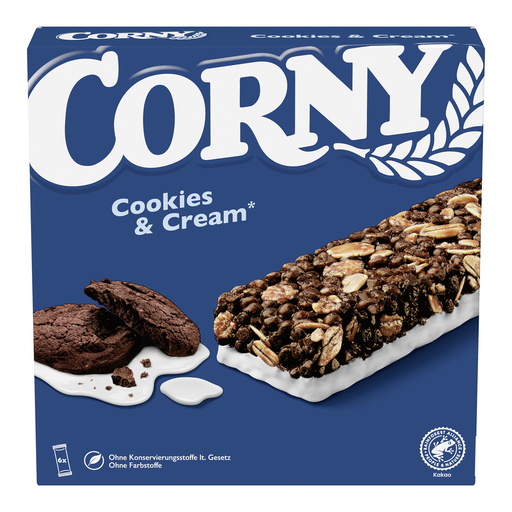
Corny Cookies & Cream Cereal Sandwich Bars, 6 × 23 g
With six bars weighing 23 g each, you can plan a portion to take with you. Before buying, check the pack to see whether the bars are individually wrapped and what the fat content per 100 g is for this variety.
View at Joybuy
Frequently asked questions
When can a cereal bar be labelled “low fat”?
Under EU Regulation (EC) No 1924/2006, solid foods can only be labelled “low fat” if they contain no more than 3 g of fat per 100 g. Check the fat content per 100 g on the specific pack; the size of an individual bar doesn’t change this limit.
Does “no added sugar” also mean low in fat?
No, a claim about added sugar tells you nothing about the fat content. Netto Online lists 1.5 g of sugar and 9.4 g of fat per 100 g for CORNY free Schoko, putting this variety above the limit for a “low fat” claim on solid foods.
How do I compare bars of different sizes?
Compare the fat content per 100 g first, so the different bar sizes don’t skew the results. To work out the amount in your planned portion, multiply the fat content per 100 g by the bar’s weight in grams, then divide by 100.
What should I check for allergens in a multipack?
The ingredients and allergen information for the specific variety you’ve chosen are what matter. For EDEKA Bio Knusperriegel Sesam, EDEKA lists sesame and possible traces of peanuts and tree nuts; check the labelling on the pack before you buy.


