People who plan lunchboxes
If you pack snacks for several mornings or family members, you can divide individually wrapped bars between snack days. The key is to make sure the number of bars and their size fit your plans.


For lunchboxes packed regularly, individually wrapped cereal bars in a pack of 6 or 8 are easy to plan for. If several people have different tastes, a variety pack could be a good option – but its twin bars count as a different portion size. So compare the grams per bar, along with the ingredients, sugar and allergen information for the specific variety.
If you pack snacks for several mornings or family members, you can divide individually wrapped bars between snack days. The key is to make sure the number of bars and their size fit your plans.
For them, it’s the labelling of the chosen variety that matters: recipes, sugar content and allergen information can vary between cereal bars.
A variety pack brings different flavours together in one pack. Before sharing, check how many bars of each variety it contains and how large each portion is.
First decide how many separate snacks you need. Then compare the size of each bar and the information on the label for every variety.
A good fit if: You’re planning separate portions for several lunchboxes or mornings.
Bear in mind: More bars doesn’t automatically mean more in each portion.
A good fit if: The weight of each individual bar matters more to you than having a large number of bars.
Bear in mind: Nutritional values per 100 g don’t directly tell you how much you’ll actually eat.
A good fit if: Having several flavours to share matters more than having identical portions.
Bear in mind: You can’t compare a twin bar with a small individual bar just by counting pieces.
| What to consider | What to check before buying | Who it matters most to |
|---|---|---|
| Portions you can plan for | Number of bars, grams per bar and individual wrapping. | I want to plan separate snacks for several lunchboxes without having to split up a pack first. Around 42% of consumers prioritise individual portions that are easy to plan for. |
| Ingredients and labelling | Sugar per 100 g and per portion eaten, ingredients list and allergen information. | If a particular recipe matters to my household, I check the details for the specific variety rather than just the front of the pack. For around 33% of consumers, ingredients and labelling come first. |
| Pack size and varieties | Total weight, bar size and flavours included. | When tastes vary, I want to know which varieties are actually in the pack and how the portions can be shared. Around 25% of consumers focus mainly on this format. |
Six 25 g bars and five 42 g twin bars are different portion sizes. The number of pieces alone doesn’t tell you how much you’ll have for your planned snack days.
Compare the number of pieces, total weight and grams per bar. For twin bars, decide what amount you’ll count as one portion.
The two terms don’t mean the same thing. To compare products, check the sugar information in the nutritional values for the specific variety; the ingredients list matters too.
Check the sugar per 100 g and, for bars of different sizes, take account of the portion you’ll actually eat.
A name such as chocolate, nut or oat is no substitute for allergen labelling. EDEKA points out that online information may differ from the details on the packaging.
If you have an allergy, check the current labelling on the pack you’ve chosen, including any ‘may contain’ warnings.
According to the German Food Federation, the best-before date is a quality date, not a use-by date. The stated storage conditions also matter when you’re planning to stock up.
Compare the best-before date and storage instructions with how long you expect the bars to last.
REWE lists Corny cereal bars in formats including 6 × 25 g, 4 × 30 g and 4 × 35 g.
ALDI SÜD sells cereal bars under this own-brand label in an 8 × 25 g format.
EDEKA describes cereal bars under this own-brand label in 8 × 25 g packs, including individually wrapped chocolate and peanut varieties.
REWE lists several varieties of cereal bars under this own-brand label in an 8 × 25 g format.
REWE describes a variety pack containing five 42 g twin bars in three flavours.
This selection includes Corny multipacks with bars of different sizes. Compare the portions and, if needed, check the ingredients, nutritional values and allergen information for the variety you choose.
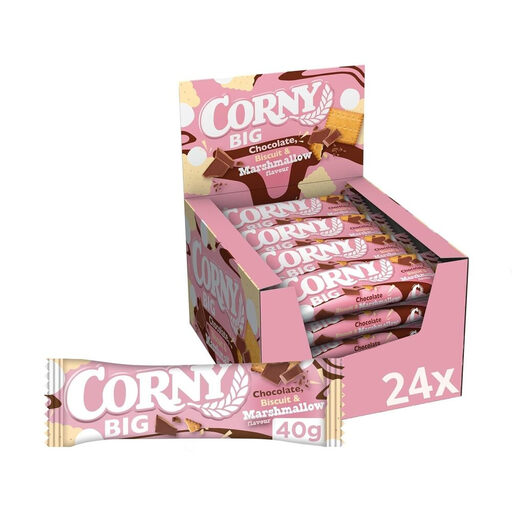 No image available
For stocking up on 40 g bars: the pack states that it contains 24. If you’re putting them in lunchboxes, check whether they’re individually wrapped and look at the ingredients and allergens on the pack.
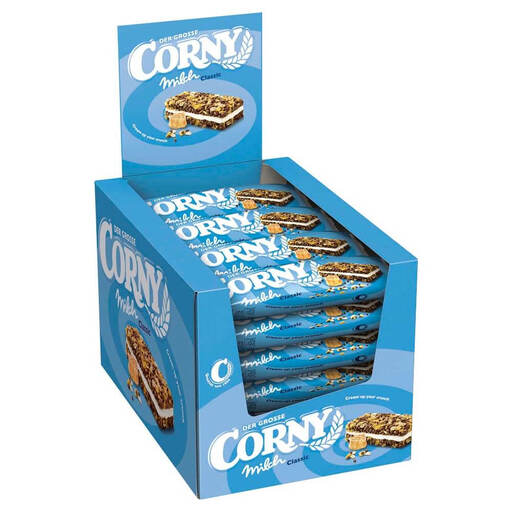 No image available
If you’re planning 40 g bars for several snack days, the pack states that it contains 24. Check the labelling for the Milk Classic variety against your requirements.
 No image available
For planning with larger individual bars: the pack states that it contains 12 bars at 50 g each. If you want to put them separately in lunchboxes, check their packaging and the allergen information.
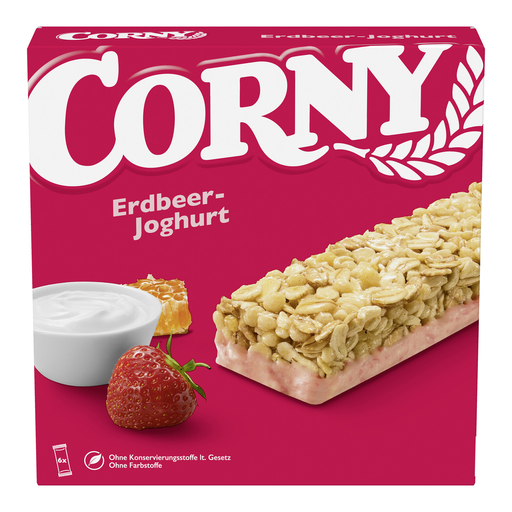 No image available
If you want to divide smaller bars between morning snacks, the pack states that it contains six bars at 25 g each. Check the ingredients and allergen information for the Strawberry Yoghurt variety.
 No image available
For planning with 20 g bars, the pack states that it contains six. Compare the sugar information for this variety with other bars and check whether the bars are individually wrapped for lunchboxes.
A pack of individually wrapped bars can be divided between lunchboxes or snack days. For formats described by REWE and EDEKA, such as 6 × 25 g or 8 × 25 g, you should also check whether the size of each bar suits the portion you have in mind.
No, the terms don’t mean the same thing. The Consumer Advice Centre explains the difference; for a specific cereal bar, check the sugar information in the nutritional values and read the ingredients list.
Check the allergen labelling and any ‘may contain’ warnings on the specific pack, rather than relying on the variety name. For example, EDEKA lists cereals containing gluten, milk and peanuts as allergens in its chocolate cereal bar; other varieties may have different labelling.
As the German Food Federation explains, the best-before date is a quality date, not a use-by date. Also follow the storage instructions when planning your supplies. After the best-before date has passed, check the product carefully rather than relying on the date alone.