When choosing cereal bar multipacks to support your weight management, compare the energy and sugar in the bar you’ll actually eat – not just the figures per 100 g or the size of the pack. Check the number of bars, ingredients and allergens too: ‘no added sugar’ does not mean unsweetened or calorie-free, and a larger pack doesn’t tell you what a suitable snack portion is.
Who might find multipacks useful?
Snack planners watching their sugar intake
You want to keep bars handy for when you’re out and about, and compare the sugar content of each bar. What matters is what the nutritional information says about the specific variety – even if the front of the pack says ‘no added sugar’.
Households with set snack portions
You buy several bars at a time and want to know how many portions are in the pack, how much each bar weighs and how much energy is in the portion you actually plan to eat.
Shoppers with ingredient and allergen requirements
You need to check whether a particular variety meets your requirements before choosing it. The ingredients list, highlighted allergens and possible ‘may contain’ warnings matter more than the brand name alone.
What should you look for when choosing?
Start with the portion you plan to eat, then check the pack contents and ingredients. Figures per 100 g help you compare varieties; for snack planning, you’ll also need to know how much each bar weighs.
| What to check |
What to look for when buying |
Who it matters most to |
| Sugar and energy |
Compare ‘of which sugars’ and kcal per 100 g and per bar. Check whether the stated bar weight matches the portion you plan to eat. |
If I’m planning to have a bar as a snack, I want to know the sugar and energy in the whole portion, rather than relying only on the figures per 100 g. Around 42% of consumers put this portion-based comparison first. |
| Pack contents and portions |
Check the total weight, number of bars and weight per bar; think about whether you usually eat one bar or several at a time. |
I want the pack to cover several planned snack breaks at home, without having to guess the portion size from the total weight. Around 33% of consumers prioritise this need for both stock and portion planning. |
| Ingredients and allergens |
Read the ingredients list for the specific variety, particularly for sweeteners, peanuts, milk and cereals containing gluten. |
When trying a new variety, I need to be able to see which ingredients and allergens it contains; a claim such as ‘no added sugar’ doesn’t answer that question. Around 25% of consumers make this check their top priority. |
Which mistakes can you avoid?
-
Assuming ‘no added sugar’ means ‘unsweetened’
The claim doesn’t rule out sweeteners. Lebensmittelklarheit points out that products with this claim may still contain sweeteners or sugar substitutes. For its GUT&GÜNSTIG chocolate cereal bar with no added sugar, EDEKA lists maltitol and isomalt, as well as 349 kcal per 100 g.
Alongside the claim on the front of the pack, check the ingredients list and the sugar and energy figures in the nutritional information.
-
Confusing pack size with a suitable portion
A multipack contains several bars, but that doesn’t tell you how many make up a snack. For example, REWE lists its ja! chocolate cereal bars as a pack of eight bars weighing 25 g each, with 98 kcal and 6.1 g of sugar per bar.
Compare the total weight with the number of bars and the weight of each one, then check the nutritional values for the amount you actually plan to eat.
-
Focusing only on fibre or protein
A single nutritional value doesn’t tell you everything about a bar. For its GOLDEN BRIDGE peanut cereal bar, ALDI SÜD lists 8.3 g of fibre and 11.7 g of protein per 100 g, as well as 473 kcal and 23 g of sugar.
Look at the nutritional information as a whole and take the weight of each bar into account.
-
Not checking the current variety just because you know the brand
Ingredients and allergens can vary between varieties. The cereal bar varieties described by EDEKA include peanuts, milk and cereals containing gluten.
For every variety, check the ingredients, highlighted allergens and ‘may contain’ warnings on the current pack.
Brands to help guide your choice
The examples below refer to specific cereal bar ranges and varieties. Information about one variety doesn’t necessarily apply to other bars from the same brand.
CORNY
The Haferkraft range includes oat bars. REWE describes the Haferkraft Cocoa variety as a vegan bar with no added sugar.
- A useful option to compare if you’re specifically looking for an oat bar with this product claim.
- ‘No added sugar’ doesn’t mean you can skip checking the nutritional information and ingredients for your chosen variety.
ja!
REWE sells its chocolate cereal bars in a pack of eight, with each bar weighing 25 g, and provides nutritional information per bar.
- The stated portion for each bar makes it easier to compare with bars of a different size.
- The chocolate variety includes milk, peanuts and cereals containing gluten, among other ingredients; check the pack for the specific variety.
GUT&GÜNSTIG
EDEKA describes a 200-g pack of chocolate cereal bars with no added sugar.
- For this variety, EDEKA lists 2.1 g of sugar per 100 g, making it possible to compare its sugar content with the figures for other varieties.
- According to EDEKA, the variety contains maltitol and isomalt, as well as peanuts, milk and cereals containing gluten, among other ingredients. EDEKA also lists 349 kcal per 100 g.
GOLDEN BRIDGE
ALDI SÜD describes its peanut cereal bars as a pack of eight bars weighing 25 g each.
- For this variety, ALDI SÜD lists fibre, protein, sugar and energy per 100 g, so you can compare the figures on the same basis.
- The variety contains peanuts. ALDI SÜD notes that information may vary between products from different suppliers, so check the current pack.
Cereal bar multipacks at Joybuy
These CORNY multipacks include bars and packs in a range of sizes to help you plan your cupboard stock. When choosing a product to support your weight management, check the nutritional information per bar for the specific variety; you can’t work out a suitable portion from the pack size or product name alone.
 No product image available
Corny Haferkraft Zero Peanut Butter oat bars 12 × 50 g
If you want to stock up on bars for several snack portions, you can plan around the twelve 50-g bars listed here.
Check the sugar and energy for the portion you plan to eat, as well as the ingredients and allergen information on the pack.
View at Joybuy
 No product image available
Corny Free Chocolate No Added Sugar cereal bars 6 × 20 g
If you’re planning smaller individual bars, the listed pack of six gives you portions of 20 g each.
Consider the claim in the product name alongside the sugar, energy and ingredients on the specific pack; ‘no added sugar’ doesn’t mean calorie-free.
View at Joybuy
 No product image available
Corny Free White Chocolate No Added Sugar cereal bars 6 × 20 g
The product name lists six bars weighing 20 g each, making it easy to plan smaller snack portions.
Compare the nutritional information for the White Chocolate variety per bar, and read its own ingredients and allergen information rather than assuming details from another CORNY variety apply.
View at Joybuy
 No product image available
Corny Haferkraft Zero Cocoa oat bars 4 × 35 g
If a smaller multipack suits how much you plan to eat, the product name lists four bars.
The product title and description give different weights for each bar. So, before comparing the nutritional information per bar, check the total and individual weights on the pack.
View at Joybuy
 No product image available
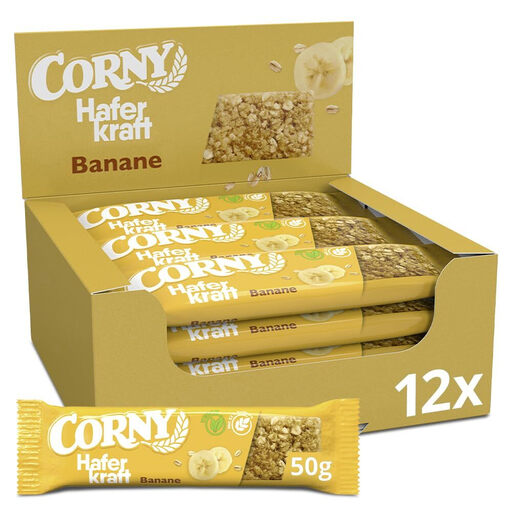
Corny Haferkraft Banana oat bars 12 × 50 g
For a stock of individually portioned bars, the product name lists twelve bars weighing 50 g each.
Compare the sugar and energy in the Banana variety per 50-g bar with your planned snack portion, and check the ingredients on the current pack.
View at Joybuy
Frequently asked questions
Does a cereal bar with no added sugar also mean it’s unsweetened or calorie-free?
No. Lebensmittelklarheit explains that products labelled ‘no added sugar’ may still contain sweeteners or sugar substitutes. The nutritional information shows how much sugar and energy a particular bar contains; the ingredients list helps you identify the sweeteners used.
Should I compare sugar or calories per bar in multipacks?
Compare both for the portion you actually plan to eat. Sugar alone doesn’t tell you the total energy in a cereal bar; to work out the figures for your portion, you’ll need to apply the per-100-g information to the weight of the bar.
How do I check allergens across different cereal bar varieties?
For each variety, read the ingredients list, highlighted allergens and any ‘may contain’ warnings on the current pack. For example, the varieties described by EDEKA include peanuts, milk and cereals containing gluten; don’t assume these details apply to other varieties without checking.
Which nutritional information should I rely on if the online details differ from the pack?
Check the information on the specific pack before buying. ALDI SÜD notes that details for its peanut cereal bar may vary between suppliers, so the information shown online may differ from what’s on the pack.


