Families planning portions
If you’re packing a bar for a day out during the holidays, you’ll want to know how many kcal are in that individual bar. As well as the calorie content per 100 g, you’ll need to check the bar’s weight.


When choosing a cereal bar for a holiday lunch with calories in mind, start with the energy in the bar you’re actually packing. To work this out, consider the calorie content per 100 g alongside the weight of the individual bar. Sugar, ingredients and allergens are separate factors to check; a small bar or a ‘light’ label won’t answer those questions.
If you’re packing a bar for a day out during the holidays, you’ll want to know how many kcal are in that individual bar. As well as the calorie content per 100 g, you’ll need to check the bar’s weight.
If sugar matters as well as energy, check the ‘of which sugars’ figure in the nutritional information. You can’t work this out from a ‘light’ label or the portion size.
If certain ingredients need to be avoided, the information on the specific pack will determine whether a bar is suitable. Check this before comparing the kcal.
When choosing a cereal bar for a holiday lunch, first work out the energy in each bar you’ll be packing, then check sugar and ingredients separately. If allergens are a concern, checking the packaging takes priority over comparing kcal.
| What to check | What to look for | Who it matters to |
|---|---|---|
| Energy per bar | Check the calorie content per 100 g and the weight of an individual bar, then calculate the kcal per bar. | If I’m packing a bar for a holiday lunch, I want to know how much energy is in that actual portion. For around 50% of shoppers, this is the main priority. |
| Sugar | Check the ‘of which sugars’ figure per 100 g. If the bars are different weights, also compare the figures per portion. | If I want my snack to meet my requirements for sugar too, the kcal figure alone isn’t enough; around 30% of shoppers prioritise the sugar content. |
| Ingredients and allergens | Check the current ingredients list, highlighted allergens and any ‘may contain’ information on the pack. | Before putting a bar in the lunchbox, I need to know whether its ingredients are suitable for my child. For around 20% of shoppers, this check comes first. |
The product name doesn’t tell you how much energy is in the portion you’re packing. For example, the GOLDEN BRIDGE Schoko light listed by ALDI SÜD contains 369 kcal per 100 g.
Check the calorie content in the nutritional information alongside the bar’s weight, rather than relying on the name to tell you the kcal per bar.
Sugar and energy are different measurements. A 50 g bar can also contain more energy per bar than a 25 g bar, even if its kcal per 100 g are lower.
Calculate the kcal per bar you’ll be packing, and compare the sugar content separately.
If certain ingredients need to be avoided, a bar may not be suitable regardless of its portion size. The product examples listed by EDEKA and REWE specify the allergens they contain and any possible traces.
First check the current packaging for ingredients, allergens and ‘may contain’ information. Then compare the nutritional information of suitable bars.
For its bar example, ALDI SÜD notes that nutritional information may vary depending on the supplier. So when choosing and packing a bar, always check the pack you have.
Double-check the bar’s weight, ingredients and nutritional information on the pack you’ve bought.
The examples below show different portion sizes and product information. The features of one variety don’t necessarily apply to every bar from the same brand.
REWE stocks several CORNY cereal bar ranges, including Free and Haferkraft.
One example from ALDI SÜD is the Schoko light cereal bar, sold in a pack of eight 25 g bars.
One example from EDEKA is the Schoko-Banane cereal bar, sold in a pack of eight 25 g bars.
One example listed by REWE is the Seitenbacher Müsli Riegel, sold as a 50 g bar.
These CORNY bars come in different varieties, with pack sizes shown in the product names, so you can choose a snack for the holidays. To compare kcal per bar, check the actual weight of each bar and the nutritional information on the relevant pack.
 No image available
If you’re planning around a 50 g bar, as stated in the product name, check the nutritional information on the pack to work out the energy and sugar per bar before packing it.
If you need to check the ingredients, look at the allergen information on the pack.
 No image available
For a smaller portion listed as 20 g in the product name, compare the kcal in an individual bar with the calorie content per 100 g.
Check the sugar content separately, and look at the ingredients and allergen information on the pack if needed.
 No image available
When choosing a white chocolate variety with a 20 g portion listed in the product name, compare the energy per bar and sugar per 100 g separately.
If you need to avoid certain ingredients, check the information on the specific pack.
 No image available
For a snack with 23 g per bar listed in the product name, check the calorie content and bar weight on the pack before comparing kcal.
Check the sugar content, allergens and any possible traces separately.
 No image available
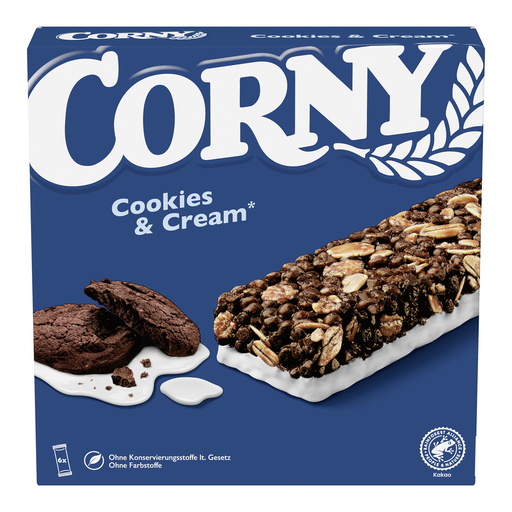
If you’re choosing a cocoa variety, check the actual weight of each bar on the pack before calculating the energy per bar. The product’s weight information varies.
Check the sugar content and any ‘may contain’ information on the specific pack too.
No. The name alone doesn’t tell you the calorie content. ALDI SÜD lists 369 kcal per 100 g for its GOLDEN BRIDGE Schoko light; to work out the amount in the portion you’re packing, you’ll also need to check the bar’s weight.
Both figures are useful for different reasons: kcal per 100 g let you compare energy density, while kcal per bar tell you how much energy is in the portion you’re packing. Based on ALDI SÜD’s figures, a 25 g bar with 369 kcal per 100 g contains around 92 kcal. REWE’s figures for a 50 g Seitenbacher bar with 381 kcal per 100 g work out at around 191 kcal.
Check the ingredients list, highlighted allergens and any ‘may contain’ information on the current pack. The Verbraucherzentrale explains why ingredients and allergen information matter on packaged foods. Which details are relevant for a child will depend on the ingredients they need to avoid.
Online information is useful for narrowing down your options, but before packing a bar, check its weight, nutritional information and ingredients on the pack you’ve bought. For its bar example, ALDI SÜD notes that nutritional information may vary depending on the supplier.