What should you look for when buying?
For a snack alongside your canteen meal, start by checking the fat content of the specific variety, then look at the ingredients and sweeteners, and finally choose a portion size that suits you.
| What to check | Buying check | Who is it important for? |
|---|
| Fat content |
Compare similar cereal bars by their fat content per 100 g and per bar, taking the weight of each bar into account. |
If you want to choose a snack based on its fat content, you need a comparison that doesn’t treat large and small bars as equal. For around 50% of consumers, fat content is the main consideration. |
| Sugar and ingredients |
Check ‘of which sugars’, the ingredients list, and any information about sweeteners and allergens on the specific pack. |
If I want a sweet variety with no added sugar, I want to know which sweeteners it contains and whether there are any ingredients I need to avoid. Around 30% of consumers pay closest attention to this information. |
| Portion and pack size |
Check the number of bars in the multipack and the weight of each individual bar. |
If I’m taking bars with me for several canteen days, each portion should suit the snack I have planned. Portion and pack size are the first selection criteria for around 20% of consumers. |
You can’t use figures for different types of bars as a straightforward comparison to prove a reduction in fat. REWE lists 9,4 g of fat per 100 g and 1,9 g per 20-g bar for CORNY Free Schoko. EDEKA gives 32 g of fat per 100 g for its organic sesame crispy bar. The sesame crispy bar is not a directly comparable type of cereal bar.
Brands and product ranges to help you choose
Brand names can help you find a variety, but when choosing a bar to go with your canteen lunch, its own nutritional information and ingredients are what matter.
CORNY
The Free range includes cereal bars with no added sugar. This description doesn’t mean they have a reduced fat content.
- REWE lists 9,4 g of fat per 100 g and 1,9 g per 20-g bar for CORNY Free Schoko.
- CORNY Free Schoko contains maltitol syrup. Check the ingredients and pack information separately for other flavours.
EDEKA Bio / GUT&GÜNSTIG
EDEKA sells different types of bars under these ranges, including an organic sesame crispy bar and a GUT&GÜNSTIG cereal bar with no added sugar.
- The different product descriptions make it easier to find the type of bar you’re looking for.
- According to EDEKA, its organic sesame crispy bar contains 32 g of fat per 100 g and includes sesame. Its nutritional figures don’t apply to other varieties.
GOLDEN BRIDGE / ALDI SÜD
ALDI SÜD lists GOLDEN BRIDGE cereal bars in various flavours, including packs of eight bars weighing 25 g each.
- The stated weight of each bar can help you plan your snack.
- A name such as ‘Schoko light’ alone doesn’t tell you the fat content. Check the nutritional information for the variety you choose.
Cereal bars on Joybuy
These CORNY Hafer cereal bars could work as individually portioned snacks for your canteen break. Before choosing a variety to meet your fat criteria, compare its specific pack size and nutritional information.
 No image available
CORNY Haferkraft Zero Peanut Butter Oat, 12 × 50 g
The stated weight of each bar makes this a good option if you’re planning a 50-g bar as a snack. To check whether it meets your fat criteria, look at the nutritional information on the specific pack. If you have a peanut allergy, pay particular attention to its ingredients and allergen information.
View on Joybuy
 No image available
CORNY Haferkraft Zero Cocoa cereal bar
If you’re planning this as a single-serve snack, check the weight of each Cocoa bar on the pack before buying: the information about bar size is inconsistent. You’ll need the actual weight to work out the fat content per bar from the nutritional information. Also check the ingredients and any information about sweeteners.
View on Joybuy
 No image available
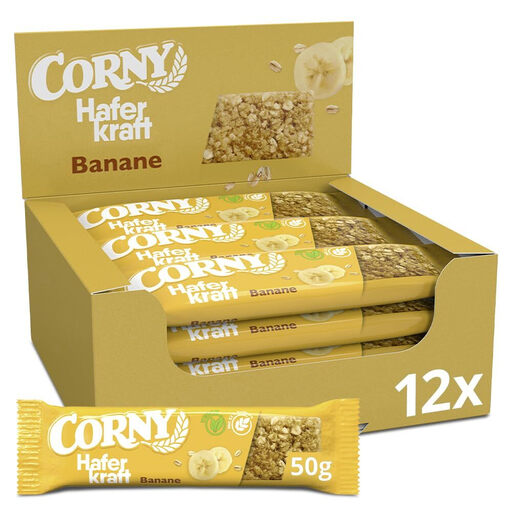
CORNY Haferkraft Banana Oat, 12 × 50 g
At 50 g per bar, you can easily plan a portion for a break alongside your canteen meal. The nutritional information for this variety is the only way to tell whether it meets your fat criteria. Check the pack’s allergen information too, if needed.
View on Joybuy
Questions about your canteen break
Does ‘Schoko light’ mean the bar has less fat?
No. The variety name alone doesn’t tell you how much fat it contains. Compare the fat per 100 g with that of a similar bar, and also take the weight of each portion into account.
Is a cereal bar with no added sugar also low in fat?
Not necessarily. ‘No added sugar’ doesn’t answer the question of how much fat a bar contains. For example, REWE lists 9,4 g of fat per 100 g for CORNY Free Schoko. The nutritional information for each variety is what matters when you’re choosing.
How do I check allergens in a bar for my canteen break?
Read the ingredients list, highlighted allergens and any may-contain information on the specific pack. EDEKA lists sesame and possible traces of peanuts and tree nuts for its organic sesame crispy bar; other bars have their own allergen information.
Can I have a cereal bar instead of my canteen lunch?
Pack size alone isn’t enough to tell you whether a cereal bar can replace lunch. If you’re choosing it as an additional snack, check the actual portion size, its nutritional information and the ingredients.


