Shoppers keeping an eye on fat
If you’re looking for a bar with a lower stated fat value for an after-school snack, compare similar cereal bars per 100 g and then per bar. Fat alone doesn’t tell you how much sugar or energy a bar contains.


For an after-school cereal bar, a lower fat value is only a useful way to choose if you compare similar bars on the same basis. As well as fat and saturates, check sugar, energy and the weight of each bar. If you have allergies or need to eat gluten-free, the labelling on the specific pack takes priority.
If you’re looking for a bar with a lower stated fat value for an after-school snack, compare similar cereal bars per 100 g and then per bar. Fat alone doesn’t tell you how much sugar or energy a bar contains.
If gluten, peanuts, milk or other allergens are a concern in your household, check the ingredients list, highlighted allergens and any ‘may contain’ warnings on the specific pack before buying.
For a bar to pop in a school bag, the weight of each portion and the packaging matter. A handy portion size doesn’t make it any less important to compare the nutrition information per bar.
First compare the fat values of similar cereal bars per 100 g, then consider what the individual bar and its other nutrition information mean for your choice.
| What to check | What to look for when buying | Who it matters to |
|---|---|---|
| Fat content | Compare fat and saturates per 100 g for similar cereal bars, then consider the individual portion. | If a lower stated fat value is my main concern, I want to compare like-for-like bars rather than just the claims on the packaging. Around 36% of shoppers prioritise this comparison. |
| Sugar and energy | Check sugar and energy per 100 g and per bar, including on products labelled ‘light’ or ‘no added sugar’. | I want a bar that suits my preferences for portion size and nutrition after school, not just one with less fat. Around 29% of shoppers prioritise this broader comparison. |
| Gluten and allergens | Check the ingredients list, allergen labelling and any ‘may contain’ warnings on the pack. If you need to eat gluten-free, look for a clear gluten-free label. | If certain ingredients need to be avoided for my child, suitability determines what I choose. This is the top priority for around 21% of shoppers. |
| Individual portion | Check the weight in grams of each bar and the number of bars in the pack against the nutrition information. | For a school bag, I’m looking for a portion size I can assess when I shop. For around 14% of shoppers, portion size is their main concern. |
A label may highlight just one aspect of a product. The Verbraucherzentrale advises shoppers to read nutrition information critically, particularly on light products.
Compare fat, saturates, sugar and energy per 100 g, then take the size of each bar into account.
The GUT&GÜNSTIG peanut cereal bar listed by EDEKA contains 24.7 g of fat per 100 g. That figure applies to this specific variety, not to every bar containing peanuts.
Compare the nutrition information for the varieties you’re actually considering, and check their allergen information if needed.
ALDI SÜD notes that nutrition information for its listed cereal bars may vary depending on the supplier.
Before eating, check the ingredients, allergens and nutrition information on the pack you’ve bought — especially if an ingredient needs to be avoided.
REWE lists several CORNY cereal bar ranges, including Free, Haferkraft and chocolate varieties.
ALDI SÜD lists its Müsliriegel Schoko light as a pack of eight 25 g bars.
EDEKA lists a peanut cereal bar under this brand, in a pack of eight 25 g bars.
REWE lists both a Seitenbacher cereal bar and an Extra-Frucht bar labelled gluten-free.
These CORNY bars are worth considering when comparing cereal bars as an after-school snack. Check the nutrition information on the pack for each variety: a product name or a single figure isn’t enough to assess fat, sugar and portion size together.
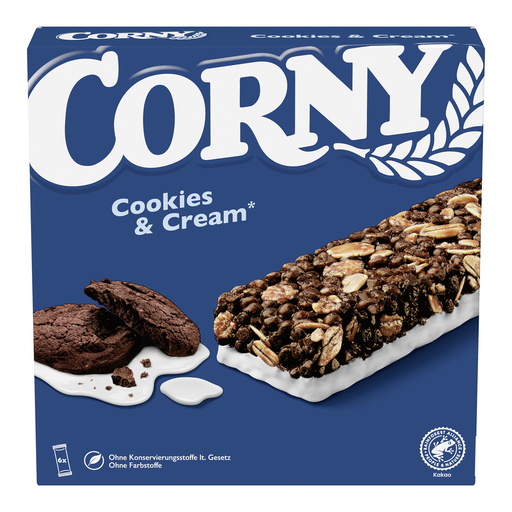 No image available
The stated weight of each bar is useful if you’re portioning a snack for a school bag.
Pack size: 6 × 23 g. Compare the nutrition information and, if needed, check the ingredients and allergens on the specific pack.
 No image available
This variety is worth considering if you want to compare smaller individual bars with other cereal bars.
Pack size: 6 × 20 g. The variety name is no substitute for comparing fat, sugar and energy; check the allergen labelling too.
 No image available
This chocolate variety can be compared with others if you’re looking at smaller cereal bar portions.
Pack size: 6 × 20 g. Assess fat and sugar using the nutrition information, and check the ingredients on the pack you buy.
 No image available
If you’re considering an oat and cocoa bar as a snack, compare its nutrition information with that of other cereal bars.
Check the actual weight of each bar on the pack before comparing nutrition information per portion. Also check the ingredients, allergens and storage instructions there.
No, the label alone won’t tell you that. The Verbraucherzentrale recommends checking nutrition information critically on light products. Compare the fat content of similar bars and take sugar, energy and portion size into account too.
Check the ingredients list and highlighted allergen information on the specific pack. The European Commission describes how relevant allergens are highlighted on pre-packed foods; also check any product-specific ‘may contain’ warnings.
No, a bar containing gluten isn’t suitable for someone who needs to eat gluten-free. Choose only a variety specifically labelled gluten-free, and check its other ingredients and allergens too.
No, fat content alone isn’t a measure of a child’s overall diet. The Verbraucherzentrale describes fat as part of the diet. When choosing a cereal bar, you can compare fat, sugar, energy and portion size together.