People who prioritise fat content
You want a small, sweet bar to enjoy with your morning coffee, so you’re comparing both the fat per 100 g and the amount in the portion you plan to have.


If you’re looking for a cereal bar with as little fat as possible to enjoy with your morning coffee, start by comparing the fat content per 100 g, then check the amount per bar. ‘Light’ and ‘no added sugar’ don’t answer that question. A limited selection of retailer products lists 7.6 g of fat per 100 g for REWE’s ja! Schoko ohne Zuckerzusatz and 9.4 g for Corny Free Schoko, 10 g for ALDI SÜD’s Golden Bridge Schoko light, and 13.9 g for EDEKA’s GUT&GÜNSTIG Schoko. Sugar, sweeteners, ingredients and allergens are separate factors to consider.
You want a small, sweet bar to enjoy with your morning coffee, so you’re comparing both the fat per 100 g and the amount in the portion you plan to have.
You’re interested in ‘no added sugar’ or ‘light’ options, but want to assess the fat content separately and check the ingredients too.
You’re looking for a bar to enjoy during your break, but need to check the ingredients, highlighted allergens and possible traces on the specific pack.
When comparing similar cereal bars, start with the fat content per 100 g. Then check the size of the bar you plan to have and any other details that matter to you.
| Buying criterion | What to check | Who it matters to |
|---|---|---|
| Fat content | Compare the ‘fat’ content per 100 g of similar bars, then check the amount in the portion you plan to have. | If I’m specifically looking for a lower-fat bar, I don’t want to rely on the word ‘light’ alone. Around 42% of consumers prioritise fat content when making this choice. |
| Sugar and sweeteners | Check ‘of which sugars’ per 100 g and the ingredients list; look out for the polyols figure if provided. | When choosing a sweet snack for my break, what matters most is what’s behind the ‘no added sugar’ label. Around 25% of consumers prioritise checking sugar and sweeteners. |
| Portion size | Check the weight of each bar and the nutritional values per portion, if provided. | I plan to have exactly one bar with my coffee and want to know how much that actually is. Portion size comes first for around 17% of consumers. |
| Ingredients and allergens | Check the ingredients list, highlighted allergens and precautionary allergen statements on the pack. | If I need to avoid certain ingredients, the labelling determines whether the bar is suitable for me. Around 16% of consumers prioritise this check when choosing. |
ALDI SÜD lists 10 g of fat per 100 g for Golden Bridge Schoko light. The name alone doesn’t tell you how the bar compares with other varieties.
Compare the fat content per 100 g with a similar cereal bar, then check the portion size.
Bars with this label still contain fat. REWE also lists 42 g of polyols per 100 g for Corny Free Schoko and 32 g for ja! Schoko ohne Zuckerzusatz.
Check fat and sugar separately in the nutritional information, and look at the ingredients list for these varieties too.
The organic sesame bar listed by EDEKA contains 53% sesame and has 32 g of fat per 100 g. So the product category alone isn’t a substitute for checking the nutritional information.
If fat content is your main priority, compare seed and cereal bars using the same serving basis.
EDEKA’s GUT&GÜNSTIG chocolate cereal bar lists cereals containing gluten, milk and peanuts, among other ingredients, as well as possible traces of other allergens.
When buying, check the ingredients, highlighted allergens and precautionary allergen statements on the actual pack.
The examples below relate to specific cereal bars, not a brand’s entire range. When comparing products, use the information for the specific variety.
Corny offers Free varieties, among others; REWE stocks Corny Free Schoko as a 20-g bar.
REWE’s own-brand range offers a chocolate cereal bar with no added sugar in an 8-pack, with each bar weighing 25 g.
EDEKA stocks a chocolate cereal bar from this own-brand range in an 8-pack.
ALDI SÜD sells a cereal bar called Schoko light in its own-brand range, among other products.
These Corny cereal bars come in different varieties and pack sizes, for a coffee break or a snack on the go. If you’re choosing by fat content, the nutritional information on the specific pack is what matters; similar product names don’t mean two varieties are the same.
 No image available
This peanut butter oat variety could be a good option if you’re looking for a bar to enjoy with your coffee and the larger bar size suits the portion you have in mind.
The product name specifies twelve bars, each weighing 50 g. Check the fat content per 100 g on the pack, and look at the ingredients and allergen information if needed.
 No image available
The Cocoa variety is an option if you’re looking for this type of cereal bar for your break and want to compare fat and sugar using the information on the pack.
The bar size details differ: the product name states 4 × 35 g, while the description says 50 g per bar. Before buying, check the pack size and the nutritional values per portion on the specific pack.
 No image available
This White Chocolate variety could suit you if you’re looking for a small individual portion to have with your coffee, provided the ingredients are right for you.
The product name specifies six bars, each weighing 20 g. Assess the fat content using the nutritional information, not the words ‘No Added Sugar’ in the name.
 No image available
According to the product name, the Chocolate variety offers a 20 g portion for a short coffee break.
The pack contains six bars. If you’re choosing based on fat content, compare the nutritional information separately from the ‘No Added Sugar’ claim and check the ingredients list.
 No image available
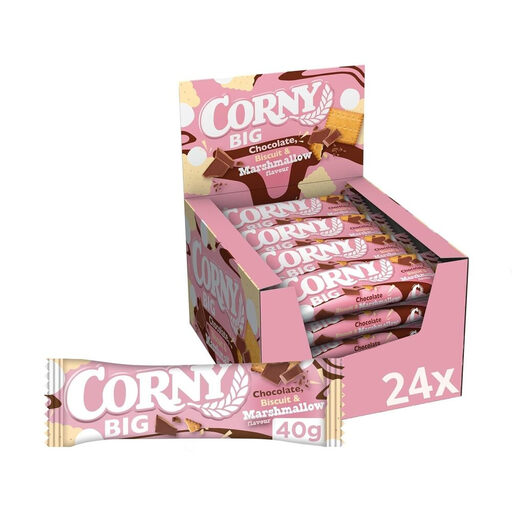
This Marshmallow variety may be a better fit if you’re planning to have a bar weighing 40 g, according to the product name.
The product name specifies 24 bars. Before choosing, check both fat and sugar per 100 g, and allow for the larger bar size when comparing it with 20-g bars.
No. The word ‘light’ alone doesn’t tell you how the fat content compares with other cereal bars. ALDI SÜD lists 10 g of fat per 100 g for Golden Bridge Schoko light; compare the nutritional information for similar varieties using the same serving basis.
No, the label doesn’t tell you about the fat content. REWE lists 9.4 g of fat per 100 g for Corny Free Schoko and 7.6 g for ja! Schoko ohne Zuckerzusatz. So check sugar and fat separately.
Use both figures for different reasons: fat per 100 g lets you compare bars of different sizes, while the amount per bar helps you work out how it fits your planned portion. Start by checking the actual bar weight on the pack.
Check the ingredients list, highlighted allergens and precautionary allergen statements on the specific pack. For example, EDEKA’s GUT&GÜNSTIG chocolate cereal bar lists cereals containing gluten, milk and peanuts, as well as possible traces of other allergens.