If you’re looking for a cereal bar with as little fat as possible to take to the Christmas market, start by comparing the nutrition information per 100 g rather than relying on terms such as ‘light’ or ‘no added sugar’. Under EU rules, solid foods can only be labelled ‘low fat’ if they contain no more than 3 g of fat per 100 g. Also check the ingredients, allergens and actual serving size.
Who should compare these products?
Shoppers choosing by fat content
You want to take a bar with you when you’re out and about, and the fat content is your main consideration. The figure per 100 g is more useful than the packaging design, while EU rules on the ‘low fat’ claim provide an additional benchmark.
Shoppers keeping an eye on sugar
You check the sugar content or are looking for a no-added-sugar option. Check the fat content separately: the two figures answer different questions.
Shoppers with specific ingredient requirements
You’re buying for yourself or someone else and need to avoid certain ingredients. Before heading to the market, check the ingredients list, highlighted allergens and any ‘may contain’ warnings on the specific pack.
What should you look for when buying?
To meet your fat target, first compare bars on the same 100 g basis. Then check the sugar content and ingredients to see whether the specific option meets your other requirements too.
| What to check |
How to assess it |
Who it matters most to |
| Fat content |
Compare the fat per 100 g. For solid foods, EU rules require a maximum of 3 g of fat per 100 g to make a ‘low fat’ claim. |
If I want to choose a low-fat bar to eat on the go, I need to compare bars of different sizes on the same basis. Around 50% of consumers would consider fat content their most important buying criterion. |
| Sugars and sweeteners |
Check ‘of which sugars’ per 100 g and the ingredients list; assess the fat content separately. |
When choosing a sweet snack, I mainly want to know how much sugar it contains and which ingredients are used to sweeten it. This would be the top priority for around 30% of consumers. |
| Ingredients and allergens |
Check the ingredients, highlighted allergens and any ‘may contain’ warnings on the pack you choose. |
If I’m taking a bar for someone who needs to avoid certain ingredients, the specific pack must meet their requirements. This check would take priority for around 20% of consumers. |
Common comparison mistakes
-
Assuming ‘light’ means ‘low fat’
ALDI SÜD lists 9.4 g of fat per 100 g for CORNY Schoko light. That’s above the EU limit of no more than 3 g per 100 g for a ‘low fat’ claim on solid foods.
Use the wording as a prompt to check the label, not as a substitute for the nutrition information.
-
Assuming ‘no added sugar’ means lower fat
According to the nutrition information listed by REWE, ja! Müsli-Riegel Schoko ohne Zuckerzusatz contains 7.6 g of fat per 100 g. The claim about added sugar doesn’t tell you anything about the fat content.
Compare sugar and fat per 100 g separately, and check the ingredients list if sweeteners are relevant to your choice.
-
Assuming a protein or nut bar is automatically lower in fat
EDEKA24 lists 27 g of protein and 28 g of fat per 100 g for CORNY Nuts & Protein Schoko. A high protein figure alone doesn’t mean the bar is low in fat.
Make your decision based on each nutrition figure, and check the allergen information if needed.
-
Leaving allergen checks until you’re out and about
Ingredients and ‘may contain’ warnings vary between bars and flavours. A brand name alone won’t tell you whether a specific pack is suitable for someone with allergies.
Check the labelling on the pack you’re actually taking with you before heading to the market.
Brands to compare
CORNY
The cereal bar range includes different recipes, including chocolate, nut and protein options.
- If you’re comparing different CORNY options, you can look at the nutrition information and ingredients for each one individually.
- EDEKA24 lists 17.6 g of fat per 100 g for CORNY Schoko and 28 g for CORNY Nuts & Protein Schoko. You can’t assume a single fat content across the brand.
ja!
REWE’s own-brand range includes a chocolate cereal bar labelled ‘no added sugar’.
- REWE lists 1.4 g of sugar per 100 g for this option, giving you a specific figure to compare if you’re checking sugar content.
- REWE also lists 7.6 g of fat per 100 g. This option therefore doesn’t meet the EU limit for a ‘low fat’ claim on solid foods.
Alnatura
The organic Maple & Date cereal bar is an option for shoppers comparing the ingredients and nutrition of a bar without chocolate.
- EDEKA24 lists 9.7 g of fat and 23 g of sugar per 100 g for the Maple & Date bar.
- Being ‘organic’ and made without chocolate doesn’t, by itself, mean a bar is low in fat.
Cereal bars at Joybuy
These two CORNY options are individually wrapped bars that you could take with you when you’re out and about. If you’re specifically looking for a low-fat cereal bar, check the fat per 100 g for each option on the current packaging; this product selection doesn’t mean they’re classed as ‘low fat’.
 No image available
CORNY Haferkraft Zero Cocoa, 4 × 35 g
If you’d like to take an oat cereal bar to the Christmas market, compare the fat per 100 g before buying and check the actual bar size on the pack.
View at Joybuy
 No image available
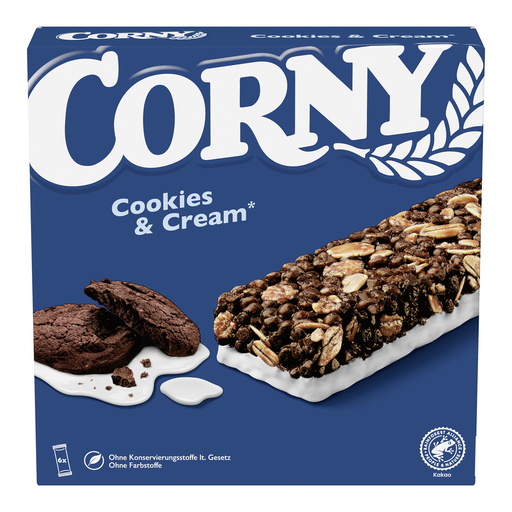
CORNY Cookies & Cream Cereal Sandwich Bars, 6 × 23 g
If you’re looking for a portioned cereal bar with a cookies-and-cream flavour to take with you, the product name gives you six bars of 23 g each to compare. For your fat target, the figure per 100 g on the pack is still what matters.
View at Joybuy
Frequently asked questions
How can I tell whether a cereal bar is low in fat?
Compare the fat per 100 g: under EU rules, solid foods can only be labelled ‘low fat’ if they contain no more than 3 g of fat per 100 g. A small serving on its own doesn’t make a bar low in fat.
Is a ‘light’ cereal bar automatically low in fat?
No. The word alone doesn’t prove that the fat content is below the limit for ‘low fat’. ALDI SÜD lists 9.4 g of fat per 100 g for CORNY Schoko light, so always check the nutrition information for the specific option.
Does a cereal bar with no added sugar also contain less fat?
The claim about added sugar doesn’t tell you that. REWE lists 1.4 g of sugar and 7.6 g of fat per 100 g for ja! Müsli-Riegel Schoko ohne Zuckerzusatz; compare the two figures separately.
Which allergen details should I check before going to the Christmas market?
Check the ingredients list, highlighted allergens and any ‘may contain’ warnings on the pack you choose. Depending on the bar, information about milk, peanuts, tree nuts, soya or cereals containing gluten may be important to your choice.


