What should you look for when buying?
Before you shop, find out which ingredients and possible traces matter to each guest. Then choose suitable varieties and keep them clearly matched with their packaging when you serve them.
| Requirement |
What to check when buying |
Who it matters most to |
| Known allergies |
Current ingredients list, with allergens highlighted, and relevant may-contain warnings. |
If a guest needs to avoid peanuts, sesame or another allergen, I wouldn’t offer a bar based on a general free-from claim alone. For around 33 % of consumers, checking allergens that must be strictly avoided is the top priority. |
| Gluten-free options |
A gluten-free claim on the specific pack; check for other allergens separately. |
If someone follows a gluten-free diet, I need confirmation that the product is suitable for them; I can’t rely on a product name that simply doesn’t mention wheat. Being gluten-free is the main buying consideration for around 27 % of consumers. |
| Vegan or lactose-related requirements |
A vegan suitability claim or ingredients containing milk, depending on what the individual needs to avoid. |
If a guest avoids animal-derived ingredients or lactose, I don’t want to confuse the two requirements. Around 20 % of consumers prioritise one of these requirements when buying. |
| Sharing with a group |
Several suitable varieties and a clear match between bars and their packaging. |
When guests at the table have different preferences, I want to avoid anyone mistaking one bar for another variety. A clear selection for the group is the priority for around 20 % of consumers. |
Brands to help guide your choice
These examples show why a brand name alone doesn’t tell you whether all its bars are suitable. The specific variety is what matters.
EDEKA Bio
EDEKA Bio Knusperriegel Sesam is sold in a pack of 3 × 25 g.
- EDEKA describes this variety as gluten-free and lactose-free.
- Sesame is an ingredient; the pack also warns of possible traces of peanuts and tree nuts. Check the packaging again when buying.
GUT&GÜNSTIG
EDEKA lists its Müsliriegel Schoko as a pack of 8 × 25 g.
- According to EDEKA, the bars are individually wrapped, making it easier to keep track of them at the table.
- For this chocolate variety, EDEKA lists milk, oats, wheat, barley and peanuts, along with possible traces of soya, sesame and tree nuts.
CORNY
ALDI SÜD stocks several CORNY cereal bar varieties, including Schoko-Banane and Schoko.
- Choose between the varieties according to their flavour and the information on the specific pack.
- The brand name or range overview doesn’t mean that every variety carries the same gluten-free, vegan or allergen claim.
GOLDEN BRIDGE
ALDI SÜD’s own-brand range includes cereal, oat and nut bars, among other products.
- ALDI SÜD also stocks some GOLDEN BRIDGE varieties described as vegan.
- A claim for one variety doesn’t apply to the whole range. For one peanut cereal bar variety, ALDI SÜD also notes that it uses different suppliers.
ALDI SPORTS
The Lower Carb Protein Riegel Kokos-Mandel is a protein bar, not a one-size-fits-all alternative to cereal bars for people avoiding allergens.
- ALDI SÜD describes this specific variety as gluten-free.
- ALDI SÜD warns of possible traces of egg, peanuts, hazelnuts, cashews, lupin and wheat, and notes that excessive consumption may have a laxative effect.
Cereal and oat bars at Joybuy
These three varieties are worth considering if you’re looking for bars described as vegan. If guests need to avoid gluten or specific allergens, check each variety against its current packaging too.
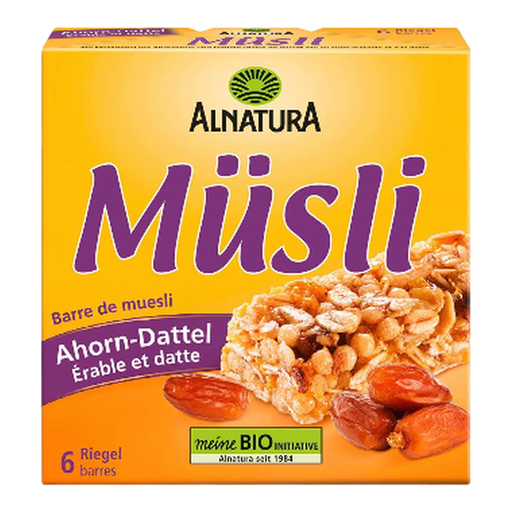 Image unavailable
Alnatura Organic Maple & Date Müsliriegel, 6 × 25 g
For a group with vegan preferences, this variety, described as vegan, is one option. The six individually wrapped bars are easy to serve separately.
The product information lists oats and wheat as gluten-containing cereals, and warns of possible traces of soya, milk and tree nuts. Check these details against your guests’ requirements and the current packaging.
View at Joybuy
 Image unavailable
Corny Haferkraft Zero Cocoa Müsliriegel
If you’re looking for an oat bar described as vegan, this variety is worth checking. The product information lists oats as a gluten-containing cereal, and also warns of possible traces of nuts, peanuts and milk.
Check the pack for this information, as well as the quantity and number of portions, before buying bars for several guests.
View at Joybuy
 Image unavailable
Alnatura Organic Blueberry Oat Flapjack Bar, 60 g
This oat bar, described as vegan, may be an option for guests avoiding animal-derived ingredients. The product information lists oats as a gluten-containing cereal and warns of possible traces of egg, milk, sesame, soya and nuts.
For guests with these requirements, the current packaging is what matters; the vegan description alone doesn’t answer these questions.
View at Joybuy
Frequently asked questions
Is a gluten-free cereal bar suitable for all guests with allergies?
No. A gluten-free claim doesn’t tell you whether a bar contains sesame, milk, peanuts or tree nuts, for example, or carries warnings about possible traces of these allergens. Check this information separately for each guest concerned.
Where can I find the allergens in a packaged cereal bar?
Read the ingredients list and any other allergen information on the current pack. According to the Federal Ministry of Agriculture, Food and Regional Identity, intentionally used ingredients from the 14 allergen groups that must be declared have to be listed; possible traces are a separate matter.
What does ‘may contain traces of peanuts’ mean when choosing a bar?
This warning relates to possible accidental contact; it doesn’t mean peanuts were intentionally used as an ingredient. Whether the bar is suitable for a particular guest depends on how they manage warnings like this. If you’re unsure of their requirements, don’t describe it as peanut-free.
Is a vegan bar automatically suitable for guests avoiding milk or nuts?
No. A vegan description doesn’t replace checking the specific ingredients and any may-contain warnings. In particular, find out whether the guest is avoiding animal-derived ingredients, lactose or a specific allergen.
Is the online product description enough when shopping?
Check the current packaging before choosing a specific bar. EDEKA warns on its product pages that online information may differ from the packaging. This is especially important if a guest needs to strictly avoid an ingredient.


