For anyone keeping an eye on fat
If you mainly want to keep track of the fat in a snack, you’ll need two figures: fat per 100 g to compare different bars, and fat per portion for the amount you’ll actually eat.


When choosing cereal bars for a low-fat diet, first compare the fat content per 100 g, then check the fat and energy in the portion you actually plan to eat. “No added sugar” or a lower calorie count does not, by itself, mean a bar is low in fat. You should also check the ingredients and allergens for the specific variety.
If you mainly want to keep track of the fat in a snack, you’ll need two figures: fat per 100 g to compare different bars, and fat per portion for the amount you’ll actually eat.
If you’re picking up a bar to eat on the go, you’ll want to know how much an individual bar weighs and how much energy the portion you actually eat contains.
If you need to avoid certain ingredients or allergens, check the label on the specific variety. You can’t assume that the information for another bar from the same brand also applies.
Start by comparing the nutritional information per 100 g, so differences in bar size don’t skew your choice. Then check the weight per bar and the labelling of the variety you want to buy.
| What to check | Buying checklist | Who should pay particular attention? |
|---|---|---|
| Fat content | Compare the fat per 100 g in specific varieties, then take the amount per bar into account. | If I mainly want to limit the fat in my snack, information about sugar or calories alone isn’t enough. Around 50% of consumers prioritise fat content when choosing what to buy. |
| Energy and portion size | Check the grams per individual bar, as well as the energy per 100 g and in the portion you eat. | When I’m out and about, I want to be able to work out how much I’ll eat in one bar. Around 30% of consumers put a clearly defined portion size first. |
| Ingredients and allergens | Read the ingredients list and allergen information on the specific pack. | If I need to avoid an ingredient, the labelling for that variety determines what I choose. Around 20% of consumers prioritise checking ingredients and allergens. |
According to EDEKA, GUT&GÜNSTIG’s chocolate cereal bar with no added sugar contains 9.1 g of fat per 100 g. Under Regulation (EC) No 1924/2006, published on EUR-Lex, the claim “low fat” can only be used for solid foods containing no more than 3 g of fat per 100 g.
Check the fat content separately from the no-added-sugar claim, then factor in calories and portion size.
ALDI SÜD lists 24.7 g of fat per 100 g for its GOLDEN BRIDGE peanut cereal bar. The size of an individual bar doesn’t tell you how much fat it contains per 100 g.
Even with small bars, compare the per-100 g figure first, then take the portion weight into account.
EDEKA warns that product information may differ from what’s shown on the pack. ALDI SÜD lists several possible suppliers for its peanut bar, so the nutritional information may vary.
Before buying, read the nutritional information, ingredients and allergen details on the specific pack.
REWE lists several varieties, including Corny Free Chocolate and Corny Haferkraft Cocoa.
EDEKA provides product information for a chocolate cereal bar and a chocolate cereal bar with no added sugar.
ALDI SÜD sells several products under the GOLDEN BRIDGE name, including cereal bars and oat bars. These are different product varieties.
Here, REWE is a retailer offering different cereal bars, rather than a cereal bar brand in its own right.
These two Corny multipacks are useful for comparing the stated size of individual bars. To decide whether a variety suits your preferences for fat and energy, check the nutritional information on its specific pack.
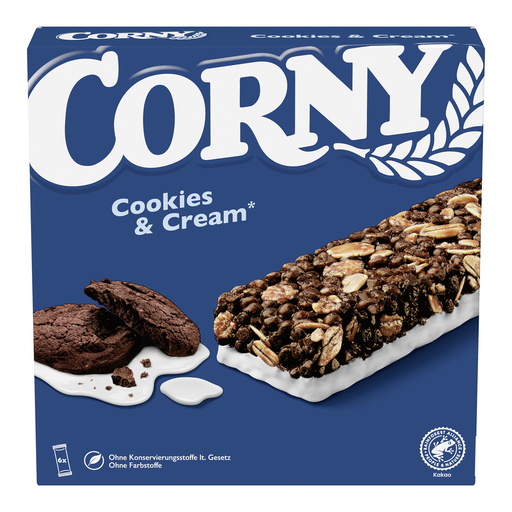 No image available
If you want to compare the amount in an individual snack, the pack size of 6 × 23 g gives you a starting point. To assess fat and energy, check the nutritional information on the specific pack.
 No image available
If knowing the size of each individual bar matters to you, the pack size of 6 × 20 g helps you work out the portion. The product name doesn’t replace checking the fat, energy and ingredients on the specific pack.
Under Regulation (EC) No 1924/2006, published on EUR-Lex, solid foods must contain no more than 3 g of fat per 100 g to be labelled “low fat”. A claim about added sugar or calorie content doesn’t prove that a product meets this requirement.
No, this claim doesn’t tell you how much fat a bar contains. EDEKA lists 9.1 g of fat per 100 g for the GUT&GÜNSTIG chocolate cereal bar with no added sugar. For other varieties, always check their own nutritional information.
The figure per 100 g lets you compare cereal bars of different sizes. The weight of the bar then shows you how much fat is in the portion you’ll actually eat.
If you need to avoid certain substances, check the allergen information for the exact variety you want to buy. EDEKA lists possible traces of tree nuts, sesame and soya in its chocolate cereal bar; for any other variety, check the labelling on its own pack.
Not necessarily: it depends on the fat content of the specific product. ALDI SÜD lists 24.7 g of fat per 100 g for its GOLDEN BRIDGE peanut cereal bar. If low fat is your priority, compare this figure with those for other specific varieties.