What should you look for when buying?
Start with your main priority: should the bar contain less fat, provide a targeted source of protein, or work as a snack within your planned carbohydrate intake? Then compare the nutritional information per 100 g and check how much of that is in each bar.
| Criteria |
What to check when buying |
Who it matters to |
| Fat content |
Compare fat and saturated fat per 100 g and per bar. If the label says “reduced”, also check which product it is being compared with. |
After a workout, I want to choose a snack whose fat content suits the portion I plan to eat. For around 40% of consumers, fat content is the top priority. |
| Protein |
Compare protein and fat using the same reference amount, and take the size of each bar into account. |
I want to plan the bar into my other meals rather than be guided by the word “protein” alone. Around 30% of consumers cite protein as their main reason for buying. |
| Ingredients and tolerance |
Check “of which sugars”, polyols, ingredients, allergens and, where applicable, consumption advice. |
If a bar tastes sweet, I want to know what it contains and which information is relevant to me. For around 20% of consumers, these checks come first. |
| Pack and range |
Check the pack contents and individual bar size; if the range changes, read the details for the variety you’re actually choosing. |
If I want to include the same snack regularly in my routine, I need to be able to find that specific variety in my preferred range. Around 10% of consumers make this their main consideration. |
Cereal bars and snack bars on Joybuy
This selection includes Corny oat bars, Corny Free cereal bars and a cereal sandwich bar for a post-workout snack. If less fat is your main priority, check the nutritional information for each variety; the product name and pack size aren’t enough to compare fat content.
 No image available
Corny Haferkraft Zero Cocoa, 4 × 35 g
If you’re considering an oat bar as a post-workout snack, check the nutritional information and choose a portion size that works for you. The product title states 4 × 35 g; check the individual bar weight on the pack before comparing serving values.
View on Joybuy
 No image available
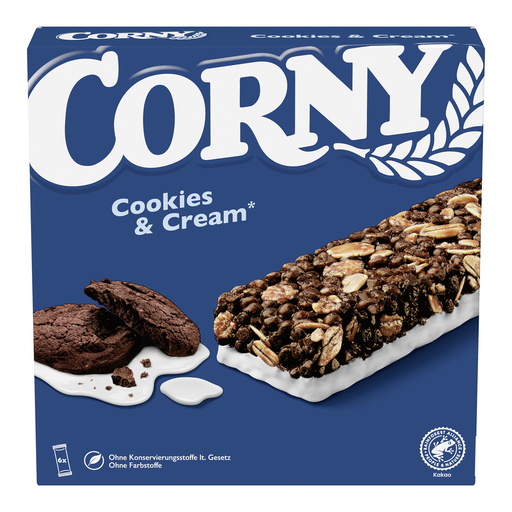
Corny Cookies & Cream cereal sandwich bar, 6 × 23 g
If you’re looking for individually portioned cereal sandwich bars, the product title gives you a pack size of 6 × 23 g. To compare fat content, check the nutritional table and pay attention to saturated fat too.
View on Joybuy
 No image available
Corny Haferkraft Zero Peanut Butter Oat, 12 × 50 g
If you’re planning a larger individual bar for your snack, the product title states 12 bars of 50 g each. As well as fat and saturated fat, check the ingredients list, especially if peanuts or sugar alcohols are relevant to you.
View on Joybuy
 No image available
Corny Free White Chocolate No Added Sugar, 6 × 20 g
If you’re looking for a cereal bar in smaller individual portions, the product title states 6 × 20 g. The “No Added Sugar” label is no substitute for comparing fat content or checking the ingredients, allergens and consumption advice.
View on Joybuy
 No image available
Corny Free Chocolate No Added Sugar, 6 × 20 g
If you’re planning a chocolate cereal bar as an individual snack, the product title states 6 bars of 20 g each. Compare fat and saturated fat per 100 g, then check the information for one bar and read the ingredients list.
View on Joybuy
Frequently asked questions
Is a cereal bar with less fat automatically “low fat”?
No. “Less fat” can describe a comparison between two varieties, while “low fat” is a separate claim made about a food. When choosing, compare fat values per 100 g and per bar rather than treating the two phrases as equivalent.
Does “no added sugar” also mean less fat?
No. The claim says nothing about the amount of fat. Check the fat and sugar figures and the ingredients list for the specific variety; sugar alcohols may also be relevant to your choice.
Do I need a protein bar after a workout?
A protein bar isn’t necessary just because you’ve worked out. The consumer advice centre Verbraucherzentrale points out that athletes can also meet their protein needs with everyday foods that are high in protein. If you’re choosing a bar specifically for its protein content, compare the fat content and serving size too.
What role do carbohydrates play after endurance exercise?
According to the German Nutrition Society (Deutsche Gesellschaft für Ernährung), carbohydrates are important for providing energy during sport. The importance of a carbohydrate-containing snack after exercise depends, among other things, on the duration and intensity of the activity and the rest of your diet; a single cereal bar isn’t a substitute for a complete meal.
What should I check about ingredients and allergens?
Check the ingredients and allergen information for the exact variety you want to buy. For the Corny protein varieties described by EDEKA24, peanuts, soya, milk or wheat may be relevant, depending on the variety. A warning is also given for a peanut protein bar about a possible laxative effect if consumed in excess.


