Students comparing portion sizes
You’re looking for a small, sweet bar to pack in your school bag and want to know how many kcal are in the piece you’ll actually eat – not just the figure per 100 g on the pack.


For a calorie-conscious lunchbox, first check the kcal per individual cereal bar, then look at the ingredients and allergens. REWE lists 68 kcal per 20-g bar and 85 kcal per 25-g bar for two chocolate varieties with no added sugar. Whether a small bar is enough for a school-break snack also depends on how much breakfast you had and how hungry you are.
You’re looking for a small, sweet bar to pack in your school bag and want to know how many kcal are in the piece you’ll actually eat – not just the figure per 100 g on the pack.
If breakfast was light or lunch is still a while away, you’re more likely to plan the bar as part of your lunchbox rather than as the only thing in it.
The ingredients in the specific variety are what matter to you. The label ‘no added sugar’ doesn’t tell you whether a bar contains gluten-containing cereals, milk or peanuts.
When comparing cereal bars for a school break, start with the individual portion, then consider whether it fits with the rest of the lunchbox. If allergens are a concern, check the labelling for the specific variety.
| Criteria | What to check | Who it matters to |
|---|---|---|
| Kcal per bar | Compare the nutrition information per bar and the weight of each bar; ‘no added sugar’ doesn’t mean you can ignore the energy value. | If I’m packing just one bar, I want to know its kcal value. Around 50% of consumers prioritise comparing individual portions. |
| What’s in the lunchbox | Take breakfast, hunger and the time until lunch into account; fruit or vegetables can also be part of the lunchbox. | After a small breakfast, I don’t want to rely on a small bar alone. That’s why around 30% of consumers prioritise a lunchbox that can be topped up with other foods. |
| Ingredients and allergens | Read the ingredients and allergen information for the specific variety, especially for gluten-containing cereals, milk or peanuts. | If there are ingredients I can’t eat, I check the bar before comparing portions. Checking for allergens takes priority for around 20% of consumers. |
REWE lists 339 and 340 kcal per 100 g for CORNY Free Chocolate and the ja! chocolate cereal bar with no added sugar, respectively. European Union Regulation (EC) No 1924/2006 sets a maximum of 40 kcal per 100 g for the claim ‘low energy’ on solid foods.
To assess how much to pack for a school break, also check the kcal per bar and the weight of each bar.
A 20-g or 25-g bar is just one part of what you could eat during a break. The German Nutrition Society’s School + Food programme looks at breakfast and snacks together, and also recommends fruit and vegetables as between-meal snacks.
Use breakfast and how hungry you are to decide whether to add other foods and a drink to your lunchbox.
The chocolate varieties with no added sugar described by REWE and EDEKA contain gluten-containing cereals; some varieties also list milk or peanuts. Information about added sugar doesn’t replace these details.
Check the ingredients and allergen information on the pack for every variety you buy.
The brand offers a range of cereal bars. CORNY Free Chocolate is one option to consider if you’re looking for a small individual portion.
REWE’s own-brand range includes a chocolate cereal bar with no added sugar, sold in a pack of 25-g bars.
EDEKA’s own-brand range includes a chocolate cereal bar with no added sugar, which you can compare by ingredients and nutrition information.
ALDI SÜD sells various types of bars under this brand, including chocolate-light cereal bars in a pack of 8 × 25 g.
This CORNY selection includes bars weighing 20 g and 25 g, as well as a 50-g oat bar. Choose according to the portion size you want, and check the nutrition information on the specific pack to compare kcal per bar.
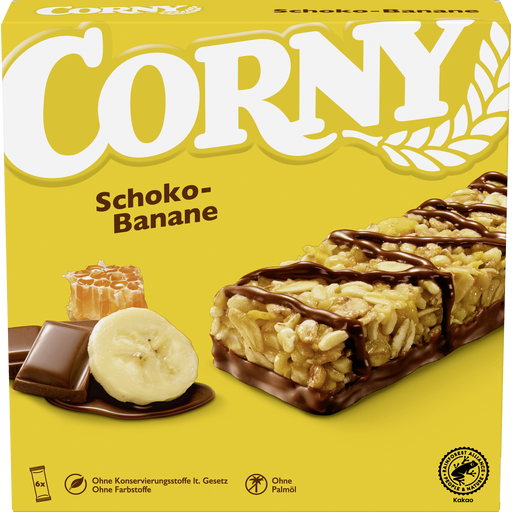 No image available
The 25-g individual portion can be included as part of a lunchbox. To compare it with other bars, check the kcal per bar and the ingredients and allergen information on the pack.
 No image available
The 20-g bars are a good option if you’re looking for a small individual portion. ‘No added sugar’ isn’t a kcal value: compare the nutrition information per bar and check the allergen information on the pack.
 No image available
Each of these oat bars weighs 50 g, making it a different portion choice from the 20-g and 25-g bars. To compare kcal, check the value per bar on the pack and read the ingredients and allergen information.
No. European Union Regulation (EC) No 1924/2006 sets a maximum of 40 kcal per 100 g for the claim ‘low energy’ on solid foods. REWE lists 339 and 340 kcal per 100 g for the CORNY and ja! chocolate varieties with no added sugar compared here, respectively. You should also compare the kcal per bar when choosing what to pack for a school break.
It depends on what you had for breakfast, how hungry you are and how long it is until lunch. The German Nutrition Society’s School + Food programme considers snacks in relation to breakfast and lists fruit and vegetables as options for between-meal snacks. A small bar can be part of a lunchbox without dictating what else goes in it.
For the CORNY, ja! and GUT&GÜNSTIG varieties described, pay particular attention to gluten-containing cereals and, depending on the variety, milk or peanuts. REWE and EDEKA list these ingredients or allergens for the respective products; always check the labelling on the specific pack.
Follow the storage instructions on the pack. For the ja! chocolate cereal bar with no added sugar, REWE recommends storing it in a dry place and protecting it from heat. Check the instructions separately for other varieties.