Anyone keeping an eye on fat content
You’d like to have a wrapped bar ready for study breaks and prefer to compare the fat content per 100 g rather than relying on a “Light” label alone.


If you’re looking for a cereal bar with less fat for a study break, start by comparing the fat content per 100 g, then check the amount per bar. “Light” and “no added sugar” don’t replace this comparison. Sugar, ingredients and allergens may also affect your choice, especially if you need to avoid certain ingredients.
You’d like to have a wrapped bar ready for study breaks and prefer to compare the fat content per 100 g rather than relying on a “Light” label alone.
You’re looking for a bar with chocolate, but also want to check the sugar, sweeteners used and fat content of the specific variety.
Whether it’s for school, the library or a study group, check before buying that the ingredients and allergen information on the specific pack meet your needs.
When choosing a cereal bar as a snack during a study break, the fat content per 100 g gives you a consistent basis for comparison. The portion size, along with the sugar and ingredient information, can then help you choose a specific bar.
| Criterion | What to check | Who it matters to |
|---|---|---|
| Fat content | Compare the fat content per 100 g across specific varieties, then check the portion weight and fat content per bar. | When I want a bar for a study break, a lower fat content matters more to me than the wording on the front of the pack. Around 42% of consumers put this comparison first. |
| Sugar and sweeteners | Check the sugar and, where applicable, polyols in the nutritional information, as well as any sweeteners in the ingredients list. | When choosing a sweet bar, I want to know what “no added sugar” means in practice. For around 33% of consumers, this is the main consideration. |
| Ingredients and allergens | Read the ingredients list, highlighted allergens and any warnings about possible traces on the specific pack. | If I can’t tolerate certain ingredients, the bar has to meet my needs first. This is the most important criterion for around 25% of consumers. |
These claims don’t necessarily refer to the same nutritional value. The Verbraucherzentrale (German consumer advice centre) recommends checking the nutrition table, even for “Light” products.
Compare the fat content per 100 g, and check sugar and ingredients separately. You can only tell whether a bar is specifically described as “reduced fat” by checking the exact product claim and what it is compared with.
Bars can weigh different amounts, so comparing one bar with another doesn’t show which product contains less fat per 100 g.
Start with the figures per 100 g. Then check the portion information to see what applies to the bar you’ll have during your study break.
If you have an allergy or intolerance, whether the specific variety is suitable for you matters more than its fat content. The German Federal Office of Consumer Protection and Food Safety explains that relevant allergens must be identified in the ingredients list.
Check the highlighted allergens and any warnings about possible traces on the pack every time you choose a different variety.
REWE and EDEKA24 list different fat contents for CORNY Schoko: 15.7 g and 17.6 g per 100 g respectively. So you shouldn’t automatically assume these figures apply to a pack sold elsewhere.
Check the nutritional information on the pack you’re actually planning to buy.
The CORNY cereal bars reviewed include a chocolate light variety and a classic chocolate variety.
The ja! Chocolate Muesli Bar with no added sugar, listed by REWE, is an example of why it’s worth checking fat and sugar separately.
EDEKA24 includes an organic nut mix crisp bar in its range of bars.
These CORNY varieties could make handy, individually portioned snacks for study breaks. If you’re choosing based on fat content, compare the nutritional information for each variety. “Zero”, “Free” and “no added sugar” don’t tell you how much fat a bar contains.
 No image available
An Haferkraft variety for study breaks, if you’d like to check fat and sugar separately using the nutritional information.
The product title states 4 × 35 g. Check the portion weight on the pack being offered carefully before comparing figures per bar.
 No image available
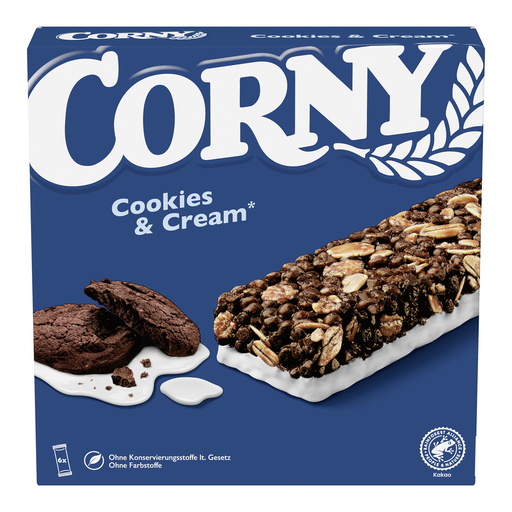
A cereal bar for a portioned study break, if you’d like to compare the Cookies & Cream variety with other bars.
The product title states 6 × 23 g. Compare the fat content per 100 g and, if you have specific requirements, check the allergen information on the pack.
 No image available
A peanut and oat variety for study breaks, if you’re looking for this flavour and would also like to compare the fat content.
The product title states 12 × 50 g. If you have specific dietary requirements, check the ingredients and allergen information on the pack carefully.
 No image available
A white chocolate variety for study breaks, if you’d like to consider the sugar information as well as the fat content.
The product title states 6 × 20 g. Check the nutritional information and ingredients on the specific pack separately; the variety name doesn’t answer the question of fat content.
 No image available
A chocolate variety for a portioned study break, if you’d like to consider both the sugar information and fat content when choosing.
The product title states 6 × 20 g. Compare the fat content per 100 g with other varieties and read the ingredients list rather than assuming “No Added Sugar” means low fat.
No. Added sugar and fat content need to be considered separately. REWE lists 1.4 g of sugar and 7.6 g of fat per 100 g for the ja! Chocolate Muesli Bar with no added sugar. Check both figures on the specific pack when making your choice.
Compare the nutritional information, and read the ingredients list and highlighted allergens. The German Federal Office of Consumer Protection and Food Safety lists gluten-containing cereals, peanuts, soya, milk and nuts among the allergens that must be labelled. Check the information for the specific variety you’re considering.
No. To compare fat content, you need figures for specific bars on the same basis. The Verbraucherzentrale recommends checking the nutrition table even when a product is labelled “Light”. Start by comparing fat per 100 g, then check the portion size.
Follow the storage instructions on the specific pack. Check them when you buy the bars if you’re planning to keep them ready for study breaks over a longer period.