Shoppers with a strict sugar limit
If you specifically want to buy sugar-free cereal, compare the sugar content per 100 g with the applicable limit. The words ‘no added sugar’ don’t answer this question.


If sugar-free cereal is a must for breakfast in your holiday rental, look for products with no more than 0.5 g of sugar per 100 g; ‘no added sugar’ is not enough. If a less strict sugar limit works for you, low-sugar products are another option. Also check the ingredients, allergens and pack size you’ll need for everyone travelling with you.
If you specifically want to buy sugar-free cereal, compare the sugar content per 100 g with the applicable limit. The words ‘no added sugar’ don’t answer this question.
If you’re planning several breakfasts, consider the ingredients and pack size as well as the sugar content, and check the storage instructions on the product.
If anyone travelling with you needs to avoid certain ingredients, check the details of gluten-containing cereals, nuts and other allergens for each specific product. A low sugar content doesn’t replace this check.
First decide whether the total sugar content needs to meet the limit for ‘sugar-free’, or whether ‘low sugar’ or ‘no added sugar’ fits your needs. Then compare the figures per 100 g and check the ingredients for everyone travelling with you.
A good choice if: No more than 0.5 g of sugar per 100 g is a firm requirement.
Worth noting: A label such as ‘no added sugar’ doesn’t prove that the product meets this sugar limit. The threshold for the ‘sugar-free’ claim is set by EU Regulation (EC) No 1924/2006.
A good choice if: A low sugar content is enough and the product doesn’t need to be specifically labelled sugar-free.
Worth noting: For solid foods, ‘low sugar’ means no more than 5 g of sugar per 100 g, not zero, as Lebensmittelklarheit explains.
A good choice if: You mainly want to avoid added sugar and will check the total sugar content separately.
Worth noting: Naturally occurring sugars, sweeteners and sugar substitutes may still be relevant, as Lebensmittelklarheit explains.
| Criterion | What to check | Who it matters to |
|---|---|---|
| Strict sugar limit | For ‘sugar-free’, compare the sugar content per 100 g with the 0.5 g limit; the front of the pack alone isn’t enough. | If ‘sugar-free’ is a firm requirement for me, I don’t want to confuse it with another sugar claim. Around 40% of shoppers put this strict criterion first. |
| Added sugar and ingredients | Check the sugar content per 100 g alongside the ingredients list; look out for sweeteners and sugar substitutes too, if needed. | I want to avoid added sugar, but I also want to know what else is in the mix. Around 30% of shoppers prioritise this ingredients check. |
| Shared holiday supplies | Check allergen information and pack size; compare nutritional values per 100 g if needed. | When several people are having breakfast together, the ingredients need to suit everyone and the pack needs to last for the planned number of days. For around 30% of shoppers, sharing is the main consideration. |
A product with no added sugar can still contain naturally occurring sugars. It may also contain sweeteners or sugar substitutes, as Lebensmittelklarheit explains.
If you need a sugar-free product, check that it contains no more than 0.5 g of sugar per 100 g, in line with EU Regulation (EC) No 1924/2006, and read the ingredients list too.
Serving sizes can vary, so comparing the serving information alone won’t show you straight away which product contains less sugar for the same amount.
Compare the figures per 100 g first, then work out what serving size you’ll need in your holiday rental.
Wholegrain content and sugar levels are separate things. Kellogg’s lists wholegrain oats in the ingredients for Oaties Cocoa Crunch, but also includes sugar and glucose syrup.
Check the sugar content per 100 g in the nutrition information, even when the pack highlights wholegrains or fibre.
A low sugar content tells you nothing about whether a product is suitable for anyone travelling with you who has allergies. The muesli examples mentioned contain cereals or nuts, among other ingredients.
Before you buy, find out which ingredients need to be avoided and read the ingredients and allergen information on the specific pack.
Its low-sugar muesli is a specific option for shoppers who are happy with a low sugar content.
Müller Deutschland stocks Knusperli crunchy muesli in several varieties labelled ‘0% added sugar’.
Some Kellogg’s cereals show why you can’t work out the sugar content from a wholegrain claim.
Cini Minis are a useful comparison if you want to gauge the sugar content of cinnamon cereal.
This selection includes cornflakes, oats and crunchy muesli to suit different breakfast preferences in your holiday rental. Check the information on the specific pack to see whether a product meets your sugar limit and the needs of everyone travelling with you.
 No image available
If cornflakes are on the menu and you have a strict sugar limit, check the sugar content per 100 g on the pack. If anyone travelling with you has allergies, the ingredients and allergen information on the specific product are also important.
Pack size: 300 g.
 No image available
If you’re considering oats for several breakfasts, compare the sugar content per 100 g with your preferred limit. Check the allergen information on the pack too, if needed.
Pack size: 500 g.
 No image available
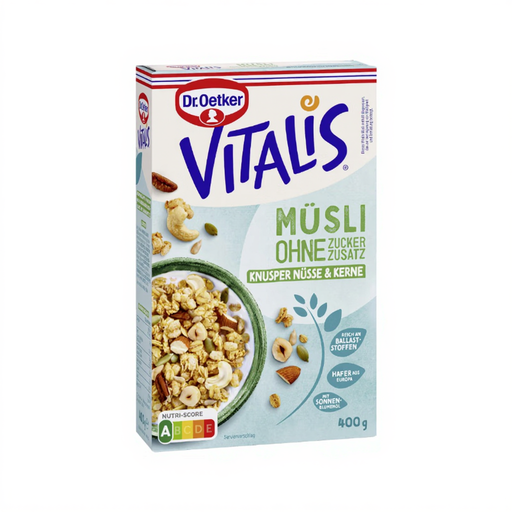
If you’re looking for crunchy muesli with no added sugar, don’t assume that means it’s sugar-free. Compare the sugar content per 100 g and check the ingredients and allergens on the specific pack.
Pack size: 400 g.
No. Under EU Regulation (EC) No 1924/2006, solid foods can only be labelled ‘sugar-free’ if they contain no more than 0.5 g of sugar per 100 g. ‘No added sugar’ doesn’t tell you the total sugar content, so check the nutritional information too.
For solid foods, the ‘low sugar’ claim is permitted when the product contains no more than 5 g of sugar per 100 g, as Lebensmittelklarheit explains. Check the figure per 100 g in the nutrition table rather than relying only on wording on the front of the pack.
Choose a pack size to suit the number of people travelling with you and the breakfasts you have planned. Check the best-before date and storage instructions on the pack, and reseal it after opening as directed.
Yes. The sugar content doesn’t tell you whether a product is suitable for anyone with allergies. Check the ingredients and allergen information on the packaging for each variety you choose, especially if anyone travelling with you needs to avoid cereals or nuts.