Families with one firm favourite
If several people regularly eat the same cereal, a large pack could suit your weekly consumption. Kellogg's packs of 660 to 750 g are listed.


A large pack makes sense for your weekly shop if several people regularly eat the same variety and you’ll use it all. If everyone has different tastes, a variety pack or a smaller pack of muesli offers more flexibility. As well as pack size, compare sugar and other nutritional values per 100 g, check the ingredients and allergen information, and store it correctly.
If several people regularly eat the same cereal, a large pack could suit your weekly consumption. Kellogg's packs of 660 to 750 g are listed.
To compare products, check the nutritional information per 100 g and the ingredients list. A stated wholegrain content doesn’t tell you how much sugar a product contains.
If everyone likes different things, a variety pack can help you avoid committing to a large pack of just one kind. If certain ingredients need to be avoided, always check the allergen information on the specific pack before buying.
First, decide whether you’ll actually use up a pack of the same variety. Then compare the nutritional information and, if needed, check the ingredients and allergens on the specific pack.
| Criteria | What to check | Who it matters to |
|---|---|---|
| Pack size and consumption | Compare the weight, what you already have in the cupboard and the best-before date with how much you actually use. | If we eat the same variety every week, I want to buy enough for everyone without leaving an opened pack sitting around for too long. Stocking up is the main consideration for around 33% of consumers. |
| Taste and variety | If you’re trying a variety for the first time, consider a smaller pack or a variety pack. | Not everyone in our household likes the same breakfast, so I don’t want to commit to a large pack too soon. Variety is the top priority for around 27% of consumers. |
| Sugar and nutritional values | Compare sugar and other nutritional values on the same per-100 g basis; consider wholegrain claims separately. | Even if everyone likes a variety, I want to compare its sugar content with other products. This nutritional comparison is the top priority for around 27% of consumers. |
| Ingredients and allergens | Read the current ingredients list and allergen information on the pack you’ve chosen. | If someone in our household needs to avoid certain ingredients, the labelling determines which pack is suitable. This check takes priority for around 13% of consumers. |
A large pack only makes your weekly shop easier if you’ll eat it and store it properly. Verbraucherzentrale recommends checking what you already have and storing food correctly when stocking up.
Try an unfamiliar variety in a smaller quantity first, and check what you have in the cupboard and the best-before date before shopping.
Wholegrain content and sugar content are different things. Verbraucherzentrale also points out that ingredients such as syrup, honey and dried fruit can contribute to a product’s sugar content.
Compare the sugar value in the nutrition table per 100 g and read the ingredients list too.
Recipes can change. For products containing nuts, sesame or other relevant ingredients, an old photo is no substitute for checking the current pack.
If you have an allergy or intolerance, check the ingredients list and allergen information on the specific pack before buying.
Kellogg's products listed include 750 g packs of Corn Flakes and several cereal varieties in 700 g packs.
Cini Minis are cinnamon-flavoured cereal. Nestlé Cereals states that the product contains 33% wholegrain and 24 g of sugar per 100 g.
Seitenbacher Bio Müsli #583 is a 500 g pack of muesli, not a large pack of cereal.
familia offers a range of muesli lines, including organic, protein and lower-sugar varieties. The manufacturer's website lists products in 500 to 600 g packs.
The range includes rice, pulses, couscous and bulgur, so it isn’t a direct choice of ready-to-eat breakfast cereal.
These packs show cereal and muesli in 600 g and 750 g formats. The right size for your weekly shop depends on how regularly your household eats each variety.
 No image available
The 750 g pack could suit you if your household regularly eats crunchy oat muesli. Before buying, check the nutritional information and, if you have allergies, the current labelling.
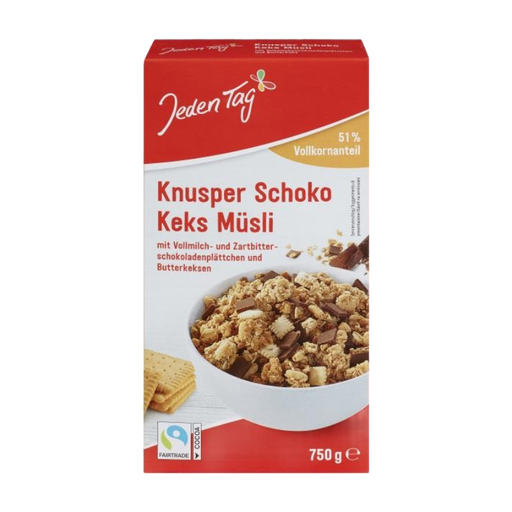 No image available
This 750 g crunchy muesli could suit you if you’re looking for a chocolate cookie variety that your household will eat regularly. Take the sugar value and allergen information on the pack into account when making your choice.
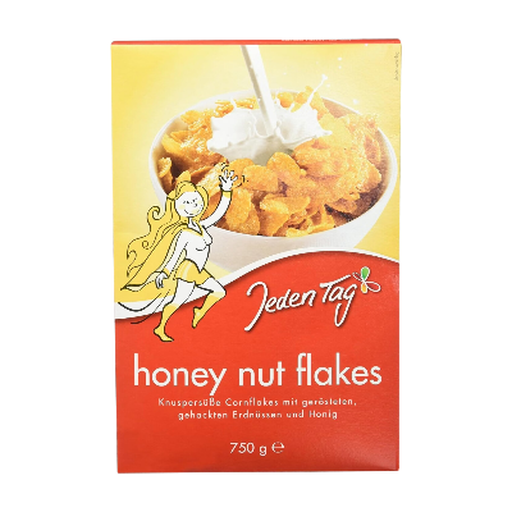 No image available
The 750 g pack is an option for households that regularly choose honey and nut-flavoured cornflakes. Before buying, check the sugar information, ingredients list and allergen details on the pack.
 No image available
The 600 g pack is smaller than the 750 g products shown here. Whether it lasts a week depends on how much you use; check the sugar value and allergen information on the pack.
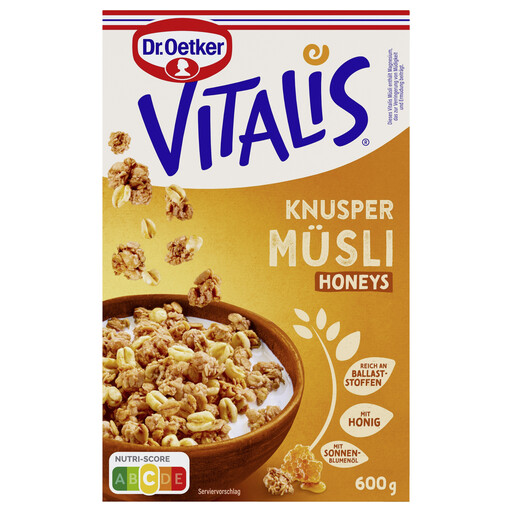 No image available
This honey crunchy muesli could suit households looking for this variety in a 600 g pack. Compare the quantity with your weekly consumption and check the nutritional information and allergen details on the pack.
There’s no set weight to aim for: what matters is how much of the same variety your household actually gets through. Aktionspreis.de gives Kellogg's varieties in 660 to 750 g packs as examples of larger packs; before buying, also consider what you already have and the best-before date.
For comparing dry cereal, it makes sense to start with the figures per 100 g. Lebensmittelklarheit explains that nutritional information is generally based on 100 g of the product as sold; you can also consider the portion you actually eat when planning how much you need.
No. Wholegrain content and sugar content should be checked separately. Nestlé Cereals states that Cini Minis contains 33% wholegrain and 24 g of sugar per 100 g.
Check the ingredients list and allergen information on the specific pack. Recipes can change, so if the variety or packaging changes, check familiar products again too.
The best-before date is not a use-by date. Verbraucherzentrale explains that it refers to the qualities of unopened food when stored correctly. For your weekly shop, make sure the pack is in good condition, follow the storage instructions and consider how quickly you’ll use it.