
Lieferung heute & morgen

Qualitätsgarantie

Willkommens-Angebote freischalten: KOSTENLOSE Lieferung | Bis zu 80 % RABATT | Kostenlose 30-Tage-JoyPlus-Testphase
App herunterladen
An ergonomic cervical support pillow is designed to keep your head, neck and shoulders in a suitable position. However, not every contoured pillow automatically provides comfortable support. An unsuitable height, an overly soft core or a cover that does not allow sufficient ventilation can make the pillow uncomfortable after a short time.
These are the three most common pitfalls when buying one:
Your sleeping position is an important starting point:
An adjustable-height cervical pillow or a model with two sides of different heights gives you more choice. However, “for all sleeping positions” should not be taken as a guarantee: your build and preferred mattress firmness also affect the fit.
A memory foam cervical support pillow responds slowly to pressure and adapts to the shape of your head. This can suit people looking for relatively firm, supportive cushioning that retains its shape. At the same time, viscoelastic foam can retain heat, depending on its construction. Air channels or a breathable cover can be useful in this respect.
A latex pillow typically springs back more quickly and retains its shape. Ventilation openings can help support air circulation. If the product is advertised as containing natural rubber, buyers should check the exact material declaration. Anyone with a known latex allergy should follow the manufacturer’s guidance.
For good hygiene, the cover should be removable and washable. The foam or latex core itself is usually cleaned only with a slightly damp cloth and then dried completely. Airing the pillow before first use can be helpful, particularly if the manufacturer recommends leaving it for 24 to 48 hours.
You should also check:
A pillow for neck pain should not be regarded as a medical device or treatment. If symptoms persist or worsen, it is advisable to seek medical advice.
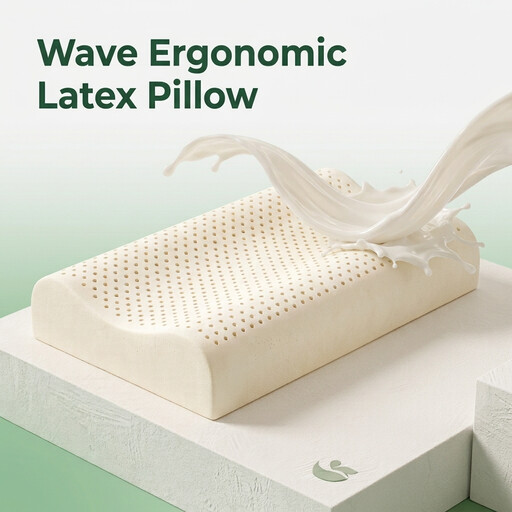
Why this product suits this profile: This 60 × 40 cm latex pillow has two stated heights of 10 and 12 cm. This makes it easier to adapt to different sleeping positions.
The material composition of 93% latex and the two heights are clearly specified. An inner and outer cover are also included.
Wave contour, ventilation openings and machine-washable outer cover according to the product description; the latex core itself is not suitable for machine washing.
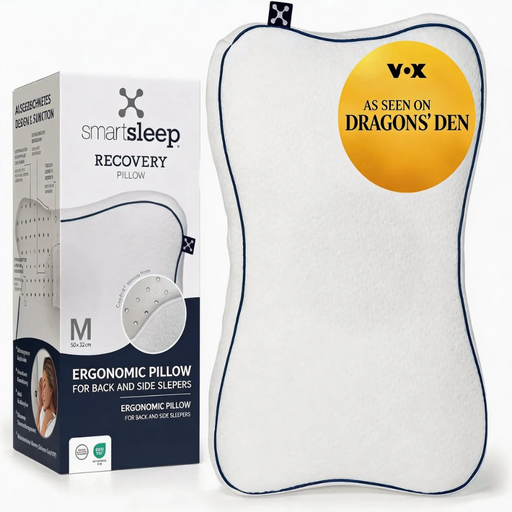
Why this product suits this profile: Back and side sleepers get a memory foam pillow with a head recess, integrated air channels and a stated 30-night trial period.
The description specifies the type of foam, sleeping positions, air channels, care instructions and safety information. The supplier states that the product is OEKO-TEX certified.
Memory foam, head recess, integrated air channels and a stated 30-night trial period according to the product information.
An ergonomic sleeping pillow may feel unfamiliar at first. Place it flat on the mattress and check that your head is not tilted noticeably upwards or downwards. Side sleepers should aim for as straight a line as possible between the head and spine. Back sleepers should check that their chin is not being pushed towards their chest.
The pillow may need airing after unpacking. Always use a suitable pillowcase and follow the manufacturer’s instructions. The memory foam core should not be machine-washed. Latex cores should generally neither be soaked nor exposed to direct heat.
You can find more models, including a latex pillow, a classic cervical pillow or another ergonomic head pillow, in the ergonomic head pillows category.
We have put together a complete, regularly updated list of products that fully meet these strict selection criteria and the safety regulations applicable in the EU.
This depends on your sleeping position, shoulder width, mattress firmness and individual body shape. Side sleepers often need more height than front sleepers. Two height options or an adjustable design can make it easier to choose.
There is no single lifespan that applies to every pillow. The material, daily use, moisture and care all affect how well it retains its shape. Replace the pillow if the core remains permanently compressed, develops cracks or no longer provides sufficient support.
A pillow can affect your sleeping position and comfort, but it is not a substitute for medical advice. If symptoms persist for a longer period, or if you experience numbness or restricted movement, you should seek medical advice.