
Lieferung heute & morgen

Qualitätsgarantie

Willkommens-Angebote freischalten: KOSTENLOSE Lieferung | Bis zu 80 % RABATT | Kostenlose 30-Tage-JoyPlus-Testphase
App herunterladen
A chalkboard can be used as a menu board in a café, a wall board in the hallway, a freestanding sign outside a shop or a creative board for children. Choosing one may seem straightforward at first, but a few details determine whether it remains practical in everyday use or soon ends up gathering dust in the cellar.
Not every chalkboard designed for writing is suitable for liquid chalk or chalk markers. Some models are specifically intended for dry standard chalk only. Liquid markers may leave residue or make the surface difficult to clean. Before buying, check which writing materials the manufacturer approves for use.
A lightweight table-top board is easy to move, but it may slide more readily with frequent use. A freestanding board or pavement sign, on the other hand, requires a sturdy frame, a sufficiently wide base and, where applicable, a crossbar. For outdoor use, information about rust-resistant materials, surface treatment and approved usage is important. A product description stating “suitable for outdoors” does not replace checking the specific location where it will be placed.
Product dimensions do not always refer to the actual writing area. With a wall-mounted board, you also need to allow for the frame, mounting space and opening direction. With an A-frame board, the depth when opened must also be taken into account. For a menu or event, the usable writing area is therefore more important than the overall size alone.
A reusable chalkboard should be easy to clean with the intended writing material, leaving no residue or at least requiring minimal effort. Dry chalk is suitable for traditional chalkboards and can usually be removed with a damp cloth. Liquid chalk can create bolder lines, but it is not approved for every surface.
For households with children, accessibility is also important. A chalkboard for children should be securely fixed or placed on a stable base. Small items such as chalk and erasers may pose a choking hazard to children under three. Chalk dust should not be inhaled wherever possible, so regular ventilation is advisable.
A wooden chalkboard often suits rustic interiors, bakeries or private living spaces. Wooden surfaces should be protected from prolonged exposure to moisture and cleaned with a soft, dry or slightly damp cloth. For metal constructions, a coated surface and information about corrosion resistance are relevant.
MDF products can offer an even surface. For indoor furniture, it is worth checking material details such as E1-grade MDF, which indicates low formaldehyde emissions. However, this information does not replace checking the general product and usage instructions.
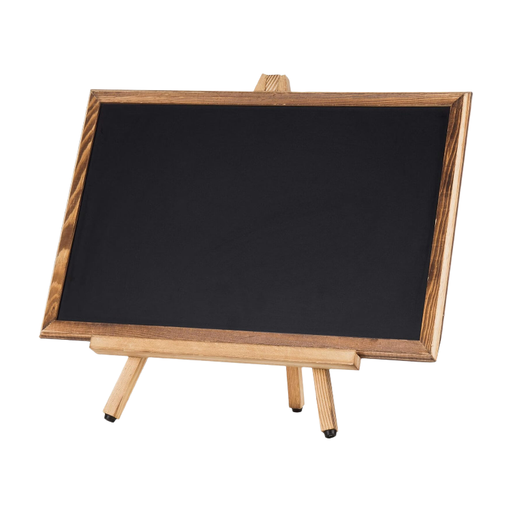
Why this product suits this profile: The compact format with folding stand is suitable for kitchens, small retail spaces, celebrations or the dining table at home. The writing area measures 10 × 16 inches.
The specifications expressly state that it can be used with dry or liquid chalk. This makes it easier to choose the right writing material for the intended use.
Folding stand, removable board and compact storage.
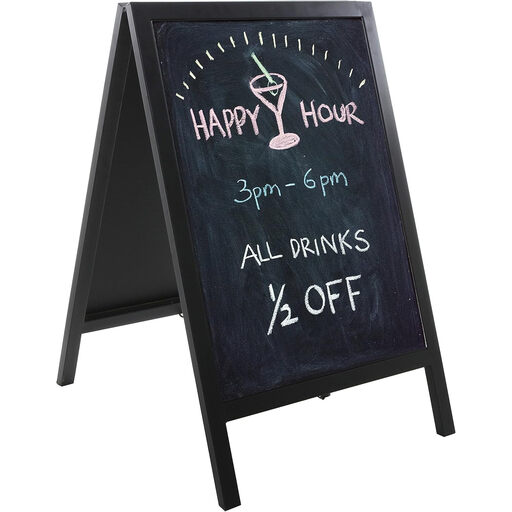
Why this product suits this profile: This freestanding pavement sign is aimed at cafés, restaurants, markets and retailers that want to display notices on both sides. Each writing surface measures 24.75 × 30 inches.
The reinforced metal frame, crossbar and open depth of 20.5 inches are clearly specified. This makes it easier to plan the required footprint.
Powder-coated steel, double-sided writing surfaces and a freestanding design. According to the product details, it is intended for dry standard chalk.
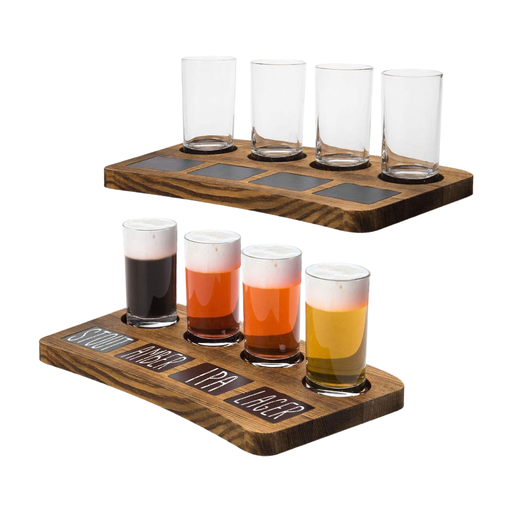
Why this product suits this profile: For private tastings, bars, restaurants and events, this set combines presentation with labelling. It includes two wooden trays and eight glasses in total, each with a capacity of 177 ml.
The number of trays and glasses, along with the size of the chalkboard areas, is clearly specified. Hand washing is recommended for cleaning.
Two serving trays, eight tasting glasses, wipe-clean chalkboard labels and foot pads to protect the table surface.
We have put together a complete, regularly updated list of products that fully meet these strict selection criteria and the safety regulations applicable in the EU.
Depending on the room and intended purpose, combination or decorative models may also be suitable:
Before placing an order, buyers should also check whether mounting accessories, chalk, erasers or additional glasses are actually included in the delivery. For wall-mounted models, the load-bearing capacity and suitable wall plugs must be checked according to the type of wall.
This depends on the product specifications. Many traditional chalkboards are intended for dry standard chalk. Liquid chalk or chalk markers should only be used if the manufacturer expressly approves them. A soft, slightly damp cloth is often sufficient for cleaning; aggressive cleaning products may damage the surface.
First, check the wall material, weight and fixing points. The mounting materials supplied are not automatically suitable for every concrete, brick or plasterboard wall. The board should be mounted level and must not cover any cables or pipes. Particularly secure fixing is required in children's bedrooms.
Its service life depends on the material, writing medium, cleaning routine and location. A wooden board kept dry can remain usable for a long time with careful care. Metal frames should be checked regularly for damage to the coating and possible rust spots. Outdoors, it is advisable to store the board in a sheltered place during heavy rain or frost, or when it will not be used for an extended period, unless the product specifications state that it is suitable for permanent outdoor storage.