For character voices in a home studio, your choice depends mainly on the room and the recording setup. In a quiet room with suitable acoustics, a condenser microphone may be a good option. If you can hear the room affecting your recordings, a dynamic microphone used at close range may work well, but it won’t eliminate reverberation or background noise. USB makes connecting to a computer easier, while XLR requires a suitable interface. For voice-over with the Shure SM7B, Shure recommends at least 60 dB of preamp gain.
Which considerations matter to you?
Recording in a room where you can hear the acoustics
If you record at home and hear reverberation or everyday noises in test recordings, pay attention to the room, microphone position and keeping a consistent speaking distance. RØDE recommends choosing a room with as little reverberation as possible.
Switching between very different roles
If you switch between whispers, normal dialogue and loud exclamations, your recording setup should let you control the levels you’re actually recording at. Test your quietest and loudest lines rather than relying on a technical specification alone.
Putting together a studio setup
If you’re choosing between a direct USB connection and an XLR setup with an interface, check the connection, accessories and preamp gain required for the specific model. For voice-over with the SM7B, Shure recommends at least 60 dB of preamp gain.
What to consider when buying
The key is to work out which challenge you want to tackle first when recording your characters.
| Buying priority |
What to check before buying |
Who is it most relevant to? |
| Room acoustics and background noise |
Record a voice test in the spot where you plan to use the microphone; check its position and distance. |
If I’m recording in a room where I can hear the acoustics, I want to find out first how much the room and microphone position affect the sound. Around 33% of consumers put room acoustics first. |
| Quiet and loud character lines |
Test whispers, normal dialogue and exclamations; listen for level changes and possible distortion. |
With big differences in volume, I want to check that my recording setup can handle both quiet and loud takes. Around 27% of consumers prioritise changing vocal volumes. |
| Connection and setup |
Check that the USB or XLR connection works with your computer and interface; check the gain required. |
If I want to get started without a separate interface or build on my setup over time, choosing the right connection is important. Around 20% of consumers put connection and setup first. |
| Monitoring, plosives and consistent takes |
Check headphone monitoring, a pop filter and the mount for the specific model. |
When recording dialogue lines more than once, I want to monitor the sound and keep the distance and position consistent. Around 20% of consumers prioritise keeping their takes under control. |
Common buying mistakes
-
Assuming a more sensitive or expensive microphone can make up for an unsuitable room
Room reflections and microphone position both affect the voice you record. A microphone won’t automatically eliminate reverberation or everyday noise.
Start by testing it in the spot where you plan to record. See whether changing position or reducing nearby noise helps.
Adjusting the room may take extra work, and you may need to record some lines again.
-
Buying an XLR microphone without checking the signal chain
The XLR recording setup described here requires a suitable interface. For voice-over with the SM7B, Shure recommends at least 60 dB of preamp gain.
Check that your interface has the right connection and enough gain. Don’t assume the SM7B figure applies to other microphones.
Depending on the equipment you already have, you may need an interface, cable or additional preamp gain.
-
Assuming 32-bit float protects you from every recording problem
With the RØDE NT1 5th Generation, 32-bit float output requires a USB connection and compatible software settings. It won’t fix room reverberation or plosives.
Check the connection and recording format, and listen back to a test recording of your loudest character lines.
-
Treating similarly named models as if they were the same
Test results and manufacturer specifications apply to specific model names and configurations.
Check the full model name, connection and included items against the source of the information that matters to you.
Notable microphone brands
RØDE
According to RØDE, the NT1 5th Generation offers both USB and XLR connections, making it an option for different recording setups.
- RØDE lists a pop filter and shock mount among the accessories included with this model.
- 32-bit float output requires USB and recording software configured accordingly. This specification doesn’t automatically apply to other NT1 versions.
Shure
The dynamic SM7B is an option for close-miked, fixed-position voice recordings, provided you have a suitable recording setup.
- For voice-over with the SM7B, Shure recommends at least 60 dB of preamp gain.
- Check whether your interface can provide this much gain or whether suitable additional amplification is needed. This figure doesn’t apply to all Shure microphones.
Audio-Technica
According to Audio-Technica, the AT2020USB-X is a USB condenser microphone for direct recording to a computer.
- Audio-Technica lists a headphone output, monitor mix and desk stand for this model.
- A shock mount is listed as an optional accessory. These features don’t automatically apply to the AT2020 or AT2020USB+.
Sennheiser
According to the German product page, the MK 4 is an XLR condenser microphone with a cardioid pickup pattern, designed for home and project studios.
- Sennheiser lists an equivalent noise level of 10 dB(A) for the MK 4.
- This manufacturer specification doesn’t describe the noise level or reverberation in your own room.
LEWITT
According to LEWITT, the LCT 440 PURE is an XLR condenser microphone with a fixed cardioid pattern for voice recording.
- LEWITT lists a pop filter, shock mount and windscreen among the included accessories, along with a self-noise level of 7 dB(A).
- These specifications aren’t proof of an independent sound comparison and don’t automatically apply to other variants.
Microphones at Joybuy
This selection includes USB and USB/XLR microphones for recording speech on a computer, as well as kits with a microphone arm or desk stand.
 No image available
FIFINE K688CTW dynamic microphone with boom arm, White
For voice recording with a choice of USB or XLR connection and headphone monitoring.
The description lists a boom arm, shock mount, mute button and gain control. An XLR cable isn’t included, according to the description.
View at Joybuy
 No image available
FIFINE AM8 dynamic USB/XLR microphone
For voice recording when you want the choice of a USB connection or XLR connection.
A headphone socket and monitoring control are specified for USB use; according to the description, these controls are only active in USB mode. An XLR cable and microphone arm aren’t included.
View at Joybuy
 No image available
Razer SEIRÉN V3 MINI White USB microphone
For direct USB connection to a computer; the adjustable tilt stand can be repositioned to angle the microphone.
The product name specifies tap-to-mute functionality.
View at Joybuy
 No image available
USB condenser microphone for PC, 7-piece set
For recording speech on a PC; the product name also lists streaming as a use.
The product description lists a mute button and a Type-C adapter.
View at Joybuy
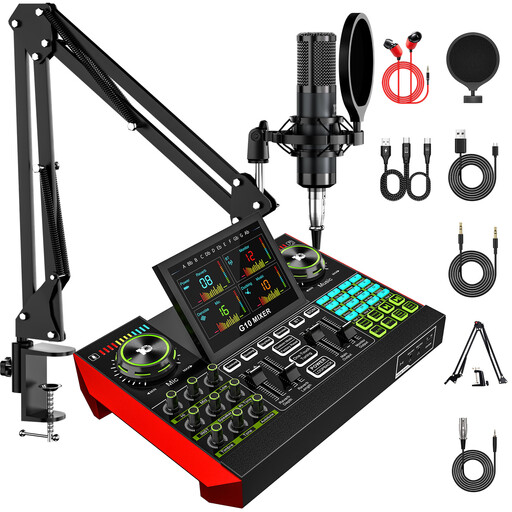 No image available
Yinkaer G10-P15-XB podcast microphone kit with audio mixer
A kit combining a microphone and audio mixer; the title also lists a 3.5 mm condenser microphone and boom arm.
The title lists computers and mobile devices as compatible devices.
View at Joybuy
Frequently asked questions
How can I check whether a microphone suits my character voices?
Record the same text in the room where you plan to use the microphone, speaking quietly, normally and with your loudest exclamations. Listen for reverberation, background noise and plosives, and check the levels. Try changing the position and distance before comparing models based on specifications alone.
Do I need extra equipment to use an XLR microphone with a computer?
The XLR recording setup described here requires a suitable audio interface. Check that it’s compatible with the specific microphone. For voice-over with the SM7B, Shure recommends at least 60 dB of preamp gain or suitable additional amplification.
How can I avoid plosives and inconsistencies between takes?
Place a pop filter between your voice and the microphone, and keep your position consistent. RØDE recommends trying different distances and angles to suit the microphone and room. A headphone output on the specific model can make it easier to monitor as you record.


