Solo speaker at a busy desk
If you’re recording characters one at a time, you can position the microphone close to your voice. Other voices at the desk may still be audible.


For recording different roles one at a time at a shared desk, a directional dynamic USB microphone is a suitable starting point if you can speak into it from close range and in the right direction. However, it won’t reliably block out other voices. Test the background noise with a sample recording and listen back to both quiet and emphatic passages. If several people will be speaking at once and you want to edit their voices separately, you’ll need multiple microphones and suitable separate recording channels. A USB condenser microphone may be an option if the planned speaking distance works at your desk.
If you’re recording characters one at a time, you can position the microphone close to your voice. Other voices at the desk may still be audible.
When recording both quieter and more emphatic lines, adjustable recording levels and direct monitoring are useful. They let you check the recording as you speak.
If several people will be speaking at once and you want to edit their contributions separately later, check the microphones and recording channels you’ll need for each voice.
A good fit if: You’re recording roles one at a time on a computer and can stay close to the microphone.
Keep in mind: Speaking close to the microphone limits how freely you can move. Directional pickup and digital noise processing won’t reliably remove other voices.
A good fit if: You’d like to use the controls on the microphone itself, and a test recording from your planned position confirms the room sound is suitable.
Keep in mind: Speaking from further away may make more room sound audible. The Sennheiser Profile USB is not listed as having an XLR output.
A good fit if: You already have a suitable interface, or want to record several people speaking at once using separate microphones.
Keep in mind: To record the XLR-only PodMic on a computer, you’ll also need an XLR cable and an audio interface.
| Priority | What to check when buying | Who it matters most to |
|---|---|---|
| Reduce other voices as much as possible | Check the speaking direction, suitable mounting and a test recording in your usual workspace. | When I record a character at a shared desk, I want to capture my voice clearly without assuming conversations will be completely isolated. Around 36% of consumers make this their main priority. |
| Control quiet and loud passages | Check the gain control, level display and headphone monitoring on the specific model. | When switching between quiet and emphatic lines, I want to be able to check the recording level straight away. Around 29% of consumers put level control first. |
| Get started easily on a computer | Compare the USB connection, what’s included, desk space and how easily you can position yourself to speak. | If I want to record on a computer without a separate interface, a simple setup that fits on a shared desk is important to me. Around 21% of consumers say ease of getting started matters most. |
| Record simultaneous voices separately | Check that the number of microphones, suitable interface inputs and recording software all work together. | If several people are speaking at once, I want to be able to edit their voices individually later. Around 14% of consumers prioritise separate recording channels. |
Shure explains that the MV7+ denoiser can’t remove background voices or keyboard clicks. You may therefore need to record an affected passage again.
Test the microphone with your usual background noise. If it affects the recording, choosing a quieter time to record may help.
The PodMic USB has USB-C and XLR connections. For computer recording with the XLR-only PodMic, RØDE also specifies an XLR cable and an audio interface.
Before buying, check the full model name, its connections and the recording equipment you already have.
With the XLR-only PodMic, you’ll need additional equipment and connections to record on a computer.
At a shared desk, a stand may not let you position the microphone close enough to speak into it comfortably.
Check the available desk space, mounting options and cable routing for the specific version.
Depending on where you want to position it, you may need a suitable microphone arm or stand.
According to Audio-Technica, the ATR2100x-USB combines a dynamic microphone with USB and XLR connections. It may suit you if you want to start with USB and might use XLR later.
The PodMic USB offers USB-C and XLR connections for close-range voice recording. The separate PodMic is an XLR model.
The MV7+ is a dynamic voice microphone with USB-C and XLR connections. Shure describes it as having digital features for adjusting levels and sound.
The Sennheiser Profile USB is a USB-C condenser microphone with gain, mix and headphone volume controls.
The Q2U is a dynamic microphone with USB and XLR connections.
The Joybuy models below include dynamic USB/XLR microphones for recording voice at a desk, as well as podcast kits with multiple microphones.
 No image available
May suit recording character voices one at a time on a computer, if you can position the microphone appropriately.
The product title lists USB/XLR, a boom arm, mute button, volume control and headphone socket. According to the product information, the XLR cable is not included.
 No image available
May suit a desk-based voice recording setup if the desk stand gives you the positioning you need.
The product title lists USB/XLR, a desk stand, RGB lighting, a mute button and a headphone socket. According to the product information, the XLR cable is not included.
 No image available
May suit voice recording on a computer if you want to use the controls listed on the microphone.
The product title lists USB/XLR, gain control, an echo function, mute and a desk stand.
 No image available
May suit a small group recording if two microphones and an audio mixer work with your planned setup.
According to the product title, the kit includes two 3.5 mm condenser microphones, stands and an audio mixer.
 No image available
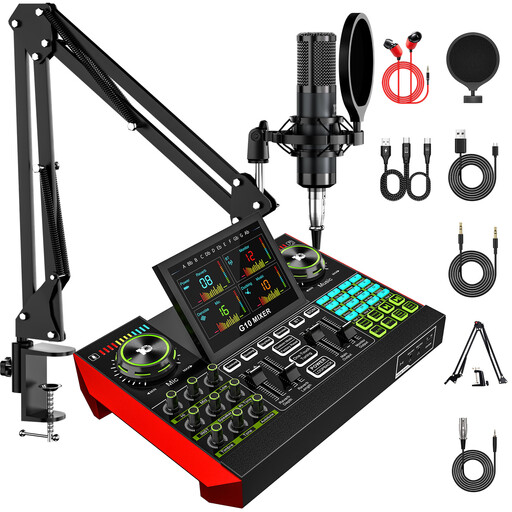
May suit voice recording on a computer or mobile device if a single microphone and mixer work for your setup.
The product title lists a 3.5 mm condenser microphone, an audio mixer and a boom arm.
Not reliably. Shure explains that the MV7+ real-time denoiser can’t remove background voices. Speak as close as possible in the intended direction and test the background noise with a recording at your actual workspace.
Point the speaking side towards your mouth and check the level using both quiet and emphatic lines. RØDE specifically recommends a distance of around 5–10 cm for the PodMic USB; don’t assume this distance applies to other microphones without checking.
You don’t need a separate audio interface with a suitable USB microphone. However, for computer recording with the PodMic, which connects via XLR only, RØDE specifies an XLR cable and an audio interface.
Plan for separate microphones and suitable recording channels if you want to edit each voice individually. Check whether an audio interface has enough suitable inputs. A single desk microphone won’t automatically create separate microphone tracks.
§ 201 Abs. 1 StGB covers the unauthorised recording on an audio carrier of another person’s words spoken in private. Discuss any planned recording with the people involved and avoid accidentally recording conversations. Whether the provision applies in a particular case depends on the circumstances.