What should you look for when buying?
First decide whether you have room for two lights positioned at the sides. Then check that the colour temperature, softbox fitting and included accessories work with your existing setup.
Two continuous lights with softboxes
Best for: regularly photographing larger drawings, with room for light stands on both sides of the sheet.
Consider: two lights and stands take up more floor space; check that the light reaches the edges of the sheet.
One light with a softbox and a reflector
Best for: smaller drawings, or when there isn’t room for a second light stand.
Consider: a white reflector is a practical option, but it doesn’t guarantee the same even illumination as two lights.
A softbox for a light you already own
Best for: if you already have a suitable continuous light and sturdy stand, and want to diffuse the light.
Consider: the fitting and mounting need to be compatible; a softbox on its own doesn’t automatically include a light source.
| Buying criterion |
What to check before buying |
Who it matters most to |
| Even illumination |
Number and position of the lights; use a test shot to check the light at the centre and edges of the sheet. |
If I want to document the whole sheet consistently, I need even illumination right to the edges. Around 36% of consumers put even illumination first. |
| Consistent tonal reproduction |
Check whether both lights allow the same colour temperature setting; compare colour-rendering specifications only for the specific model. |
When photographing the same drawing, I want to capture the paper and charcoal tones under comparable lighting. Around 29% of consumers prioritise consistent tonal reproduction. |
| Space and setup |
Allow for the assembled dimensions and the footprint of the stands; make room for the sheet and camera. |
At a small workspace, I want to fit in my camera and drawing without the stands taking up all the available room. Around 21% of consumers consider the space required especially important. |
| Compatibility |
Check the light’s mount, the softbox fitting and what’s actually included. |
If I already own a light, the modifier should fit it, rather than leaving me to buy extra equipment. Around 14% of consumers put compatibility with their existing equipment first. |
Suitable products at Joybuy
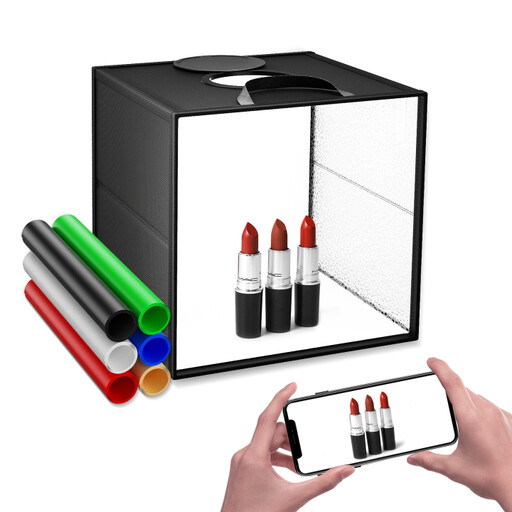
For small subjects that fit inside a compact photo box, this product is a space-saving option worth considering. It won’t automatically replace a two-sided softbox setup for photographing a whole drawing sheet.
 No image available
30 x 30 cm mini photo box in Oxford fabric, six coloured backgrounds, dimmable lighting
For small drawings that fit entirely within the 30 × 30 cm shooting area; the product description specifies dimmable, diffused lighting.
Foldable design with front and overhead shooting options. The description lists CRI 95+; this isn’t an independent measurement of how charcoal drawings are reproduced.
View at Joybuy
Frequently asked questions
How should I position the lights for a documentation photo?
Start with two lights at the sides of the drawing. For cultural objects, the Canadian Conservation Institute describes positioning lights on both sides at a 45-degree angle for even, general illumination. Then use a test shot to check the edges of the sheet too. If you want to capture surface texture in detail, it may be worth taking an additional photo with the light coming from a different direction.
Should I take the charcoal drawing out of its frame for the photo?
Not necessarily. If the medium is delicate or easily smudged, avoid unnecessary contact; the Library of Congress recommends keeping such materials away from the glazing. If reflections are a problem, try changing the light or camera position first, rather than handling the original straight away.
What extra costs and rights should I consider when buying?
Check whether the lights, diffusers, stands and cables are actually included. According to the Verbraucherzentrale, online purchases in Germany generally come with a 14-day right to cancel; when the period starts and what exceptions apply depend on the specific circumstances. Your statutory rights and a voluntary manufacturer’s warranty are separate entitlements.
What should I know about electric photography lights in Germany?
Electrical products covered by relevant EU harmonisation rules must meet the applicable conformity requirements. The European Commission explains that CE marking is only required when the relevant EU rules call for it. When carrying out checks, the Bundesnetzagentur looks at things such as labelling, manufacturer details and German-language instructions with the necessary warnings; a CE mark on its own isn’t an independent quality seal. A purely mechanical softbox isn’t automatically assessed under the same rules.


