Photographers with limited space
If you’re arranging a cheese board on a small table, make sure the light and its stand can be positioned securely to one side and put away afterwards.


If you’re shooting in indirect window light, start by trying side lighting and a white reflector. An LED panel is most useful when you need more control or consistency. For close-up details, a compact light may be suitable, while a larger panel with diffusion can illuminate the whole board but needs more room for the light and its stand. Check the shadows and coverage on your own subject, as the results will depend on the framing and position of the light.
If you’re arranging a cheese board on a small table, make sure the light and its stand can be positioned securely to one side and put away afterwards.
When you’re photographing the board with its accompaniments, consider whether the light’s coverage suits your framing and whether you can control harsh shadows. A small light won’t necessarily work as a suitable main light source.
If you shoot at different times of day, adjustable white light can help you set the brightness and colour temperature to suit. Still, check the result with your subject.
Start by deciding on your framing and how much space you have. This will help you work out whether window light is enough, or whether a compact light for details or a larger panel for the whole board would work better with your setup.
| Buying criterion | What to look for | Who is this important to? |
|---|---|---|
| Secure positioning | Check the space needed for the stand or mount, along with the angle and cable routing on the table. | If there’s hardly any room beside the board and camera, I need the light to stand securely to one side. Around 31% of consumers prioritise positioning in tight spaces. |
| Light for the whole board | Consider the light’s coverage and diffuser; test the shadows and how evenly the light reaches the edge of the board in your own setup. | If I want the board and its accompaniments in the same shot, I need to be able to control shadows across the whole surface. Around 31% of consumers prioritise soft light across the entire board. |
| Adjustable white light | Check the colour temperature and brightness of the exact model; test how it renders the colours of your cheeses. | If the ambient light changes, I want to be able to adjust the settings for consistent-looking shots. Around 25% of consumers prioritise control over white light and food colours. |
| Power supply and what’s included | Check the power source and battery life of the specific model, as well as whether a power supply, cable and mount are included. | If I’m shooting without a nearby socket or for an extended period, I need a suitable power supply and a complete setup. Around 13% of consumers prioritise the power supply and what’s actually included in the set. |
The manufacturer’s specifications for a mini light don’t prove that it will softly illuminate the whole arranged board within your chosen frame.
Decide on your framing and check the light and shadows right to the edge of the board. Use a mini light for details if it doesn’t cover the whole setup.
If the mini light doesn’t cover the board, you may need a larger light source or a different lighting setup.
The NEEWER NL-116AI is available with or without a mini tripod. The VL49 and VL49 RGB are also different versions.
Check the full model name, the set option you’ve selected and what’s included, rather than relying only on the product image or a shortened name.
Check whether the specific set includes any tripod, power supply or mount you need.
The manufacturer’s figures for the NEEWER NL-116AI and the amaran P60x are based on different measuring distances, so they aren’t a direct comparison for photographing a cheese board.
Check the measuring distance and settings. Also consider the light’s coverage, diffusion and where you can position it on your table.
The details below apply to the models and versions listed. Manufacturer figures are based on their stated conditions; on their own, they don’t tell you how evenly your cheese board will be lit.
The NL-116AI is a compact, dimmable white-light panel. Check whether the version you’re buying comes with a mini tripod.
The Vibe P96, model 3286, is a small light for adding illumination to details with flexibility.
The P260C Pro is a larger white-light panel with a diffuser, suited to a setup with more room to one side.
The P60x is a larger, adjustable white-light panel for a planned lighting setup, rather than an especially small tabletop light.
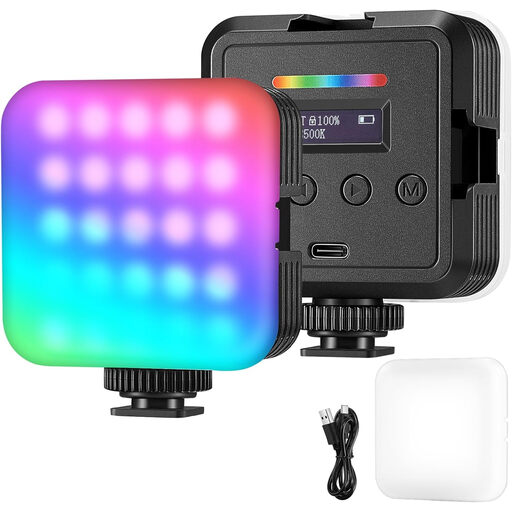
The VL49 RGB is a small battery-powered light for details or supplementary lighting. It’s a different version from the VL49, which has a fixed daylight setting.
Here you’ll find an LED camera light for photography and video, with adjustable lighting modes, brightness and colour temperature.
 No image available
For photography and video when you want to adjust the brightness and colour temperature.
The description lists white and warm-light modes, along with adjustable brightness and colour temperature.
Not necessarily. Canon Europe recommends indirect window light. Try placing it to one side, and use a white reflector to brighten the opposite side if needed. A panel may be useful if the available light isn’t enough for your shots or changes too much.
Start with light coming from the side and check the shadows across the whole board. Nikon USA describes directional light from the side or behind as a common approach to food photography. If the light is too harsh, try diffusion or indirect window light, and use a white surface to brighten the darker side if needed.
No, not unless the measuring conditions are comparable. NEEWER gives a maximum figure for the NL-116AI at 0.5 m; Aputure gives, among other figures, an average for the amaran P60x at 1 m and 5,600 K. Take the measuring distance and settings into account, and also consider the framing, diffusion and position for your own photos.
Statutory consumer rights are separate from a voluntary manufacturer’s warranty. The Verbraucherzentrale says that new goods are generally covered by a two-year statutory guarantee. For purchases made from 31 July 2026, it notes that this period may be extended from two to three years if the fault is remedied by repair within the two-year period. The requirements need to be checked in each individual case.
CE marking is required for products covered by the relevant harmonised EU rules; it isn’t an independent quality mark for photographic performance. The German Environment Agency points out that waste electrical equipment must be collected separately, and that used batteries and rechargeable batteries must not go in household waste. They can be returned to retailers free of charge.