Which lighting option is right for you?

Food photographers dealing with dark shadows

If the side of your cheese board facing away from the window looks too dark, placing a reflector opposite the window can be a simple first step. Nikon USA and Canon Europe both cover indirect window light and ways to brighten shadows in their food photography tips.

Creators taking repeatable food shots

If you photograph similar arrangements at different times of day, adjustable brightness and white light are important features to look for. Compare the specifications for the exact model, then adjust the light to suit your own setup.

Photographers working at a small table

When space is limited, weigh the size and mounting options against the area you want to light. A table stand or small panel can make positioning easier, but check that it lets you light the cheese board from the side as you’d like.

What should you look for when buying?

Window light with a reflector

Best if: the indirect window light is enough for your shot and it’s mainly the shadow side that looks too dark.

Trade-off: A reflector redirects the light you already have rather than producing its own, so changes in daylight will still be noticeable.

Larger bi-colour panel

Best if: you regularly want to brighten the whole board and adjust the light output and white light to suit changing window light.

Trade-off: The light and its mount take up space; power options and what’s included depend on the specific version.

Compact table or mini panel

Best if: you have limited table space or want to brighten a specific area of shadow.

Trade-off: Check at your actual shooting distance that the smaller light reaches the area you want, while still leaving room for a diffuser.

What you need What to check when buying Who it matters to
Soft fill light Check for a diffuser or softbox, as well as positioning and distance; dimming helps you match the extra light to the available window light. If I want to brighten the shadow side without creating a second harsh shadow, I pay particular attention to how the light is shaped and positioned. Around 36% of consumers are likely to prioritise soft fill light.
Colour matching Compare adjustable colour temperature and dimming; manufacturer colour-rendering specifications are no substitute for adjusting the light in your own setup. If I’m using window light and panel light together, I want to be able to match the white light to the arrangement. Around 29% of consumers are likely to consider colour matching especially important.
Repeatable exposure Check the dimming range, power supply for your shooting session and a mount that lets you repeat the same position. If I want to take similar shots in changing daylight, I need a light output I can set again. Around 21% of consumers are likely to prioritise repeatable exposure.
Space and mounting Measure the available space and check for a table stand or tripod mount, as well as which cables and power supply are actually included. If my table is short on space, the light needs to fit beside the board without getting in the way of the setup. Around 14% of consumers are likely to consider a compact setup first.

Common buying mistakes

  • Assuming more light output means softer light

    The shadows on your cheese board also depend on positioning, diffusion and the window light available. A lux figure measured under the manufacturer’s conditions doesn’t automatically tell you how the light will look in your own setup.

    First, see whether a reflector is enough. If you choose a panel, check whether it comes with a diffuser or softbox and whether you have room to set it up.

    Depending on your setup, you may need a suitable mount or additional light modifiers. So check what’s included with the specific version.

  • Assuming similarly named VL49 versions are identical

    Ulanzi offers a VL49 RGB with adjustable colour temperature and a VL49 with a fixed daylight colour temperature. Their options for matching the light to a window differ.

    Compare the full model name, the adjustable white-light range and what’s included with the specific version.

Relevant brands and product ranges

Godox

The LP Bi range includes larger adjustable panels for setups with a separate light beside the cheese board.

  • Godox specifies 2.800–6.500 K for the range’s bi-colour models. For the LP600Bi, the manufacturer lists 60 W input power and operation from both mains power and NP-F batteries.
  • A diffusion panel and barn doors let you shape the light; check what’s included with the specific version.
  • These manufacturer specifications don’t show how well the panel will light a cheese board by your own window.

amaran

The P60x is a bi-colour panel supplied with a softbox and grid for shaping your fill light.

  • amaran specifies 3.200–6.500 K and a CRI of at least 95 for the P60x, and says a softbox is included.
  • The manufacturer says the D-Tap cable is sold separately. A lux figure only applies under the measurement conditions stated and doesn’t automatically reflect a setup by a window.

NEEWER

The RGB660 PRO II offers RGB features and adjustable bi-colour white light.

  • NEEWER’s EU product page lists 3.200–5.600 K, 50 W and a diffuser for this model.
  • The manufacturer says a light stand isn’t included. RGB features aren’t essential for neutral fill light on a cheese board.

Rollei

The LUMIS Key Light Pro is a table-mounted panel for a compact photography workspace set up on a desk.

  • Rollei specifies 2.500–9.000 K, dimming, a table stand and a panel diagonal of 27 cm.
  • Check your own setup to see whether the height and angle allow you to position the light to the side as required. The product description is aimed primarily at video calls and streaming, not specifically at food photography.

Ulanzi

The VL49 RGB is a small battery-powered panel for targeted fill light on the go, not a drop-in replacement for a larger panel.

  • For the RGB version, Ulanzi specifies 2.500–9.000 K, a built-in battery and 800 lx at 0,5 m.
  • Its compact design makes it easier to position, but doesn’t tell you whether it will light the whole cheese board evenly. Don’t confuse the RGB version with the VL49, which has a fixed colour temperature.

Joybuy product selection

This selection includes compact, portable LED camera lights for photography. Check that the light position, power supply and coverage suit your cheese board.
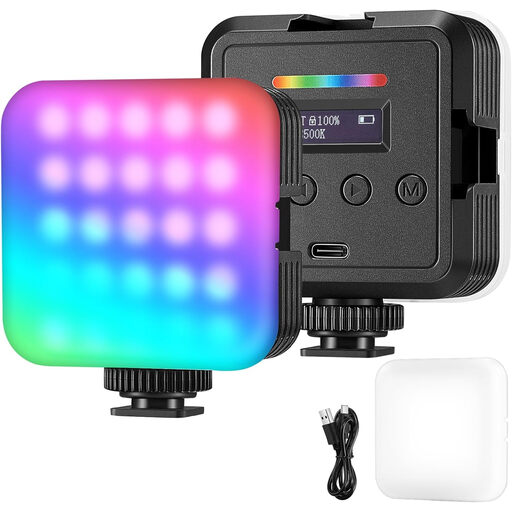
Compact RGB LED camera light with adjustable colour temperature

RGB LED camera light with adjustable colour temperature

The portable light is described as suitable for photography and may come in handy when you’re shooting in different locations.

Features include RGB colours, adjustable colour temperature and brightness, and white and warm-light modes.

Power options listed are a built-in battery or USB.

View at Joybuy

Frequently asked questions

How should I position extra light by a window?

Start by placing the cheese board beside a window with indirect light. If only the side opposite the window looks too dark, try a white reflector there first. With a panel, adjust its position and brightness a little at a time, checking the shadows in the actual image. One fixed position won’t suit every window size or time of day.

Does a panel need RGB for natural-looking cheese colours?

No, RGB isn’t essential for neutral white light on a cheese board. What matters more is whether you can match the white light to the window light already available. A manufacturer’s colour temperature or CRI rating alone can’t guarantee a particular colour in the finished photo.

What should I bear in mind when cleaning and using a light near food?

Position the light, cable and mount so they don’t get in the way of your arrangement. In its instructions for the LP400Bi and LP600Bi, Godox recommends a dry, well-ventilated environment, disconnecting the light from the power supply before cleaning, and using a dry, soft cloth. Check the instructions for your specific model; this manufacturer guidance doesn’t automatically apply to every panel.

What should I check about accessories and possible faults?

Check what’s included, including the stand, power supply and battery accessories. amaran lists a D-Tap cable as sold separately; NEEWER says a light stand isn’t included with the RGB660 PRO II. In Germany, the statutory warranty against the seller is distinct from a voluntary guarantee, as explained by the Verbraucherzentrale.

What labelling and disposal rules apply when buying in Germany?

For products covered by relevant EU harmonisation legislation, the manufacturer uses the CE marking to declare conformity. As Your Europe explains, it isn’t an independent quality mark. For lighting products, the Bundesnetzagentur lists labelling, traceability, German-language instructions and a declaration of conformity among the points to check. In Germany, waste electrical equipment must be disposed of separately and can be returned free of charge under the conditions described by the Umweltbundesamt. These general points don’t prove that any individual listing meets all the requirements.