What should you look for when buying?
First decide whether you want to bake several trays at once and whether you have a suitable built-in oven space. Extra features are less important if they won’t be useful for your other dishes or your preferred cleaning routine.
| What you need |
What to check before buying |
Who it matters most to |
| Baking several trays at once |
Usable tray area and what’s included; the specific model’s guidance on suitable levels and clearances. |
If I want to bake enough for the family in one go, I’ll check the area I can actually use. Around 40 % of consumers put the amount of scones they need and the number of batches first. |
| Built-in or countertop space |
For a built-in oven, check the niche and connection details; for a countertop oven, check the appliance dimensions and required clearances. |
Without a suitable built-in oven space, I need to know if there’s enough room on the worktop for the appliance and the required clearances. Around 30 % of consumers prioritise finding the right spot in the kitchen. |
| Heating mode for the recipe |
Available fan-assisted or hot air settings and the temperature given in the recipe; follow the recipe and appliance instructions. |
If I’m baking a particular cheese scone recipe, I want to match its heating mode and temperature to the oven settings. Around 15 % of consumers focus mainly on choosing the right heating mode. |
| Energy use and cleaning |
For household ovens covered by the relevant rules, compare kWh per standard cycle for the appropriate heating mode; check the cleaning method and how much follow-up cleaning is needed. |
If I use the oven often, I’ll consider energy figures alongside the effort involved in day-to-day care. Around 15 % of consumers put how they’ll use and clean the oven first. |
The Verbraucherzentrale sets out electricity use per standard cycle separately for each heating mode. The European Commission states that small ovens fall outside the scope of the EU regulations mentioned for household ovens, so only compare figures that apply to your appliance.
Joybuy products for cheese scones and family meals
This selection of Joybuy products includes built-in ovens and a countertop pizza oven. For each model, check that its heating mode, space requirements and baking tray suit your recipe and kitchen.
 No image available
Bosch HBA571BB4 Series 2 built-in oven, 71 l
Could suit baking several trays if you have a suitable built-in oven space and want to use the multi-level function.
71 l capacity; 3D hot air for up to three levels according to the product description; five shelf positions and one universal pan.
Before buying, check the installation dimensions and the instructions for using multiple levels.
View at Joybuy
 No image available
Comfee built-in oven, 60 cm, 70 l
Could be worth considering for family-sized portions if you have a suitable built-in oven space and want to bake on multiple levels.
60 cm wide with a 70 l capacity; the product description lists hot air and simultaneous baking on multiple levels.
Check the installation dimensions and which levels the instructions say are suitable for use at the same time.
View at Joybuy
 No image available
Bosch HBG578ES3 Series 6 multifunction oven
This built-in oven could suit baking several trays if your oven space is suitable and the instructions cover your planned use of the levels.
71 l capacity; 3D hot air for up to three levels according to the product description; five shelf positions and one baking tray.
Check the installation dimensions and whether the levels are suitable for your baking tray.
View at Joybuy
 No image available
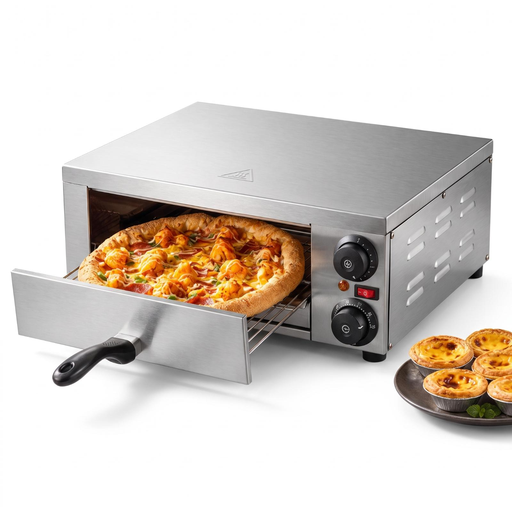
Stainless steel countertop pizza oven, 2000 W
This countertop oven is only worth considering if its design and stated features suit your recipe and the space you have available.
2000 W; temperature control up to 350 °C; timer from 0 to 15 minutes.
Good Food’s recipe gives a baking time of 15–20 minutes. Check how to use the timer for a longer baking time.
View at Joybuy
 No image available
Haier H6 ID23T3HTB built-in oven, 78 l
Could suit family meals if you’re looking for a built-in oven and its heating mode is right for your recipe.
78 l capacity, nine cooking functions and a baking tray with a height of 40 mm according to the product description.
Before buying, check that the model has the fan-assisted or hot air function your recipe needs.
View at Joybuy
Cheese scones and ovens: FAQs
What temperature should you use for cheese scones in a fan oven?
Good Food’s “Classic cheese scones” recipe recommends 180 °C in a fan oven or 200 °C without a fan, with a baking time of 15–20 minutes. It also says to preheat the oven and a baking tray; other recipes or scone sizes may need different settings.
Does the oven need to be preheated?
For Good Food’s cheese scone recipe, yes: it calls for both the oven and the baking tray to be preheated. The European Commission generally recommends preheating only when the recipe or appliance instructions call for it.
How does SteamShine cleaning work on the Beko BBIM12300X?
According to Beko, you add water to the oven cavity and start the cleaning programme; afterwards, wipe away any residue with a damp cloth. For other models, follow the relevant instructions.
What does the EU energy label tell you about energy use when baking?
For household ovens covered by the relevant rules, the label gives energy use per standard cycle for conventional baking and, where available, for fan-assisted cooking. The Verbraucherzentrale explains these figures; they don’t represent the measured energy use for your particular scone recipe. The European Commission states that small ovens fall outside the scope of the EU regulations mentioned for household ovens.


