Lunchboxes for several days
If you’re making larger batches of scones, tray space, extra baking rounds and explicit approval for multi-shelf use all need to work together.


A freestanding fan-assisted mini oven could suit you if you’re baking just a few cheese scones at a time. If you’re preparing several lunchboxes or want to bake on multiple shelves, usable tray space and explicit approval for multi-shelf baking on that model are key. First compare the amount of dough, the tray and the space available; then look at the heating functions and energy use. The capacity in litres alone won’t tell you how many scones will fit at once. A lunchbox isn’t a substitute for suitable refrigeration when it contains perishable foods.
If you’re making larger batches of scones, tray space, extra baking rounds and explicit approval for multi-shelf use all need to work together.
If you only bake a few scones at a time, check the dimensions and tray space of a freestanding oven against the space you have available.
If you want a built-in oven for other dishes too, you’ll need to consider whether it fits the available housing, as well as its fan function and energy use on a comparable basis.
A good fit if: You bake small to medium batches and don’t need a built-in oven. The manufacturer lists the Severin TO 2068 at around 20 l, with a fan function and separately or jointly selectable top and bottom heat; the CASO TO 26 SilverStyle has a capacity of 26 l.
What to consider: A smaller baking area may mean more baking rounds. The number of shelf positions alone doesn’t confirm that you can use several trays at once.
A good fit if: You’re preparing scones for several days or people, and have enough worktop space. According to the manufacturer, the Rommelsbacher BGE 1580/E has a capacity of 30 l, a fan function and four shelf positions.
What to consider: A larger appliance takes up more worktop space. Check whether the specific model is approved for baking on several trays at once.
A good fit if: You have a suitable housing or need a built-in oven anyway. Bosch lists the HBA571BB4 at 71 l, with 3D hot air for up to three shelves.
What to consider: The housing needs to be the right size. Energy use per standard baking cycle doesn’t measure the energy used to bake a small batch of scones.
| Buying priority | What to check | Who it matters most to |
|---|---|---|
| Batch size and tray space | Compare the number and size of your scones with the usable tray area. Only plan to bake on several shelves if the model is explicitly approved for it. | If you’re preparing several lunchboxes, the space available for scones on the tray matters more than the capacity in litres alone. Around 33% of consumers prioritise batch size. |
| Heating function and browning | Check the fan function, top and bottom heat, temperature range and timer for the full model name. Treat recipe temperatures as a starting point. | If you want to match a recipe’s heating method and keep an eye on browning, compare the available settings. Around 27% of consumers prioritise the heating function. |
| Worktop space and fitting | Compare the external dimensions, door clearance and required space around the appliance—or the dimensions of the housing—with your kitchen. | If worktop space is limited or you’re planning a built-in installation, the appliance needs to fit the space you have in mind. Around 20% of consumers say space requirements are their top priority. |
| Energy use and cleaning | Compare energy-use figures only on the same measurement basis. With countertop ovens, don’t use the wattage alone to estimate electricity costs. Check the cleaning instructions and whether there’s a removable crumb tray. | If you bake regularly on weekdays, you’ll want to consider the ongoing costs and cleaning. Around 20% of consumers put these running costs first. |
Oven capacity, internal dimensions and usable tray area are different things. The capacity in litres therefore won’t tell you how many scones will fit on a tray.
Compare the size and number of scones you plan to bake with the tray dimensions. Don’t assume you can bake on several shelves at once just because there are several shelf positions.
Energy labels for ovens covered by the regulations are based on standard baking cycles. Small and portable ovens aren’t covered by the same rules.
Compare energy-use figures only when they’re based on the same method of measurement. With a countertop oven, don’t estimate electricity costs from the rated power alone.
The German Federal Institute for Risk Assessment points out that perishable foods should be kept sufficiently cool while you’re out and about.
Let freshly baked scones cool before packing them. If they contain perishable ingredients, make sure they’re kept suitably chilled until they’re eaten.
If necessary, plan for suitable cooling during transport and at your destination.
Freestanding mini ovens. The BGE 1580/E is designed for larger batches, with a capacity of 30 l, a fan function and four shelf positions.
Compact freestanding baking and toaster ovens. The TO 2068 is a fan-assisted model for smaller batches.
Freestanding design ovens. The TO 26 SilverStyle combines a capacity of 26 l with a fan function and conventional heating methods.
Built-in ovens are an alternative if you have, or are planning, a suitable space for one.
This selection at Joybuy includes a built-in oven with 3D hot air and a compact countertop pizza oven for other baking jobs. Before buying, check that the appliance type, heating function and dimensions suit your kitchen and the baking you have in mind.
 No image available
For a kitchen with a suitable built-in housing; the product description specifies professional installation.
Capacity of 71 l and 3D hot air for up to three shelves.
Specified housing dimensions: 56–56.8 cm wide, 58.5–59.5 cm high and 55 cm deep.
 No image available
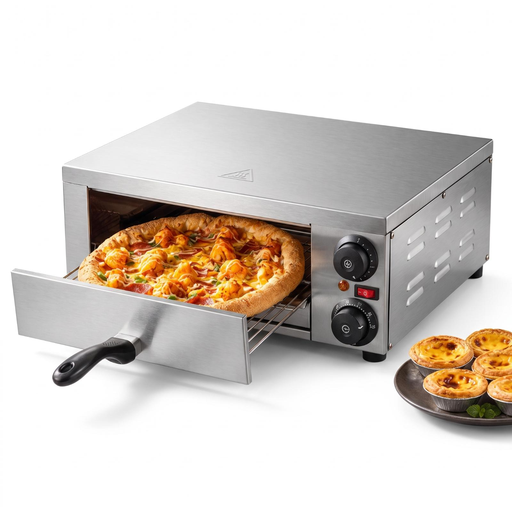
As a compact countertop oven, it could be worth considering for small baking jobs. Check that the heating function of the specific appliance suits your recipe.
The product information lists a temperature setting of up to 350 °C, a timer of up to 15 minutes and a removable crumb tray.
A Good Food recipe recommends 180 °C in a fan oven, or 200 °C without a fan, for around 15–20 minutes. Treat this as a starting point, not a setting tested for every model or scone size. Keep an eye on the colour and check that they’re cooked through.
No. The number of shelf positions alone doesn’t confirm that you can. Check the instructions and whether multi-shelf use is explicitly approved for the full model name. Make sure you also have suitable trays and enough room for the air to circulate.
The German Federal Institute for Risk Assessment recommends keeping perishable foods sufficiently cool until they’re eaten, including while you’re out and about. For perishable foods, it specifies a fridge temperature of 2 °C to no more than 7 °C. When transporting them, take the filling, topping and conditions at your destination into account.
According to the European Commission, small and portable ovens aren’t covered by the energy-labelling rules for household ovens. So, the absence of a label on one of these appliances doesn’t, by itself, tell you how efficient it is.
No. Information from the European Union explains that the CE mark indicates the manufacturer’s declaration that the product meets the relevant requirements; it isn’t automatically an independent test mark. Your statutory consumer rights are separate from a voluntary guarantee, which has its own terms and conditions.