Key buying considerations for cheese scones
Built-in oven with multi-level fan-assisted cooking
A good fit if: you prepare several batches on trays and have a suitable built-in space.
Things to weigh up: the space available, what’s included and the energy information all need to suit your needs; a multi-level specification isn’t a test of how the oven bakes scones.
Freestanding countertop oven
A good fit if: you bake smaller quantities, don’t have a suitable built-in space and can fit an appropriate tray inside.
Things to weigh up: batch size depends on the usable tray area; the appliance also needs the specified clearance from the surface it stands on and its surroundings.
The proportions refer to consumers choosing an oven for cheese scones as a weekday snack; each person’s main buying consideration is shown.
| What matters |
What to look for |
Who it matters most to |
| Tray area and batch size |
Usable tray dimensions and the number of trays supplied; specified cooking levels for multi-level baking. |
If I’m preparing scones for several weekdays, usable area matters more than the capacity in litres; around 33% of consumers in this selection context prioritise batch size. |
| Space for the oven |
For built-in ovens, check the dimensions of the housing; for countertop models, check the surface area and the minimum clearances for that model. |
If I don’t have a suitable built-in space, I need an appliance that can be positioned safely; around 27% of consumers in this selection context put the available space for installation or positioning first. |
| Heating functions and browning |
Check whether the model offers conventional top and bottom heat and fan-assisted cooking, and what temperature ranges are specified. |
If I’m following a recipe with different settings for conventional heat and fan-assisted cooking, the right heating function matters; around 20% of consumers prioritise control over the heat and browning. |
| Cleaning and energy information |
Check the cleaning function and accessories separately; compare kWh per standard cycle only where the labels are comparable. |
Frequent bakers want to keep cleaning manageable and understand energy use; around 20% of consumers put these ongoing considerations first. |
The Good Food recipe calls for 200 °C with conventional top and bottom heat, or 180 °C with fan-assisted cooking. Check your oven’s instructions and keep an eye on the browning rather than treating these recipe temperatures as a guarantee for every appliance or tray arrangement.
Joybuy products for cheese scones
The following Joybuy products include built-in and freestanding countertop ovens to suit different batch sizes and available spaces.
 No image available
Bosch HBG578ES3 built-in oven, 60 cm
The specified 3D fan-assisted cooking function may be useful if you’re baking on several trays; check the housing dimensions and which trays are included to make sure they suit your needs.
The product description specifies 3D fan-assisted cooking on up to three levels and one baking tray included. It lists top and bottom heat, a temperature range of 30–275 °C and pyrolytic cleaning.
Joybuy
 No image available
WOLTU BF12SZ mini oven, 32 l
For smaller batches when you don’t have a built-in space; check the tray and the space available for the oven before choosing.
The product description lists 1,600 W, a temperature range of 100–250 °C, a timer and a baking tray included as an accessory. A removable crumb tray is also specified.
Joybuy
 No image available
WOLTU mini oven, 10 l
For small batches and limited worktop space; check whether the tray is big enough for the batch of scones you’re planning.
The product description lists top and bottom heat, a temperature setting of up to 230 °C and a programmable 60-minute timer. A baking tray and wire rack are included; the glass door lets you keep an eye on what’s cooking.
Joybuy
 No image available
WOLTU mini convection oven, 28 l
If you’d like to use several trays in a countertop oven, check that the shelf positions and tray dimensions suit the quantity you’re making.
The product description lists three adjustable shelf positions, a baking tray and top heat, bottom heat and combined heating at 100–230 °C. A 60-minute timer and dishwasher-safe accessories are also specified.
Joybuy
 No image available
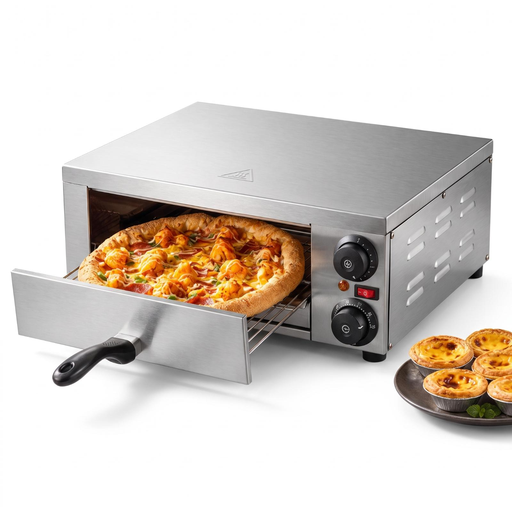
Stainless steel pizza oven, 2,000 W
Described as a compact worktop oven; before choosing it for scones, check whether the cooking surface, temperature settings and short timer suit the recipe.
The product description lists two heating elements, a temperature setting of up to 350 °C and a timer of 0–15 minutes. Other suggested uses include baking baguettes and egg tarts.
Joybuy
Frequently asked questions
Which oven setting is best for cheese scones?
Start with your recipe and the instructions for your particular oven. The Good Food cheese scone recipe calls for 200 °C with conventional top and bottom heat, or 180 °C with fan-assisted cooking, and a baking time of 15–20 minutes, until the scones are golden and cooked through. These are recipe instructions, not a general guarantee for every appliance.
How much clearance does a countertop oven need?
Follow the instructions for the particular model. The manufacturer’s FAQ specifies minimum clearances of 12 cm at the sides and back, and 30 cm above the Severin TO 2068; don’t assume these distances apply to other ovens.
How should I store cheese scones for a lunchbox?
The amount of chilling needed depends on the recipe, any additional toppings and how long the scones will be stored. The German Federal Institute for Risk Assessment advises keeping perishable foods sufficiently cool until they’re eaten and maintaining the cold chain during transport. This doesn’t mean every type of cheese scone can safely be kept unrefrigerated.
How can I check energy use, and does the energy label apply to mini ovens?
For domestic ovens covered by the relevant requirements, the EU energy label shows information including oven capacity and kWh per standard cycle for conventional cooking and, where applicable, fan-assisted cooking. The European Commission excludes small ovens from the scope of the regulations mentioned here. So, if a countertop oven doesn’t have a comparable label, that doesn’t prove its energy use is especially high or low.
What are my rights in Germany if my oven is faulty?
Your statutory rights against the seller are separate from any voluntary guarantee. The Verbraucherzentrale (German Consumer Advice Centre) gives a general period of two years from delivery and notes that, for sales contracts from 31 July 2026, there are also changes to your rights if you choose a repair.


