Holidaymakers without a suitable oven
You mainly need a practical way to bake, so before choosing a freestanding model, check the space available, the power connection and where you can set it up.


If the holiday cottage already has a suitable oven, first check its heating method and baking tray; you don’t need an additional oven just for cheese sticks. If there isn’t a suitable oven, choose a freestanding model based on the usable tray area, the quantity you want to bake, the heating method and a safe place to set it up—not just its capacity in litres. The recipe cited by REWE specifies 180 °C fan-assisted cooking and a baking time of 10–15 minutes after preheating. These timings are not a guarantee for every oven.
You mainly need a practical way to bake, so before choosing a freestanding model, check the space available, the power connection and where you can set it up.
If you’re serving lots of cheese sticks, the usable baking tray area and the number of batches you’ll need matter more than the capacity in litres alone.
A smaller oven may be enough for small quantities, provided the tray fits and there’s enough space between it and the heating elements.
The recipe cited by REWE calls for 180 °C fan-assisted cooking, preheating and a baking time of 10–15 minutes. These instructions may not apply in the same way if you’re using a different heating method or recipe.
| What you need | What to check before buying | Who is this important to? |
|---|---|---|
| Suitable heating method | Check whether the specific model offers fan-assisted cooking or conventional top and bottom heat, and whether you can set the temperature you need. | If I want to follow the recipe as closely as possible, I’ll check the heating method and temperature settings. Around 42% of consumers have this priority. |
| Space per batch | Compare the dimensions of a suitable tray with your shaped cheese sticks, allowing enough space between them. Check whether the specific model can be used on multiple levels at once. | If I’m catering for a larger group, I want to fit as many cheese sticks as possible in each batch. Around 33% of consumers prioritise the number of guests they’re serving. |
| A safe place to set it up | Measure the space you have in mind and check the required clearances and the correct power connection for the specific appliance. | If kitchen space is limited, the oven needs to fit in the available space and be safe to set up there. Around 25% of consumers say the space available is their main priority. |
The oven’s capacity alone doesn’t tell you how many long cheese sticks will fit on a suitable tray.
Compare the tray and internal dimensions of the exact model with the size of your cheese sticks, and check whether a tray is included.
A smaller tray may mean you need to bake extra batches; you may also need to buy a suitable tray separately.
The number of shelf positions doesn’t prove that the oven is suitable for baking cheese sticks on multiple trays at once. A Rommelsbacher service note refers to “BG 1580/E”, while the product page and tray overview list “BGE 1580/E”.
Check the manual or contact the manufacturer directly to confirm whether you can use multiple levels with the full model number.
An appliance may fit on the worktop but still not have the required clearance. The manual for the Steba KB M19 specifies a 10 cm gap between the back of the appliance and the kitchen wall.
Measure the space you have in mind and check the set-up requirements and power connection before buying.
The wattage alone doesn’t show how much electricity a particular batch will use. The Verbraucherzentrale notes that the appliance’s actual energy consumption is what matters.
Only compare energy consumption figures when the usage conditions and basis for measurement are the same. Don’t assume a larger or smaller appliance will automatically save energy.
The BGE 1580/E is a freestanding 30-litre model for anyone comparing tray dimensions and heating methods.
The KB M19 is a 19-litre option for smaller portions and limited worktop space.
The TO 2058 is a 42-litre model for buyers looking for a larger freestanding oven with fan-assisted cooking.
The MBG 3726 is a 20-litre option for smaller batches, with top and bottom heat.
These freestanding countertop ovens range from compact models to larger options. The space available and the tray area you need for the quantity you’re baking are still the key considerations.
 No image available
A freestanding option if there isn’t a suitable oven in your holiday cottage; check first that you have enough space to set it up.
32 l, 1600 W, 100–250 °C, timer and crumb tray; the product title lists a baking tray and rack.
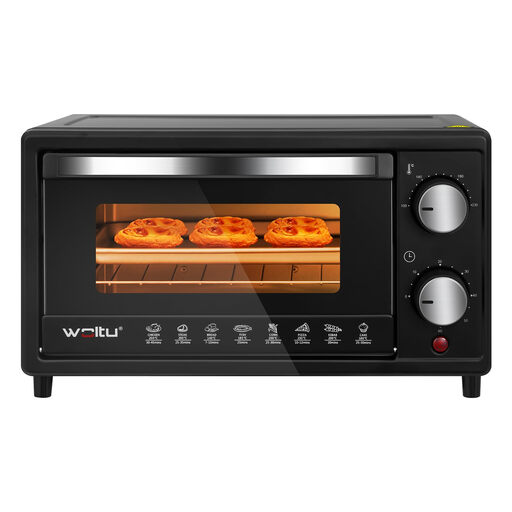 No image available
For smaller batches when a compact freestanding oven suits your needs; check that the tray has enough room for your shaped cheese sticks.
10 l with a temperature setting of 100–230 °C.
 No image available
A larger freestanding option if you’re baking for several people; check that the tray area you need fits the space available.
28 l, temperature control and timer.
The REWE recipe cited recommends 180 °C fan-assisted cooking for 10–15 minutes after preheating. Check the food as it bakes and follow the instructions for a different recipe or heating method; the recipe’s timings are not a guarantee for a particular model.
Don’t assume you can just because the oven has several shelf positions. A Rommelsbacher service note for the appliance referred to as “BG 1580/E” mentions preheating, fan-assisted cooking and keeping the airways clear, among other things. As the product page and tray overview list “BGE 1580/E”, check that using two trays at once is approved for the exact model before doing so.
Follow the manual for the model you choose. For the Steba KB M19, it warns that surfaces get hot and specifies a 10 cm gap between the back of the appliance and the kitchen wall; this clearance doesn’t automatically apply to other ovens. Let the appliance cool before cleaning and follow the relevant manufacturer’s instructions.
No. The Verbraucherzentrale distinguishes between your statutory rights against the seller and a voluntary guarantee, which is subject to its own terms and conditions. For replacement trays and repairs, also check the service information for the specific model.
New electrical equipment covered by low-voltage rules must carry CE marking before it is placed on the market. The Bundesanstalt für Arbeitsschutz und Arbeitsmedizin gives the rated voltage range covered by these rules as 50 to 1000 V AC. CE is a manufacturer’s declaration of conformity, not an independent quality seal for baking results.