For whole pieces or a small chess position on a cramped table, a mirrorless camera kit with a standard zoom lens may be a good fit, provided you get the framing and distance right. For tiny engravings, a compact camera with a documented close-up mode is a straightforward option, while a separate macro lens on a mirrorless camera gives you more control over magnification. A close-focusing distance alone does not guarantee the right framing: remember to plan your lighting and set-up too, as the shallow depth of field at close range may mean stopping down or using focus stacking.
Which camera is right for you?
For photographing full chess positions
If you want to photograph pieces or a small position repeatedly from a similar angle, getting the framing right is the first priority. Canon Deutschland and Nikon Deutschland provide details of standard zoom kits, so you can compare their framing with your table space and the distance available between the camera and the subject.
For photographing fine details on chess pieces
For carvings, surface details or damage to individual pieces, the close-up mode, magnification and working distance all matter. Canon Deutschland, Nikon Deutschland, OM SYSTEM Deutschland and Ricoh Imaging Europe describe different lens and compact camera options for this purpose.
For photographing in indoor light
If you’re photographing stationary pieces of different heights, plan for sharpness and lighting together rather than relying on image stabilisation alone. Canon Academy and Nikon Deutschland explain how a stable set-up and adjustable lighting can help with close-up photography.
What should you look for when buying?
Mirrorless camera with a standard zoom
A good fit if: You want to photograph whole pieces, groups and different compositions, and would like to start with the lens included in the kit.
Consider: A standard zoom is not automatically a macro lens. Canon states that the RF-S 18–45 mm offers a maximum magnification of 0.16x at 45 mm.
Compact camera with a built-in close-up mode
A good fit if: You’d like to get very close to individual details from time to time, without changing lenses. OM SYSTEM states that the TG-7 has a close-up mode from 1 cm, as does Ricoh Imaging Europe for the PENTAX WG-90.
Consider: A focusing distance of 1 cm alone doesn’t tell you how large the subject will appear in the image or how much room you’ll have for lighting.
Mirrorless camera with a macro lens
A good fit if: You want to capture fine carvings at a large size and choose the lens and shooting distance carefully. Nikon states that the Z MC 50 mm f/2.8 offers 1:1 magnification, while Canon gives a 1:2 ratio for the RF 35mm F1.8 MACRO IS STM.
Consider: These macro lenses are separate additions to the standard zoom kits described here, and depth of field becomes shallow at close range.
| Buying criterion |
What to check before buying |
Who it matters most to |
| Whole pieces on a small table |
Compare the table space and possible camera distance with the framing offered by the specific lens. |
If you want to fit a whole piece or a small position into the frame, the available framing is key. Around 31% of consumers prioritise an overall view. |
| Fine details |
Compare the magnification or documented framing, as well as the usable distance in front of the lens. |
If you want to show carvings or surface details at a large size, the close-up performance of the specific lens or mode matters. Around 31% of consumers put details on chess pieces first. |
| Depth of field and lighting |
Allow space for a stable set-up and adjustable lighting; if needed, check the process for capturing multiple focus planes. |
If you want pieces of different heights to appear sharp throughout and evenly lit, a controlled set-up is important. Around 23% of consumers prioritise lighting and depth of field. |
| What’s included in the kit |
Check whether the lens, power supply and, where applicable, close-up lighting are included; factor in any extras you need separately. |
If you want to use the kit without unplanned add-ons, check exactly what’s included. Around 15% of consumers prioritise having everything they need in the initial purchase. |
Common misconceptions when buying a camera
-
Assuming the camera body or kit name means “macro”
The magnification figures given apply to specific lenses: Canon states that the RF-S 18–45 mm offers up to 0.16x magnification, while the separate Z MC 50 mm from Nikon offers 1:1.
Check the name of the lens actually included and its magnification against the size of the smallest detail you want to photograph.
A suitable macro lens may be an additional purchase.
-
Taking a 1 cm focusing distance as the whole story for close-ups
A short focusing distance alone doesn’t tell you what framing you can achieve or how much room there is in front of the camera for lighting. OM SYSTEM gives this distance for the TG-7, and Ricoh Imaging Europe gives it for the PENTAX WG-90.
Check the framing you want and leave enough room for effective lighting at your chosen distance.
-
Relying on image stabilisation alone when photographing several pieces
Depth of field is shallow at close range, and stopping down can mean a longer exposure time. Focus stacking requires multiple images of a static subject to line up precisely.
Start by trying a stable set-up and adjustable lighting. Only plan to use focus stacking if you’re happy to take on the extra shooting and editing work.
A tripod, light or image-editing software may add practical effort.
Brands to consider
Canon
Canon describes the EOS R50 kit with RF-S 18–45 mm as a standard zoom set for overall views. The RF 35mm F1.8 MACRO IS STM is a separate option for closer details.
- Canon says the kit includes a vari-angle screen.
- Canon states that the RF-S 18–45 mm offers up to 0.16x magnification; the 1:2 figure applies to the separate RF 35mm F1.8 MACRO IS STM.
Nikon
The Z50II kit with Z DX 16–50 mm is a standard zoom set. The separate Z MC 50 mm f/2.8 is aimed at photographers who need 1:1 magnification.
- Nikon gives a 1:1 ratio for the separate macro lens.
- Nikon states that the Z50II kit considered here does not include a charger. The stated distance of around 5 cm from the subject applies to the macro lens at its closest focusing distance.
OM SYSTEM
The TG-7 is a compact camera with a built-in microscope mode; the Micro Adventure Kit also includes the LG-1 light guide.
- OM SYSTEM states that the microscope mode can focus from 1 cm.
- The distance in centimetres alone doesn’t determine the framing. When choosing, distinguish between the camera on its own and the kit with the light guide.
PENTAX
Ricoh Imaging Europe describes the WG-90 as a compact camera with a digital microscope function and built-in LED macro lights.
- Ricoh states that it can shoot from 1 cm and has six LED macro lights.
- The European product page described here is aimed at B2B customers placing orders.
Sony
The ZV-E10-II kit with E PZ 16–50 mm F3.5–5.6 OSS II may be worth considering if video is also a buying priority alongside photography.
- Sony states that the included lens offers a maximum magnification of 0.215x.
- Sony gives the minimum focusing distance as 0.25 m at the wide-angle end and 0.30 m at the telephoto end; this doesn’t mean the lens is especially suitable for photographing chess pieces.
Suitable products on Joybuy
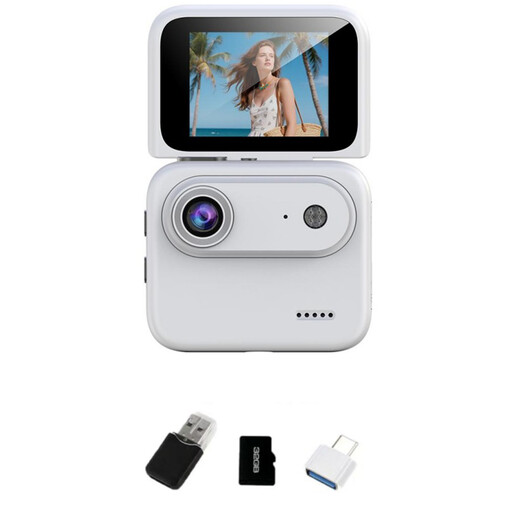
This selection includes a 4K mini action camera with a stated 143° wide-angle lens for a broad view. At a small table, check whether the perspective and framing suit your chess pieces.
 No image available
NAXSIR 4K Mini Action Camera, 32 GB TF Card, 2.0-inch flip screen, 143° wide-angle lens, built-in image stabilisation, White
The stated 143° wide-angle lens may be useful for a broad view of a chess position; check whether the perspective and framing work on your actual table.
4K; 32 GB TF Card; 2.0-inch flip screen; built-in image stabilisation.
Joybuy
Frequently asked questions
Is a standard zoom enough for individual chess pieces?
A standard zoom may be enough for a whole piece if the distance and framing you want work together. For very small details, check the framing offered by the specific lens: Canon states that the RF-S 18–45 mm offers up to 0.16x magnification, not 1:1.
How can I get a piece sharp from front to back?
For stationary pieces, secure the camera, try a smaller aperture and adjust the lighting. Stopping down increases depth of field, but may require a longer exposure time. If one shot isn’t enough, Canon Academy describes combining precisely aligned images taken at different focus planes using a tripod.
Which extra items should I compare when choosing a kit?
Check the lens, power supply and lighting in particular. Nikon notes that the Z50II kit considered here doesn’t include a charger; the NIKKOR Z MC 50 mm is a separate lens. OM SYSTEM specifically lists the LG-1 light guide as part of the TG-7 Micro Adventure Kit.
What statutory rights do I have when buying a camera in Germany?
For a defect in the goods, statutory claims generally become time-barred two years after delivery under § 438 BGB for an ordinary purchase. Statutory liability for defects is separate from a voluntary manufacturer’s warranty; specific consumer protection rules depend, among other things, on the type of contract and the individual circumstances.


