For a supervised school chess club, your choice should depend on whether the organiser needs an AI opponent that works locally, a range of practice activities or both; a high advertised maximum playing strength alone won’t answer that question. Chessnut describes offline AI play for the Move, while Particula lists LED guidance and a companion app system for GoChess XR. Check how the specific version works, how visible it is, its power requirements and the documentation before using it.
Who might be interested in a chess robot?
Organisers who lead group games
You’d like to use a computer as a shared opponent while controlling the settings and how moves are played. MILLENNIUM Chess describes this use case for traditional chess computers; try out the specific device to see whether the same approach works with a robotic chessboard.
Club leaders working with mixed abilities
You’re looking for different difficulty levels, set positions or adjustable hints to suit learners at different stages. Manufacturers document these features for individual models, but that doesn’t tell you how effective they’ll be for teaching.
Organisers who want to focus on offline use
You’d like to run supervised AI games without an internet connection and consider online features separately. Chessnut describes offline play for the Move; app and online functions need to be checked separately.
What should you consider when choosing one?
Start by working out how the group will follow a game together and what activities you want to lead. Then check local operation and how the sessions will work in practice.
| What you need |
What to check before buying |
Who is it important to? |
| Following moves as a group |
Have the organiser run a game and check the move display, piece movement and visibility from the seats you plan to use. |
When I discuss a game with the group, everyone should be able to follow the moves from their own seat. Around 28% of consumers put an easy-to-follow shared experience first. |
| Practice for different ability levels |
Try out suitable difficulty levels, set positions and the hints available in the specific software version. |
When abilities vary, I want to be able to choose activities and hints to suit the group. Around 28% of consumers prioritise practice activities for different levels. |
| Local AI play |
Test an AI game without an internet connection, and distinguish core functions from app, set-up and online features. |
If I want to avoid pupil accounts but still run a supervised AI game, I need to be able to tell local and online functions apart. Around 22% of consumers prioritise core features that work locally. |
| Set-up and handling |
Check the instructions for the specific version, including power, set-up and moving parts; plan for charging and supervision. |
When the board is used in a group room, I want to build charging, set-up and supervision into the session. Around 22% of consumers put room organisation and ease of use first. |
Common buying mistakes
-
Confusing an electronic board with a robotic chessboard
Particula distinguishes GoChess Lite and Mini from the robotic XR models. An electronic chess function alone doesn’t mean that the pieces move automatically.
Check the full model name and whether automatic piece movement is explicitly described, rather than relying on general terms such as ‘smart’ or ‘electronic’.
Getting the two confused could mean having to buy another product.
-
Assuming offline AI means everything works offline
Chessnut describes local AI games for the Move, but online opponents are accessed through the app. Online learning features involving personal data need to be assessed separately.
Make separate lists of features for local play and optional app or online functions.
Additional app and network features may require checks around data protection and set-up.
-
Assuming maximum playing strength or the number of activities guarantees suitable differentiation
Manufacturers list AI levels and numbers of activities, but that alone doesn’t show whether the easier levels and hints will suit your group.
Try typical beginner activities, suitable opponent levels and the hints you plan to use during sessions.
-
Only thinking about the board when planning charging
According to the manufacturer, the Chessnut Move’s pieces also have their own batteries and motors, so they need to be included in charging and checks.
Include a check of the complete set of pieces and charging in line with the instructions in your handover between club sessions.
Brands worth considering
Chessnut
For supervised games, the Move range is the one to consider; not every electronic chessboard from the brand is necessarily suitable.
- Chessnut describes the Move as having a built-in chess engine, position import and automatic piece set-up. The manufacturer also documents an offline mode for AI games.
- Online opponents are accessed through the app. Pieces with their own batteries and motors add extra checks and charging to your routine.
Particula
GoChess XR is aimed at buyers who want automatic piece movement alongside LED guidance; according to Particula, Lite and Mini are not robotic alternatives.
- Particula lists a companion app system for iOS and Android, LED coaching and 32 AI difficulty levels for GoChess XR.
- According to Particula, GoChess 1XR moves one piece at a time, while 4XR moves up to four at once. This feature doesn’t prove that either is better suited to group lessons.
SenseRobot
SenseRobot Chess is worth considering as a robotic-arm solution with training features. Chess, Chess Lite and Chess Mini are different products, so details for one model shouldn’t be assumed to apply to another.
- For Chess, SenseRobot advertises 26 AI levels, more than 1,200 practice activities, 145 endgame exercises and 100 classic games.
- These manufacturer claims describe the features on offer, not independently verified explanation quality or effectiveness in schools.
Chess robots at Joybuy
This product selection includes robotic-arm chess robots; one item is a bundle with an additional Ropet AI Pet Robot.
 No image available
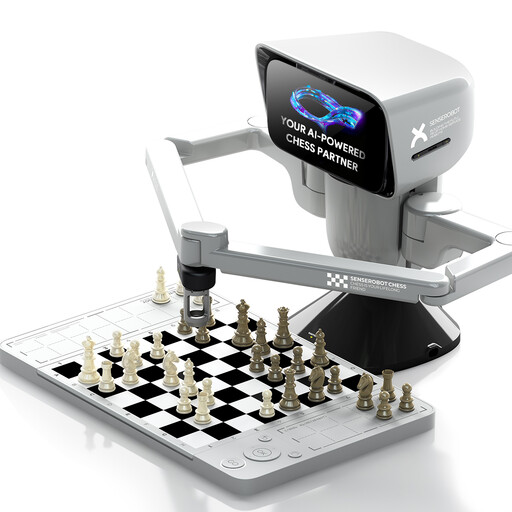
SenseRobot Mini AI chess robot
If you want computer moves to be played visibly on the board, the product title mentions a robotic arm and app connectivity.
The title also mentions support for 3D-printed DIY pieces and a portable travel design. Check that the app set-up and board placement will work in your group room.
View at Joybuy
 No image available
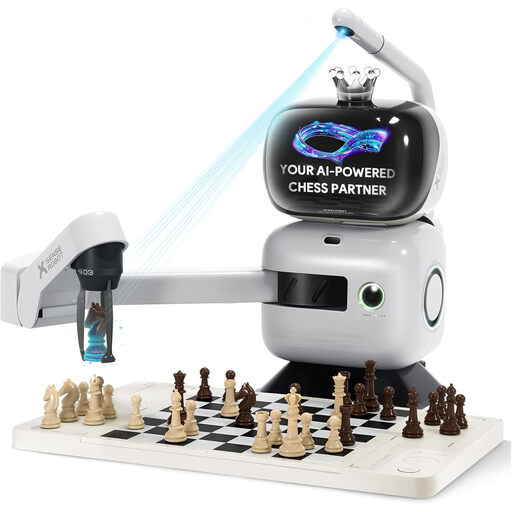
SenseRobot AI chess robot with robotic arm, 25 AI levels
For supervised practice, the product title lists training activities, endgame practice, game replay and voice guidance.
The title lists 25 AI difficulty levels and more than 1,200 training activities. According to the product description, the board should be placed on a stable, level surface. Keep hands, fingers, hair, loose clothing and small objects away from the moving arm while it is in use.
View at Joybuy
 No image available
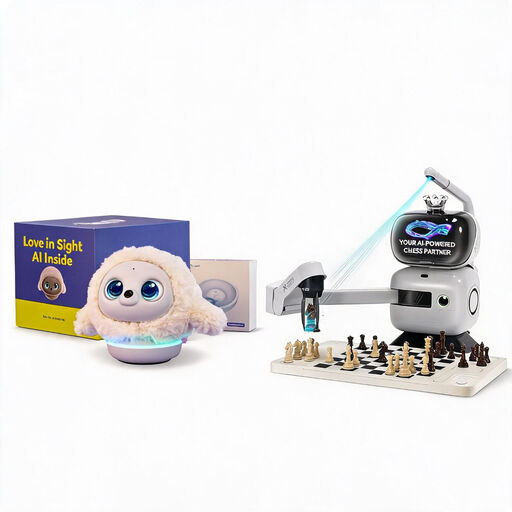
Ropet AI Pet Robot (Professional Edition) + SenseRobot AI Chess Robot
The product title describes a bundle with a SenseRobot chess robot with a robotic arm and an additional Ropet AI Pet Robot.
If you’re choosing a device for a school club, bear in mind that the chess robot is not sold on its own here. The title also lists AI levels, training activities, endgame practice and game replay.
View at Joybuy
Frequently asked questions
Does every pupil need an online account?
An internet connection isn’t needed for the offline AI game with the Move described by Chessnut; the organiser can choose the difficulty on the device. This doesn’t tell you whether accounts, set-up or data processing are required for any additional features. Pupil accounts involving personal data are outside the scope of this buying guide.
Can one chess robot serve several practice groups at once?
Start by planning to use a single board as a shared station or with one group at a time. Particula says that GoChess 4XR can move up to four pieces at once; that doesn’t mean it can run several independent games. The available manufacturer information doesn’t show that one board can host multiple separate group games simultaneously.
Do GoChess Lite and GoChess Mini also move the pieces themselves?
No. Particula distinguishes the non-robotic Lite and Mini models from GoChess XR. The manufacturer lists the 1XR and 4XR versions as having automatic piece movement.
How should the organiser manage charging and maintenance?
According to the manufacturer, the pieces and their individual batteries are also part of the Chessnut Move’s charging routine. Decide who will check the set of pieces after each club session and charge them in line with the specific instructions. Don’t assume the same routine applies to boards with built-in robots or a robotic arm.
What does CE mean when choosing an electronic chess robot?
The European Commission places CE marking within the EU conformity framework for certain product groups, including electrical and electronic equipment and toys. You’ll need to check which requirements apply to the specific product version. CE marking is not an educational assessment and, on its own, doesn’t prove that a product is suitable for the intended group room.


