Hosts who like to have baked goods ready
If you regularly prepare several portions for shared meals, compare the space you need with the room taken up by your other frozen food.


For the occasional batch of baked goods, your existing freezer compartment should be enough, as long as everything fits alongside your other frozen food. A separate chest freezer is mainly worth considering if you regularly freeze larger quantities; the consumer advice centre lists regularly freezing larger quantities as one reason to buy a separate freezer. The key factors are how much space you need at once, how easy it is to reach individual portions, annual energy consumption and whether the specific model is suitable for where you plan to put it.
If you regularly prepare several portions for shared meals, compare the space you need with the room taken up by your other frozen food.
If you want to find small, labelled portions easily, look for a suitable internal layout and keep opening times short. The consumer advice centre recommends labelling frozen food with its contents, quantity and date of storage.
If you need extra freezer space, consider the appliance dimensions, where you plan to put it and its annual energy consumption together.
A good fit if: You only add a few portions now and then, and there’s enough room for them in your existing freezer.
The trade-off: You won’t need another appliance, but you’ll need to check there’s room alongside your other frozen food.
A good fit if: You regularly freeze larger batches, but have limited floor space and storage needs.
The trade-off: Its smaller capacity limits how much extra food you can store; make sure the baskets and internal layout suit your portions.
A good fit if: You regularly need space for plenty of other frozen food as well as baked goods.
The trade-off: A larger capacity takes up more floor space and could go unused.
| Priority | What to check when buying | Who is it important to? |
|---|---|---|
| Space for frozen food | Work out how much you need to store at once; compare the model’s usable capacity in litres and its external dimensions. | If I need to store baked goods and other frozen food at the same time, I plan for my largest batch. Around 36% of consumers prioritise having enough storage space. |
| Access to individual portions | Check the number and dimensions of the baskets, and allow room for suitable labelled containers. | If I want to find individual portions quickly, I look for an organised way to store them. Around 29% of consumers say their main priority is being able to take out individual portions in an orderly way. |
| Energy consumption | Compare the annual consumption in kWh of appliances with a suitable capacity, and work out the cost using your own tariff. | If I’m running an extra appliance all the time, I want to include its consumption in my ongoing costs. Around 21% of consumers prioritise running costs. |
| Where you’ll put it | Measure the available floor space and the route for moving the appliance; check the specific model’s permitted ambient temperature. | If the chest freezer is going in a cellar or garage, it needs to suit the available space and the conditions there. Around 14% of consumers say the location is their main priority. |
The space you need depends on the largest amount you’ll store at once, not just the number of guests you’re having for one evening. An oversized freezer that goes unused takes up floor space and may use electricity unnecessarily.
Work out how much room you need for baked goods and other frozen food, then compare suitable capacities and the annual consumption of specific models.
Unused capacity takes up floor space and can increase your ongoing electricity consumption.
The energy rating alone doesn’t tell you how much it will cost to run on your electricity tariff.
Compare the model’s consumption in kWh per year for a suitable capacity, and calculate the cost using your own electricity price.
It’s easy to overlook ongoing electricity consumption when comparing different appliance sizes.
Suitability for low ambient temperatures varies by model, so you can’t assume every chest freezer will be suitable.
Check the permitted ambient temperature in the documentation for the specific model on offer.
The GTE 150MD is a chest freezer with 142 l of usable capacity and a WinterProof rating for ambient temperatures down to −15 °C.
The HCE200C is a chest freezer with 196 l of usable capacity and a C energy rating.
According to the manufacturer, the AEG AHB531D1LW offers 308 l of usable capacity and three baskets.
The CFd 2085 Plus is a chest freezer with 248 l of usable capacity and a FrostProtect rating down to −15 °C.
The freestanding Beko HSA24540N is a chest freezer with 230 l of usable capacity.
The following chest freezers available at Joybuy offer extra space for batches of baked goods, from smaller appliances to models for storing more at once.
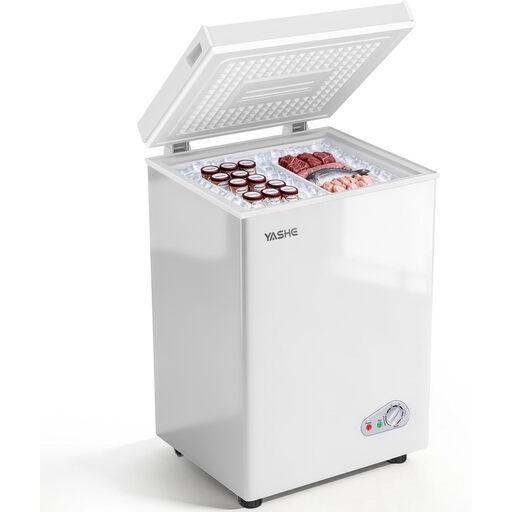 No image available
A more compact option for extra portions of baked goods when space is limited.
Freestanding; two removable baskets; six temperature settings.
 No image available
A more compact chest freezer for extra portions when you have limited space for other frozen food as well as baked goods.
E energy rating; seven temperature settings; removable basket.
 No image available
A small chest freezer for extra portions when floor space and storage needs are limited.
E energy rating; seven temperature settings; removable basket.
 No image available
The larger capacity is worth considering if you regularly need space for other frozen food as well as baked goods.
E energy rating; interior light; five temperature settings; removable basket.
 No image available
A larger option than the smaller models if you want to store portions of baked goods alongside other frozen food.
E energy rating; five temperature settings; removable basket.
Yes, as long as all the portions you need fit alongside your other frozen food. The consumer advice centre lists regularly freezing larger quantities as one reason to buy a separate freezer.
Use suitable freezer containers and label them with the contents, quantity and date of storage. The consumer advice centre says you can bake some items straight from frozen; you should assess delicate fillings and the specific type of baked good separately.
The consumer advice centre recommends −18 °C as the optimal temperature for a chest freezer or freezer. This is a storage recommendation, not a legal minimum requirement for buying an appliance.
Multiply the annual consumption in kWh shown on the EU energy label by your electricity price in euros/kWh. The label figure is based on standardised conditions; actual use and where you put the appliance may affect consumption.
The EU energy label must be clearly visible in online shops for new appliances in product groups where labelling is required. The European Union’s Your Europe information explains the A to G scale; check the details on the specific product listing.