Lunchboxes with limited freezer space
If you portion out bananas for weekdays, first check whether your existing freezer compartment has enough room for the week’s portions and for pre-freezing. The BZfE describes freezing ripe bananas in slices.


Your existing freezer compartment will usually be enough for a few prepared portions of banana, provided there is enough room to pre-freeze and store them alongside your other food. An additional chest freezer is more useful if you regularly freeze other supplies or larger quantities. If so, compare usable capacity, annual energy consumption and the space it will take up: the Verbraucherzentrale warns that an appliance that is too large can use electricity unnecessarily. Thawed bananas may become soft, and freezing them does not replace keeping the lunchbox at a suitable temperature until it is time to eat.
If you portion out bananas for weekdays, first check whether your existing freezer compartment has enough room for the week’s portions and for pre-freezing. The BZfE describes freezing ripe bananas in slices.
If you regularly freeze larger quantities of other foods as well as fruit, extra, well-organised storage could be useful. The Verbraucherzentrale recommends choosing an appliance size to suit your actual needs.
If you’re considering a second appliance, check that its external dimensions, the clearance needed to open the lid and the route to its intended location are all suitable. Remember to include the additional electricity consumption in your comparison.
A good fit if: your labelled weekly portions and the space needed to pre-freeze them fit alongside your other food.
The trade-off: Space is limited, but you won’t have a second appliance running all the time.
A good fit if: your existing compartment repeatedly proves too small and you have a suitable space for another appliance.
The trade-off: It gives you extra room, but takes up space and uses electricity, even when you’re not freezing bananas.
A good fit if: you regularly store or freeze larger quantities of other food as well as lunchbox portions.
The trade-off: More capacity only makes sense if you need the extra space; an appliance that is too large can use electricity unnecessarily.
| Priority | What to check when buying | Who is it important to? |
|---|---|---|
| Do I need a second appliance? | Consider your weekly portions, the space needed to pre-freeze them and your other frozen food together when checking your existing compartment. | If I only need a few portions for lunchboxes, I don’t want to make room for an appliance just to store things I won’t use. For around 36% of consumers, the key question is whether they need an additional freezer. |
| Easy-to-reach portions | Check that the baskets and interior layout suit small, labelled packs; if needed, pre-freeze slices with a little space between them. | If I take out individual portions on weekdays, I want to find them easily rather than search for them under other food. Around 29% of consumers prioritise easy access to individual portions. |
| Energy consumption | For appliances of a suitable size, compare the annual consumption in kWh shown on the EU energy label. | If I buy a second appliance, I want to weigh its running costs against how much freezer space I actually need. Around 21% of consumers focus primarily on this comparison. |
| Space for the appliance | Check the external dimensions, clearance for the open lid and delivery route; if you plan to keep it in an unheated room, check that the specific model is suitable. | If there’s limited space where I plan to put it, I want to make sure the appliance will fit and the lid can be opened. For around 14% of consumers, finding a suitable location is the main consideration. |
An appliance that’s larger than you need can use electricity unnecessarily. For a few portions each week, your existing freezer compartment may be enough, as long as there’s sufficient room.
Work out how much space you need over a typical week and check whether the portions fit alongside your other frozen food before planning to buy a second appliance.
The BZfE explains that fruit can become soft when thawed after being frozen relatively slowly at home. The texture you want isn’t determined by the appliance alone.
Try freezing a small portion before preparing larger quantities for lunchboxes.
An appliance may need extra clearance, and you’ll need to be able to open the lid where you plan to put it.
For the specific model, check the external dimensions, required clearance from the wall, space for the open lid and the route for moving it into place.
The white Exquisit GT100-050E is an example of a compact chest freezer. Exquisit lists a usable capacity of 99 l and a freezer basket.
Beko’s chest freezers include the HSM14550, with a capacity of 148 l, and the HSM22340, with a capacity of 230 l.
According to the manufacturer, the Haier HCE200C is a freestanding chest freezer with a capacity of 196 l and energy efficiency class C.
The Liebherr CFc 1875 Plus is a chest freezer with a capacity of 192 l. The manufacturer lists FrostProtect for ambient temperatures down to −15 °C.
The Joybuy products below are chest freezers that offer extra freezer space. Before choosing, check that the usable capacity, interior layout and installation dimensions suit your needs.
 Image unavailable
An option if you regularly want to freeze extra portions for lunchboxes.
Usable capacity of 142 l and a 4-star freezer compartment.
Manual defrosting is listed, so remember to factor in the extra maintenance.
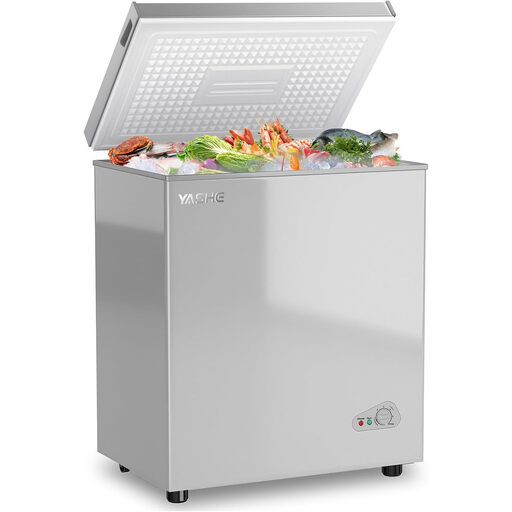 Image unavailable
The listed interior layout is useful if you want to store smaller packs separately.
The product title lists a capacity of 150 l, two removable baskets and six temperature settings.
 Image unavailable
Switchable modes could suit you if you’d like the option of using it as a fridge as well as a freezer.
The product title lists a capacity of 141 l, energy efficiency class E and seven temperature settings. A removable basket is also mentioned.
 Image unavailable
The larger capacity is more likely to suit households storing other food as well as bananas.
The product title lists a capacity of 291 l and energy efficiency class E. Switchable fridge and freezer modes and a removable basket are also mentioned.
 Image unavailable
The mid-sized capacity could suit you if you regularly need extra storage; compare it with the space you’ll actually use.
The product title lists a capacity of 197 l and energy efficiency class E. Switchable fridge and freezer modes and a removable basket are also mentioned.
No. First check whether the portioned slices fit in your existing freezer compartment. The Verbraucherzentrale recommends choosing an appliance size to suit your actual needs and warns that appliances that are too large use electricity unnecessarily.
First pre-freeze the prepared slices with a little space between them, then transfer them in portions to suitable freezer bags or containers. The BZfE describes this method for fruit; it’s a way to prepare food, not a special appliance feature.
Don’t count on it: the BZfE explains that fruit can become soft after thawing if it has been frozen relatively slowly at home. Try a small portion if texture matters to you.
No. Frozen bananas don’t provide a generally safe transport time for a lunchbox. The Federal Institute for Risk Assessment stresses the importance of suitable temperatures during transport and storage; consider the cooling needs of all perishable ingredients separately.
The EU energy label includes information such as the efficiency class, annual consumption in kWh and capacity. Compare energy consumption between models that are the right size for your needs, rather than looking only at the efficiency class or maximum usable capacity.