What should you look for when buying?
Keep using your existing freezer
A good fit if: There’s room for your prepared portions and you don’t plan to store larger quantities in the freezer regularly.
Consider: You won’t need another appliance, but banana portions may take up space you need for other frozen food.
Compact chest freezer
A good fit if: You regularly need extra freezer space, but the amount you store and the space available are limited.
Consider: Even a small second appliance needs a permanent spot and uses electricity. Check the dimensions and annual energy consumption of the specific model.
Medium or large chest freezer
A good fit if: You regularly freeze larger quantities of other food or prepared meals as well as bananas.
Consider: Extra storage space isn’t automatically worth the room it takes up if you won’t use it. Storing more food may also mean you need to keep it better organised.
Start by estimating how many portions and other foods you plan to store at the same time. For appliances that are the right size, compare usable capacity, external dimensions and annual energy consumption in kWh. The consumer advice centre recommends −18 °C as the optimal temperature for freezers.
| Priority |
What to check when buying |
Who will find this especially important? |
| Taking out portions separately |
Check that there are enough baskets and easy-to-reach storage spaces for labelled packs. |
If I want to use banana slices at different times, I need separate portions that are easy to reach. Around 36% of consumers put easy access to portions first. |
| Finding extra freezer space |
Estimate how much food you regularly need to store at the same time, and measure the space, access route and clearance needed to open the lid. |
If I regularly run out of room for bananas and other food, I need enough extra freezer space. Around 29% of consumers prioritise this. |
| Taking energy consumption into account |
For models with a similar usable capacity, compare their annual energy consumption in kWh on the EU energy label. |
If a second appliance will be running all the time, I want to estimate its energy use before buying. Around 21% of consumers prioritise ongoing electricity consumption. |
| Planning for the location and maintenance |
Check that the specific model’s permitted ambient temperature suits the location, and find out how often it needs defrosting. |
If the intended location is cold or I want to keep maintenance to a minimum, I need a model that’s suitable. Around 14% of consumers prioritise the location or maintenance. |
Joybuy products for extra freezer space
These chest freezers offer different amounts of extra usable capacity. Compare the volume, stated dimensions and features with your storage needs and the space available.
 No image available
AUCMA 141-l chest freezer, convertible
For extra freezer space, with a storage basket for portions you use often.
Usable capacity: 141 l; removable basket; 7-setting temperature control; stated energy consumption: 179 kWh/year; dimensions: 632 × 554 × 848 mm.
Shop at Joybuy
 No image available
AUCMA 95-l chest freezer, convertible
For a limited need for extra freezer space; the stated external dimensions help you check whether it will fit.
Usable capacity: 95 l; removable basket; 7-setting temperature control; stated energy consumption: 165 kWh/year; dimensions: 550 × 475 × 848 mm.
Shop at Joybuy
 No image available
AUCMA 291-l chest freezer, convertible
Its larger usable capacity is designed for regularly storing bigger quantities of food. Check that you have enough space for it before buying.
Usable capacity: 291 l; removable basket; 5-setting digital temperature control; stated energy consumption: 226 kWh/year; dimensions: 1100 × 597 × 872 mm; interior light.
Shop at Joybuy
 No image available
AUCMA 197-l chest freezer, convertible
For a medium-sized extra stock of food; the removable basket provides a handy place for portions you use often.
Usable capacity: 197 l; removable basket; 5-setting digital temperature control; stated energy consumption: 197 kWh/year; dimensions: 816 × 554 × 848 mm; defrost drain.
Shop at Joybuy
 No image available
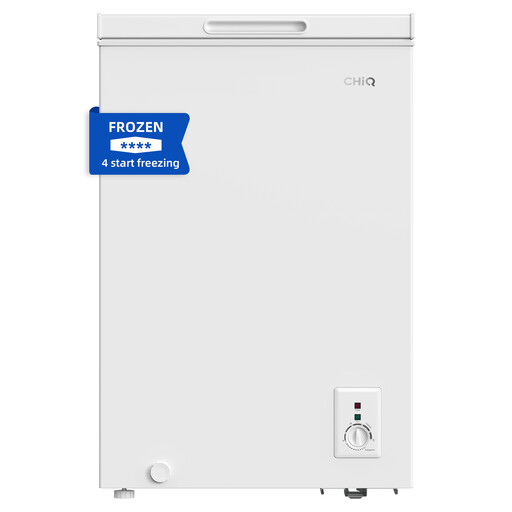
CHiQ 99-l chest freezer, 4-star freezer rating
For extra freezer space when floor space is limited; a wire basket is listed for storage.
Usable capacity: 99 l; stated freezing capacity: 4,5 kg/24 h; energy efficiency class E; floor space: 0,26 m²; wire basket.
Shop at Joybuy
Frequently asked questions
Do I need a separate chest freezer for sliced bananas?
No, not if your prepared portions fit in your existing freezer. An additional chest freezer may be worth considering if you regularly need more space for bananas and other food.
How should I prepare banana slices for different mealtimes?
Decide how much you need and divide it into portions before freezing. Label each pack with its contents, quantity and date. The Federal Centre for Nutrition recommends freezing food in the quantities you need, while the consumer advice centre gives −18 °C as the optimal temperature for freezers.
Can I keep a chest freezer in an unheated cellar?
Only if the specific model’s permitted temperature range suits the conditions at the location. For example, Bauknecht lists WinterProof for the GTE 150MD at ambient temperatures down to −15 °C. This manufacturer specification doesn’t automatically apply to other appliances.
How do I compare energy consumption and old-appliance take-back?
Compare the annual energy consumption in kWh on the EU energy label. Your actual energy use also depends on how you use the appliance and where you place it. Under section 17 of the German Electrical and Electronic Equipment Act (ElektroG), retailers who are required to do so must, when you buy a new electrical appliance, take back an old appliance of the same type and with essentially the same functions free of charge, subject to the statutory conditions. When placing your order, check how the return will be arranged for your delivery.
Which energy label applies to a new chest freezer?
The EU energy label for new refrigerators and freezers uses classes A to G. Check the model identifier, annual energy consumption in kWh and freezer volume in litres. Plus classes such as A+ are no longer part of the current labelling system for these appliances.


