Who might benefit from a chest freezer

People who batch cook together

If you regularly freeze several portions of meals and bread rolls together, plan for the space you’ll need when your stocks are at their fullest, and make sure everyone can follow the system for organising portions. The Verbraucherzentrale and the Federal Centre for Nutrition offer guidance on freezing food and building up a stock of supplies.

People who stock up on bread rolls

If you only need to take out smaller quantities at a time, first check whether your existing freezer has enough space. The Verbraucherzentrale recommends choosing a freezer that suits your needs.

Households short on space

If you need extra freezer space, check the external dimensions, the route for getting it into place and the room needed to open the lid. If you’re putting it somewhere unheated, you should also check what the manufacturer allows for that specific model, such as Liebherr’s model-specific guidance for the CFe 2500 Pure.

What to consider when choosing one

Keep using your existing freezer

A good fit if: labelled portions of bread rolls and meals fit inside, and you don’t need to freeze large batches at once.

The trade-off: You won’t need another freestanding appliance, but you’ll need to check that you have enough room and can keep portions separate in everyday use.

Compact chest freezer

A good fit if: you need an extra appliance but have limited storage needs and floor space. Beko lists the CF100EWN as having a capacity of 98 l and a width of 54.5 cm.

The trade-off: A smaller usable capacity may not be enough for several batches of meals prepared at once. Also compare the annual energy consumption of the specific model.

Medium-sized chest freezer

A good fit if: several people regularly store bread rolls and prepared meals together. Beko lists the CF200CWN as having a capacity of 198 l, while Haier lists the HCE200C at 196 l.

The trade-off: More space means a larger footprint. A fast-freeze function doesn’t replace checking that your planned batch is within the appliance’s freezing capacity in kg/24 h.

Large chest freezer for extra supplies

A good fit if: you’ll regularly store significantly more than the food prepared as part of your group batch cooking. Liebherr lists the CFe 2500 Pure as having a capacity of 497 l.

The trade-off: This capacity may be more than you need if you only want to store small quantities of bread rolls. Make sure the space available and your actual usage are a good match.

What matters What to check before buying Who this matters most to
Access to individual portions Check that your planned packs, and any baskets, fit inside and are easy to organise. Label each item with its contents and the date it was frozen. If I’m storing bread rolls and meals together, I want to find individual portions without having to search for ages. Around 36% of consumers would say that being able to access individual portions is their top priority.
Space for batch-cooked meals Work out the maximum number and size of portions, then compare the usable capacity and freezing capacity in kg/24 h with the batch you plan to freeze in a day. If you’re freezing several freshly prepared meals at once, you’ll need room for your largest batch. Around 29% of consumers would put storing larger quantities of batch-cooked food at the top of their list.
Annual energy consumption For appliances of a suitable size, compare the kWh/year figure on the energy label. The annual figure doesn’t tell you what your individual electricity costs will be. If I’m going to run an additional appliance all the time, I want to weigh up the consumption of a model that suits my needs. Around 21% of consumers would name energy use as their main buying consideration.
Location and dimensions Measure the space and the route the appliance will take to get there. If you’re placing it in an unheated room, check the permitted ambient temperature for the specific model. If you’re short on space or want to put the chest freezer in an unheated room, you’ll need to consider its dimensions and the manufacturer’s guidance together. Around 14% of consumers would first consider whether they have a suitable place to put it.

How to avoid common buying mistakes

  • Choosing the largest chest freezer you can find just for the occasional stock of bread rolls

    An appliance with far more capacity than you actually need can use electricity unnecessarily and take up valuable floor space. The Verbraucherzentrale advises matching the size of the appliance to your needs.

    First, check the freezer space you already have and the largest quantity you plan to store at one time. Then compare the usable capacity and kWh/year figures for specific models.

  • Assuming fast freezing can handle any batch of meals

    A fast-freeze function and the freezing capacity in kg/24 h are two different things. The function alone doesn’t mean the appliance can handle a fresh batch of any size.

    Compare the quantity you plan to freeze each day with the freezing capacity specified for the model.

  • Comparing litres alone and overlooking access to portions or where to put it

    Models can vary considerably in their external dimensions, and approval for low ambient temperatures applies only to the specific model. Supplies that aren’t stored clearly can also be harder to find.

    Measure the space and the route the appliance will take, plan for the packs you’ll actually store, and check the manufacturer’s guidance if you’re putting it in an unheated room.

Brand examples to help you choose

Beko

The CF100EWN and CF200CWN show how chest freezers come in two different sizes.

  • Beko lists the CF100EWN as having a capacity of 98 l and a width of 54.5 cm, and the CF200CWN as having a capacity of 198 l and a width of 102.6 cm.
  • The larger chest freezer isn’t automatically the better choice for a small stock of bread rolls. Compare the energy rating and features for each specific model.

Haier

The HCE200C is an example of a medium-sized chest freezer with a capacity of 196 l.

  • Haier lists this model as having an energy rating of C, lighting, a display and Fast Freeze.
  • These features don’t replace checking that your planned batch is within the appliance’s freezing capacity.

Exquisit

The GT100-E-040E weiss is an example of a compact chest freezer with a capacity of 98 l.

  • Exquisit lists energy consumption of 168 kWh/year and external dimensions of 54.5 × 84.5 × 54.5 cm.
  • Check that the capacity and annual energy consumption suit the supplies you plan to store and the location you have in mind.

Liebherr

With a capacity of 497 l, the CFe 2500 Pure is an example of a much larger chest freezer.

  • For this model, Liebherr lists FrostProtect down to −15 °C and StopFrost to reduce frost build-up.
  • These specifications apply to this model; StopFrost doesn’t guarantee that frost will never form. At 167 cm wide, this chest freezer isn’t an obvious choice for storing small quantities of bread rolls.

Chest freezers at Joybuy

The following Joybuy products offer extra freezer space in compact to medium-sized designs for storing portions of bread rolls and meals.
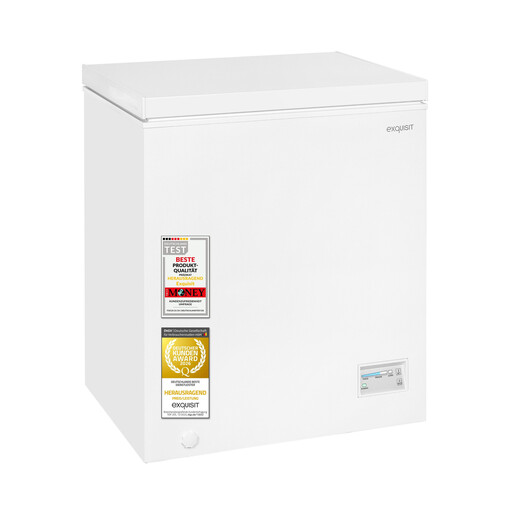
Exquisit chest freezer with 142 l usable capacity

Exquisit chest freezer, 142 l

For keeping portions of bread rolls and meals separate: the removable basket can help you organise your supplies.

142 l usable capacity; removable basket; freezing capacity of up to 7 kg in 24 hours; energy rating E and 182 kWh/year; LED display.

View at Joybuy
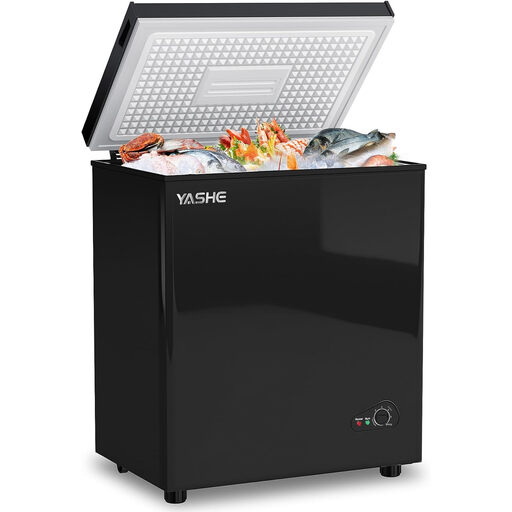
YASHE BC-150Q-EU chest freezer with 150 l capacity and two removable baskets

YASHE BC-150Q-EU, 150 l

If you want to keep several portions of food stored separately, the two removable baskets offer one way to keep things organised.

150 l usable capacity; two removable baskets; six temperature settings; fast-freeze function; energy rating E and 157 kWh/year.

View at Joybuy
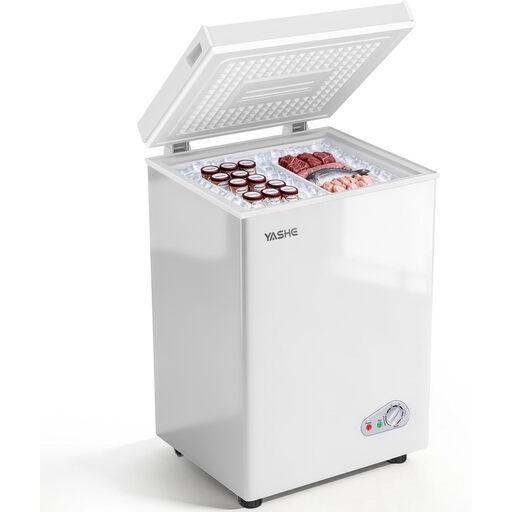
YASHE BC-100Q-EU chest freezer with 100 l capacity and two removable baskets

YASHE BC-100Q-EU, 100 l

For a limited amount of extra storage, the product description lists a usable capacity of 100 l and two removable baskets.

100 l usable capacity; two removable baskets; six temperature settings; energy rating E and 185 kWh/year.

View at Joybuy
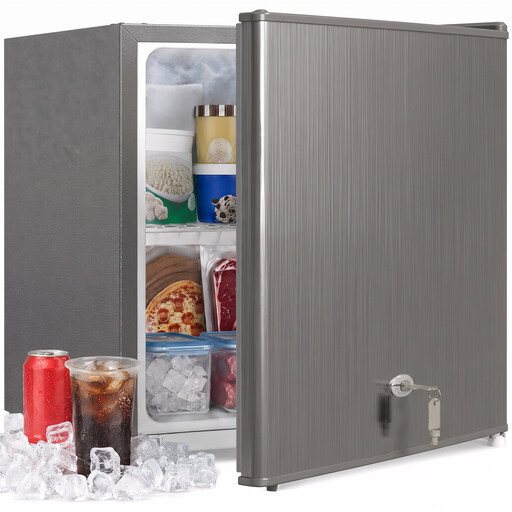
Mini chest freezer with 35 l capacity and removable shelf

Mini chest freezer, 35 l

This model is described as a small extra freezer, with a capacity of 35 l and a removable shelf.

35 l capacity; dimensions 47 × 44,2 × 48,8 cm; adjustable temperature range from −14 °C to −24 °C; five temperature settings.

View at Joybuy

AUCMA convertible chest freezer with 197 l capacity and removable basket

AUCMA convertible chest freezer, 197 l

A removable basket is listed for organising portions stored together. According to the description, the appliance can switch between fridge and freezer modes.

197 l usable capacity; energy rating E and 197 kWh/year; dimensions 816 × 554 × 848 mm; digital temperature control.

View at Joybuy

Frequently asked questions

Do I need to buy a separate chest freezer for bread rolls?

No, not if the portions you plan to store, packed separately, fit in your existing freezer. A separate chest freezer can make sense if you regularly store larger quantities or freeze large batches at once. The Verbraucherzentrale advises against choosing an appliance that’s significantly larger than you need.

How can I keep track of bread rolls and meals when batch cooking together?

Pack food in suitable portions and label the containers with their contents and the date they were frozen. The Verbraucherzentrale recommends labelling supplies this way so you can tell them apart when taking them out.

What temperature should I set my freezer to?

The Verbraucherzentrale recommends a temperature of −18 °C for freezers. You should also follow the manufacturer’s instructions for your specific appliance and the food you’re freezing.

What does the energy label tell me about electricity costs?

The energy label shows information including the energy efficiency class, annual consumption in kWh and freezer capacity. For a rough estimate of your own costs, multiply the specific model’s kWh/year figure by your electricity price per kWh. Actual consumption may vary depending on how and where you use the appliance.

How do I dispose of an old chest freezer?

An old chest freezer must not go in your household rubbish. The German Environment Agency advises that old electrical appliances must be disposed of separately. It lists recycling centres and, subject to certain conditions, the option of returning a large old appliance when buying a new appliance of the same type.