What to look for when buying a chest freezer
First check whether your existing freezer has enough room. If not, the available space and the size of your largest harvest batch will help you choose the right appliance.
Keep using your existing freezer
A good fit if: There’s already room for your berry portions and other supplies, and you only have small amounts to freeze occasionally.
The trade-off: You won’t need an additional appliance or extra floor space, but you may not have enough room to pre-freeze a larger harvest.
Compact chest freezer
A good fit if: You need a separate appliance but have limited floor space, and your largest daily batch is within the model’s freezing capacity.
The trade-off: The smaller interior limits how much of your harvest you can store at once. A compact design doesn’t automatically mean lower annual energy consumption.
Larger chest freezer
A good fit if: You regularly have larger harvests and supplies from several people to store, and have enough room for the appliance and its open lid.
The trade-off: More capacity takes up more space. Without baskets, labels and agreed storage areas, smaller portions can be harder to find.
The Verbraucherzentrale points out that an oversized freezer can use more electricity than necessary. The Federal Centre for Nutrition recommends spreading individual berries out on a tray to pre-freeze them, then packing them away once frozen.
| What to consider |
What to look for |
Who it matters most to |
| Freezing and storing a harvest |
Compare the largest amount of fresh produce to be frozen in one day in kg, usable capacity in l and freezing capacity in kg/24 h separately. |
When a lot of produce needs freezing straight after the harvest, I want to know how much fresh produce the model can freeze and how much will fit inside afterwards. Around 31% of consumers prioritise storing large harvest batches. |
| Kitchen space |
Check the route for moving the appliance, its dimensions including the model-specific wall clearance, and the space needed to open the lid. |
With limited floor space, I want to be sure the freezer and its open lid won’t block the shared kitchen. Around 25% of consumers prioritise a small footprint. |
| Finding portions again |
Check whether a shallow tray will fit and which baskets come with the specific model. Label contents and dates clearly. |
When several people share the food, I want to store smaller berry portions separately and find them quickly. Around 25% of consumers prioritise keeping shared supplies organised. |
| Running costs |
Check the exact model’s energy label for kWh/year, alongside its usable capacity and noise rating. |
To keep electricity use manageable in the long term, I don’t want to choose a larger appliance than I need. Around 19% of consumers pay particular attention to running costs. |
Chest freezers for extra storage in a shared kitchen
The following Joybuy listings are chest freezers that provide extra storage for garden berries and shared supplies.
 No image available
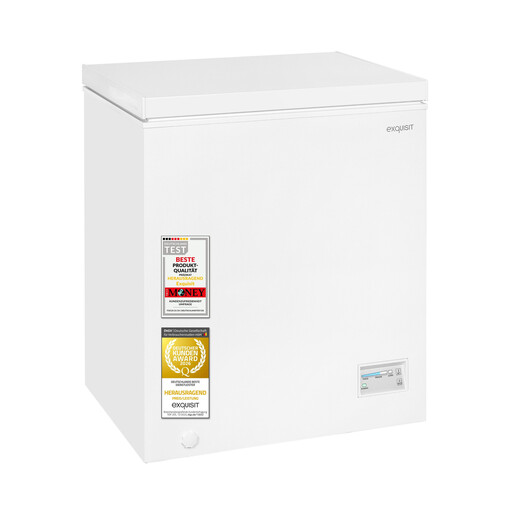
Exquisit GT5150-E-041E chest freezer, 142 l, 4 stars
For larger batches of fresh produce, provided the freezing capacity of 7 kg/24 h suits your harvest. A removable basket gives you somewhere to store smaller supplies.
142 l usable capacity; manual defrosting required.
View at Joybuy
 No image available
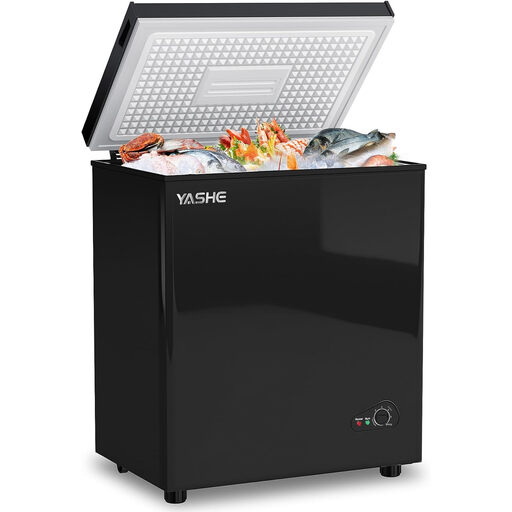
YASHE BC-150Q-EU chest freezer, 150 l
For shared supplies that can be sorted separately into two removable baskets.
150 l usable capacity; two removable baskets; six temperature settings; black.
View at Joybuy
 No image available
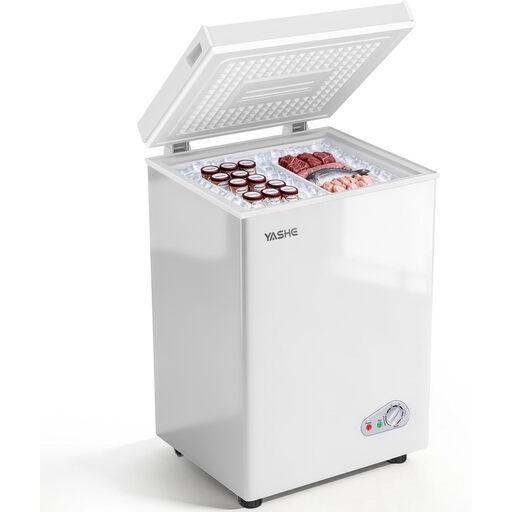
YASHE BC-100Q-EU chest freezer, 100 l
For extra freezer space, with two removable baskets to keep smaller supplies separate.
100 l usable capacity; two removable baskets; six temperature settings; white.
View at Joybuy
 No image available
AUCMA convertible chest freezer, 141 l
An option if you’re looking for a chest freezer that can switch between fridge and freezer modes. Check which mode suits the food you’ll be storing.
141 l; energy class E; one removable basket; seven thermostat settings; defrost water drain.
View at Joybuy
 No image available
AUCMA convertible chest freezer, 95 l
For extra storage in a smaller size, with one removable basket to help organise shared supplies.
95 l; energy class E; one removable basket; seven thermostat settings; defrost water drain.
View at Joybuy
Chest freezers for berries: frequently asked questions
How do I freeze berries so I can take out individual portions later?
Spread prepared berries out on a tray and pre-freeze them before transferring them to labelled freezer-safe bags or containers. This is recommended by the Federal Centre for Nutrition. In a shared kitchen, it also helps to agree on a specific storage area.
What should I consider when putting a freezer in a shared kitchen?
Check the route for moving the appliance, the space available, the clearance needed to open the lid and the clearances specified in the manual for the exact model. The German Environment Agency advises against placing freezers next to heat sources such as cookers or in direct sunlight.
Which energy rating should I compare when buying a new appliance?
For fridge-freezers and freezers, compare the current EU energy efficiency scale from A to G, as well as the figure in kWh/year. The European Union notes that the former plus rating scale has not been used for this product group since 2021.
Is a guarantee the same as your statutory rights?
No. The Verbraucherzentrale distinguishes your statutory rights against the seller from a guarantee, which is an additional voluntary promise with its own terms and conditions.
Can I put an old chest freezer in household waste?
No, old electrical appliances must be collected separately. The German Federal Ministry for the Environment explains the requirements of the Electrical and Electronic Equipment Act. Contact your local council or retailer to find out where you can take your appliance.


