What should you look for when buying?
Make use of your existing freezer space
A good fit if: you only add a few portions of carrots now and then, and you already have enough space.
The trade-off: Space and freezing capacity may be limiting when you have a larger fresh batch.
Compact chest freezer
A good fit if: you regularly add modest quantities and have limited floor space.
The trade-off: A compact freezer offers less room for larger batches. Compare the annual energy consumption with that of larger models that also suit your needs.
Medium or large chest freezer
A good fit if: you often freeze larger quantities at once or store other food supplies.
The trade-off: More usable capacity takes up more space, so don’t choose based on the litre capacity alone.
If you plan to take out portions of carrots as you need them, you’ll need both a suitable interior layout and enough room for your largest batch. The Bundeszentrum für Ernährung recommends portioning out the required amounts in advance, while the Verbraucherzentrale advises choosing an appliance size that matches your actual needs.
| What you need |
What to check when buying |
Who it matters most to |
| Taking out individual portions |
Check that the baskets and interior layout work with the containers you use; label your packs. |
If I portion food in advance for different mealtimes, I want to find the right pack without searching for ages. Around 33% of consumers prioritise easy access to individual portions. |
| Freezing larger fresh batches |
Compare your largest daily batch with the freezing capacity in kg/24 h; don’t confuse freezing capacity with usable volume. |
When I have a large batch of blanched carrots, I want to know if it will fit in the appliance and whether its freezing capacity is sufficient. Around 27% of consumers prioritise batch size and freezing capacity. |
| Choosing a size to suit the available space |
Check the external dimensions, clearance for opening the lid and the route for moving the appliance into place; estimate the volume you need based on your own containers. |
When space is limited, I want extra freezer capacity without choosing a chest freezer that’s too large for what I store. Around 20% of consumers prioritise suitable appliance dimensions and capacity. |
| Energy use and maintenance |
Compare annual consumption in kWh between appliances of a suitable size; check model-specific information on ice build-up and defrosting. |
When buying an additional freezer, I want to understand its energy use and know what maintenance it will need. Around 20% of consumers focus on ongoing energy use and maintenance. |
Chest freezers at Joybuy
The chest freezers below offer a range of capacities and removable baskets to help organise your portioned food supplies. As well as usable capacity, compare the external dimensions and, for larger batches, the stated freezing capacity.
 No image available
AUCMA convertible chest freezer, 141 l
The removable basket gives you a handy way to keep smaller or frequently used packs separate.
141 l usable capacity; four-star freezer compartment; energy rating E; 179 kWh/year; stated dimensions 632 × 554 × 848 mm; removable basket; 7-stage thermostat.
View at Joybuy
 No image available
AUCMA convertible chest freezer, 95 l
The removable basket can keep smaller packs separate from your other food supplies.
95 l usable capacity; four-star freezer compartment; energy rating E; 165 kWh/year; stated dimensions 550 × 475 × 848 mm; removable basket; 7-stage thermostat.
View at Joybuy
 No image available
AUCMA convertible chest freezer, 291 l
This model offers more usable capacity for larger food supplies; check first that its external dimensions will fit the space you have available.
291 l usable capacity; four-star freezer compartment; energy rating E; 226 kWh/year; stated dimensions 1100 × 597 × 872 mm; removable basket; 5-stage digital temperature control.
View at Joybuy
 No image available
AUCMA convertible chest freezer, 197 l
The removable basket helps you keep portions separate from other packs.
197 l usable capacity; four-star freezer compartment; energy rating E; 197 kWh/year; stated dimensions 816 × 554 × 848 mm; removable basket; 5-stage digital temperature control.
View at Joybuy
 No image available
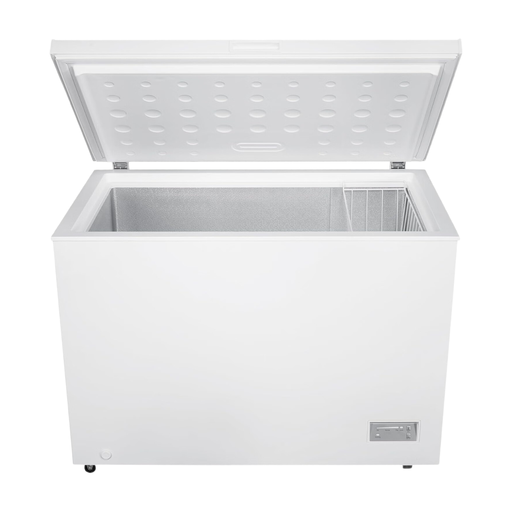
Beko CF316EWN fridge-freezer chest, 308 l
For larger fresh batches, the stated freezing capacity is an important point to compare alongside the storage space.
308 l usable capacity; four-star freezer compartment; freezing capacity 16 kg/24 h; energy rating E; one basket; stated dimensions 84,5 × 112 × 70 cm.
View at Joybuy
Frequently asked questions
How should I prepare blanched carrots for different mealtimes?
The Bundeszentrum für Ernährung recommends sealing carrots in suitable freezer packaging with as little air as possible, and portioning out the required amounts in advance. Note the contents, quantity and date; where possible, don’t place newly packed, unfrozen food directly on top of food that is already frozen.
What temperature should I set my chest freezer to?
The Verbraucherzentrale recommends −18 °C as the optimum temperature for freezers. This is usage advice, not a legal threshold for buying an appliance.
What information does the EU energy label show for a chest freezer?
The EU energy label for household freezers shows, among other things, the energy rating, annual energy consumption in kWh, capacity and noise emissions. The European Commission lists ratings from A to G; actual energy consumption at home may differ from the standardised figures.
Do I still need to defrost a chest freezer with SmartFrost or LowFrost?
Liebherr describes SmartFrost and AEG LowFrost as features that reduce ice build-up, not as a promise that defrosting won’t be needed. Always refer to the instructions and information for the specific model.


