You don’t automatically need a separate chest freezer for the occasional family-sized portion. If your cooled, packaged peas fit alongside your other supplies in your existing freezer, that should be enough to start with. If you regularly freeze larger harvests, compare the usable capacity and freezing capacity in kg/24 h with the available floor space and annual energy consumption. For portions you take out frequently, an upright freezer with drawers may be more practical. The Verbraucherzentrale points out that a chest freezer generally uses less electricity than an upright freezer, but an oversized appliance wastes energy.
Who might benefit from a chest freezer?
Families with a larger pea harvest
If you regularly blanch larger quantities and store them with other supplies, consider usable capacity and freezing capacity separately. The Federal Centre for Nutrition recommends freezing food in the portions you’ll need later.
Families who eat smaller portions
If you measure out peas for different meals, splitting them into individual packs makes it easier to find the amount you need without having to break up a large frozen block.
Households with limited space
If you need extra freezer space but don’t have much room, compare the appliance’s external dimensions and the space needed to open the lid with your actual storage needs and energy consumption.
What should you look for when buying one?
The Verbraucherzentrale suggests 50–80 l per person as a guide to freezer space, depending on your needs. For portions of peas, though, what matters most is how much you actually store. The Federal Centre for Nutrition recommends measuring out the amount you need before freezing.
| Buying consideration |
What should you check? |
Who is it important for? |
| Suitable usable capacity |
Check your existing freezer space and the amount you store; compare the capacity in litres and external dimensions of the specific model. |
If I regularly add peas and other supplies, I need enough space without running an unnecessarily large chest freezer. Around 33% of consumers put suitable usable capacity first. |
| Freezing capacity |
Compare the weight of your largest typical fresh batch with the manufacturer’s figure in kg/24 h. |
If I freeze a larger batch of peas in one go, I want to make sure the model has a suitable freezing capacity. Around 27% of consumers prioritise freezing performance for larger batches. |
| Access to portions and where you’ll put it |
Check the baskets, external dimensions and clearance for opening the lid. If the room gets cold, check the permitted ambient temperature for the specific model. |
If I often take out individual family portions, I want to be able to reach them easily in the space available. Around 20% of consumers prioritise access to portions and a suitable location. |
| Ongoing electricity costs |
For appliances of a suitable size, compare the annual consumption in kWh on the energy label. |
If I’m going to run an additional appliance all the time, I want to keep an eye on its electricity consumption. Around 20% of consumers prioritise running costs. |
Common buying misconceptions
-
Assuming one family meal means you need a large chest freezer
An extra chest freezer is most useful if you regularly have larger quantities to store. According to the Verbraucherzentrale, an oversized appliance wastes electricity.
First, check how many portions you actually freeze and whether they’ll fit alongside your other supplies in your existing freezer.
-
Confusing storage capacity in litres with freezing capacity in kilograms
The usable capacity in litres doesn’t tell you how many kilograms of fresh peas the appliance can freeze within 24 hours.
Weigh your largest typical batch and compare it with the kg/24 h figure for the exact model variant you’re considering.
-
Assuming less ice means you’ll never need to defrost it
Liebherr describes SmartFrost on the CFe 1870 Pure as a technology that reduces frost build-up, so you need to defrost less often. It doesn’t eliminate the need to defrost.
Check whether the specific chest freezer simply needs defrosting less often or genuinely doesn’t need manual defrosting.
If you still need to defrost it manually, allow time for the job.
-
Comparing an old A+++ label with today’s Class C
Since 2021, the EU energy label for the refrigerators and freezers covered has used a rescaled A to G rating. The former plus classes are no longer used for this product group.
Compare the current energy label and the stated consumption in kWh/year for each model.
Brands and suitable models at a glance
Bauknecht
The chest freezers listed here vary in usable capacity and freezing capacity depending on the model.
- Bauknecht lists the GTE 150MD with a capacity of 142 l, a freezing capacity of 8 kg and one basket. According to the manufacturer, WinterProof is designed for ambient temperatures down to −15 °C.
- Bauknecht lists the GTE 220 with a capacity of 219 l, a freezing capacity of 16 kg and three baskets.
Haier
The HCE200C is a chest freezer with a usable capacity of 196 l and an efficiency rating of Class C.
- Haier lists Fast Freeze and LED lighting for this model.
- If you regularly freeze larger fresh batches, check the freezing capacity in kg/24 h for the specific variant.
Beko
The CF200CWN is a freestanding chest freezer with a usable capacity of 198 l and an efficiency rating of Class C.
- You can check whether its external dimensions of 102,6 × 61,6 × 84,5 cm will fit the space you have in mind.
- If you’re deciding whether it can handle larger fresh batches, check the freezing capacity for the specific variant.
Liebherr
The CFe 1870 Pure has a total capacity of 281 l and a footprint measuring 104 × 71 cm.
- Liebherr lists FrostProtect for ambient temperatures down to −15 °C and describes SmartFrost as a technology that reduces frost build-up.
- According to Liebherr, SmartFrost means you need to defrost less often, not that defrosting is no longer necessary.
Chest freezers at Joybuy
This selection includes chest freezers for extra freezer space, from smaller supplies of peas to more room for peas and other family favourites.
 No image available
AUCMA 141L convertible chest freezer
For extra freezer space for family portions; according to the product name, it switches between fridge and freezer modes.
Usable capacity: 141 l; 4-star freezer compartment; energy class E; removable basket.
View at Joybuy
 No image available
AUCMA 95L convertible chest freezer
For smaller extra supplies of peas if you’re looking for a compact chest freezer.
Usable capacity: 95 l; 4-star freezer compartment; energy class E; removable basket.
View at Joybuy
 No image available
AUCMA 291L convertible chest freezer
For extra space if you want to store peas alongside other supplies.
Usable capacity: 291 l; 4-star freezer compartment; energy class E; removable basket; LED interior lighting; dimensions: 1100 × 597 × 872 mm.
View at Joybuy
 No image available
AUCMA 197L convertible chest freezer
For extra storage space for peas and other family supplies.
Usable capacity: 197 l; 4-star freezer compartment; energy class E; removable basket; dimensions: 816 × 554 × 848 mm.
View at Joybuy
 No image available
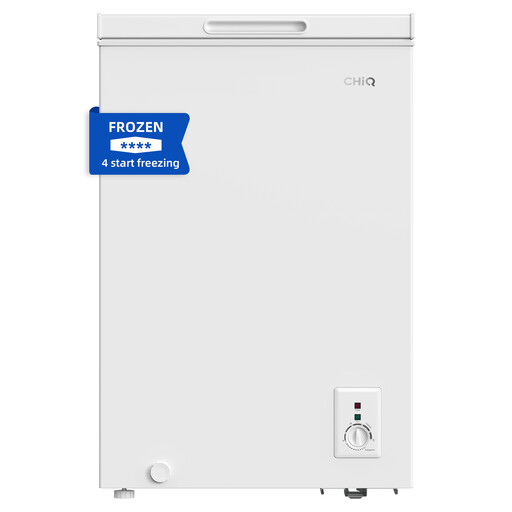
CHiQ 99L chest freezer
For smaller extra supplies if you want to compare the freezing capacity for a fresh batch with the model’s specifications.
Usable capacity: 99 l; 4-star freezer compartment; freezing capacity: 4,5 kg/24 h; wire basket.
View at Joybuy
Frequently asked questions
How should I freeze blanched peas for several family meals?
Divide the cooled peas into portions for the meals you’ll need later and pack them in freezer-safe packaging. The Federal Centre for Nutrition recommends measuring out the amount you need in advance; the Verbraucherzentrale advises noting the contents, quantity and date of freezing on the pack.
What’s a suitable temperature for storage?
The Verbraucherzentrale gives −18 °C as the optimum temperature for chest and upright freezers. The Federal Centre for Nutrition states that frozen pulses can be stored for 9 to 15 months at −18 °C; this isn’t a guarantee for every portion of peas you prepare yourself.
Can I put a chest freezer in an unheated cellar?
Only if the ambient temperature there is within the permitted range for the specific model. Bauknecht lists WinterProof for the GTE 150MD down to −15 °C; Liebherr lists FrostProtect for the CFe 1870 Pure down to −15 °C. These specifications don’t automatically apply to other appliances.
What are the rules in Germany for faulty goods and disposing of an old appliance?
For a faulty new purchase, contact the seller about your statutory two-year warranty rights; a voluntary guarantee is separate. Electrical appliances must not be put in household waste. Under section 17 of the ElektroG, retailers required to accept returns must take back a similar old appliance free of charge when delivering a new one, subject to the conditions set out there. You can also take it to a recycling centre free of charge. Check the specific collection arrangements before delivery.
Which energy label applies to new freezers?
The rescaled EU A to G scale applies to the refrigerators and freezers covered; the former plus classes have not been used for this product group since 2021. Also compare the stated consumption in kWh/year.


