A chest freezer is most worthwhile if you regularly need space for several prepared meals as well as sliced bread. For small amounts stored occasionally, check your existing freezer compartment first. Choose a capacity based on what you’ll actually be storing at the same time, and compare the dimensions and model-specific annual energy consumption. More space gives you extra capacity, but takes up room and could use more electricity than you need.
Who would benefit from a chest freezer?
Batch cooks sharing a freezer
You regularly store several labelled portions of prepared meals alongside sliced bread, and need space for both at the same time. The Federal Centre for Nutrition recommends freezing bread as fresh as possible and already sliced.
Keeping a bread stash in a small space
You want to take out individual slices and first check whether your existing freezer compartment can hold the amount you have in mind. The Federation of German Consumer Organisations recommends choosing an appliance size to suit your needs.
Planning ahead with energy costs in mind
You’ll be running the appliance all the time and want to balance the capacity you need against its model-specific annual energy consumption. The Federation of German Consumer Organisations points out that a freezer that’s too large can use more electricity than necessary.
What should you look for when buying one?
Choose a size based on the amount you’ll be storing at the same time: the Federation of German Consumer Organisations warns that an oversized freezer can use more electricity than necessary. The Federal Centre for Nutrition recommends freezing bread as fresh as possible and already sliced.
| What you need |
What to check when buying |
Who is this important to? |
| Space for bread and prepared meals |
Estimate how much you’ll store at the same time, and consider the usable capacity in litres and the containers you’ll use. |
If I want to store bread and several prepared meals in the freezer at the same time, the usable capacity needs to be right. Around 27% of consumers put having enough shared storage space first. |
| Avoiding an unnecessary second appliance |
Check the spare capacity in your existing freezer and whether it can accommodate the amounts you have in mind. |
If I only freeze a few slices now and then, I’ll check my existing compartment first. Around 21% of consumers prioritise avoiding an unnecessary second appliance. |
| Keeping shared supplies organised |
Plan to label food with its contents, quantity and date, and consider usable baskets or other ways to separate it. |
When sharing freezer space, I want to be able to find bread and prepared meals quickly. Around 21% of consumers prioritise keeping things organised and being able to take items out separately. |
| Finding the right spot |
Check the dimensions of the specific model against the available floor space, access route and room needed to open it. |
If space is tight or the location is unheated, the specific model needs to be suitable. Around 16% of consumers put the suitability of the installation space first. |
| Energy use over time |
For models with the right capacity, compare annual consumption in kWh and consider how location and use may affect it. |
If the appliance will be running all the time, I want to weigh up its energy use against the storage space I need. Around 15% of consumers prioritise running costs. |
Common buying pitfalls
-
Choosing a large freezer just for a few slices of bread
An oversized freezer can use more electricity than necessary and takes up floor space. The Federation of German Consumer Organisations therefore recommends checking your actual needs before choosing an appliance size.
First check whether your existing freezer compartment is big enough, then estimate how much you’ll need to store at the same time.
An extra freezer takes up floor space and runs all the time.
-
Assuming less frost means you’ll never need to defrost
Liebherr describes SmartFrost on the CFc 1875 Plus as reducing frost build-up; it doesn’t mean you’ll never need to defrost the appliance.
Check the defrosting information for the complete model in the manufacturer’s product data sheet, rather than assuming features apply from a different model.
You may still need to defrost it manually.
-
Comparing energy efficiency classes alone
The energy label includes several separate details. The class alone doesn’t replace comparing standardised annual energy consumption or checking that the capacity suits your actual needs.
For models with the right capacity, compare the stated kWh per year too. Energy use at home also depends on how and where the appliance is used.
Brands to consider
Beko
The CF100EWN and CF200CWN illustrate two different sizes of additional freezer space.
- Beko lists 98 l of freezer space, a width of 54.5 cm and energy class E for the CF100EWN; the CF200CWN has 198 l, a width of 102.6 cm and class C.
- These are manufacturer specifications for the models. The energy class alone doesn’t show how much electricity an appliance will use in your home.
Haier
The HCE200C and HCE420D are manufacturer examples of models for medium-sized and larger food stocks.
- Haier lists 196 l and energy class C for the HCE200C, and 418 l and class D for the HCE420D.
- Capacity and energy class are model-specific details and aren’t proof of an independent performance comparison. Check that the dimensions will fit the space you have in mind too.
Liebherr
The CFc 1875 Plus is an example of a model for buyers considering an unheated location.
- Liebherr lists a capacity of 192 l for this model and FrostProtect for ambient temperatures as low as −15 °C.
- The temperature specification applies to this model and can’t be assumed to apply to other chest freezers. Liebherr says SmartFrost reduces frost build-up, but doesn’t eliminate the need to defrost.
Chest freezers at Joybuy
This Joybuy selection includes chest freezers that give you extra room for bread and prepared meals. The usable capacities listed range from 100 l to 197 l.
 No product image available
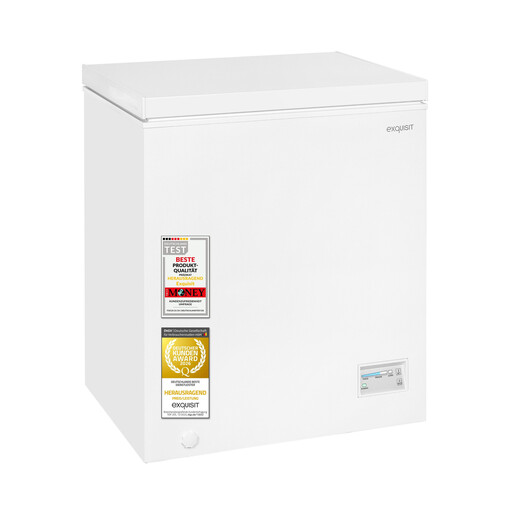
Exquisit chest freezer, 142 l, 4-star compartment
Extra space for storing bread and prepared meals at the same time.
142 l usable capacity, 4-star compartment, electronic temperature control with LED display and a fast-freeze function. A water drain and removable basket are included for manual defrosting.
View at Joybuy
 No product image available
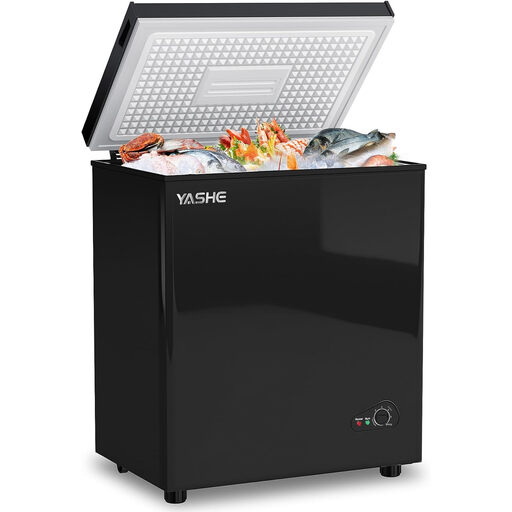
YASHE BC-150Q-EU, 150 l
For extra storage where you want smaller portions or frequently used items to be easy to reach.
150 l usable capacity, two removable baskets and six temperature settings. Freestanding model in black.
View at Joybuy
 No product image available
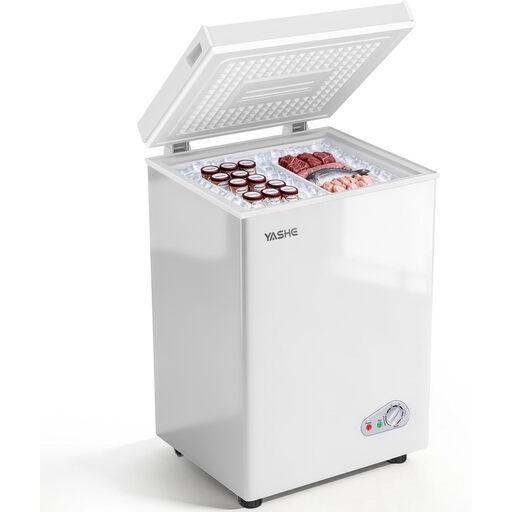
YASHE BC-100Q-EU, 100 l
For a manageable amount of extra storage, with separate access to bread and smaller portions.
100 l usable capacity, two removable baskets and six temperature settings. Freestanding model in white.
View at Joybuy
 No product image available
AUCMA chest freezer, 197 l, convertible
For bread and shared batch-cooked meals when you need extra storage and a switchable mode.
197 l usable capacity, switchable fridge and freezer modes, energy class E, digital temperature control with five settings and a removable basket.
View at Joybuy
 No product image available
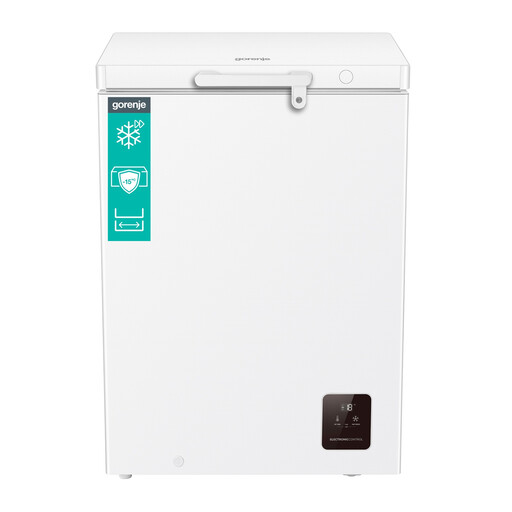
Gorenje FH15E6W5, 141 l
For extra storage if a model-specific ambient temperature specification matters for the location.
141 l usable capacity, FastFreeze, FreezeProtect down to −15 °C according to the product description, inverter compressor, flexible baskets and electronic controls. Defrosting is recommended if ice builds up.
View at Joybuy
Frequently asked questions
How should I freeze sliced bread so everyone can help themselves?
Freeze bread as fresh as possible and already sliced. The Federal Centre for Nutrition says frozen bread keeps for one to three months; you can defrost slices as needed or toast them from frozen. Knock off any ice crystals before toasting so water doesn’t get into the toaster.
What temperature and storage system work well for your supplies?
The Federation of German Consumer Organisations recommends setting freezers to −18 °C. Use suitable freezer packaging for shared portions and label them with the contents, quantity and date. Try not to put newly frozen food directly on top of food that’s already frozen.
Is freezing enough if you won’t be eating batch-cooked meals straight away?
No. Hygienic handling and keeping food properly chilled before you eat it later are important too. The German Federal Institute for Risk Assessment points out that inadequate temperatures during storage and transport can allow harmful germs to multiply. A chest freezer doesn’t replace these steps.
What does the energy label tell you when buying in Germany?
The EU energy label lets you compare several product details, including the efficiency class and standardised annual consumption in kWh. Actual energy use also depends on how and where the appliance is used. The Federation of German Consumer Organisations recommends choosing an appliance size to suit your needs. The German Environment Agency points out that the old A+++ scale isn’t the same as the current labelling system.
What should you know about faults, returns and an old freezer?
Your statutory rights against the seller are separate from any voluntary guarantee. The Federation of German Consumer Organisations says that online purchases generally come with a 14-day right of withdrawal. Old electrical appliances mustn’t go in household waste. The German Environment Agency says that large old appliances can be returned free of charge when you buy a similar new appliance, including for online purchases with delivery.


